
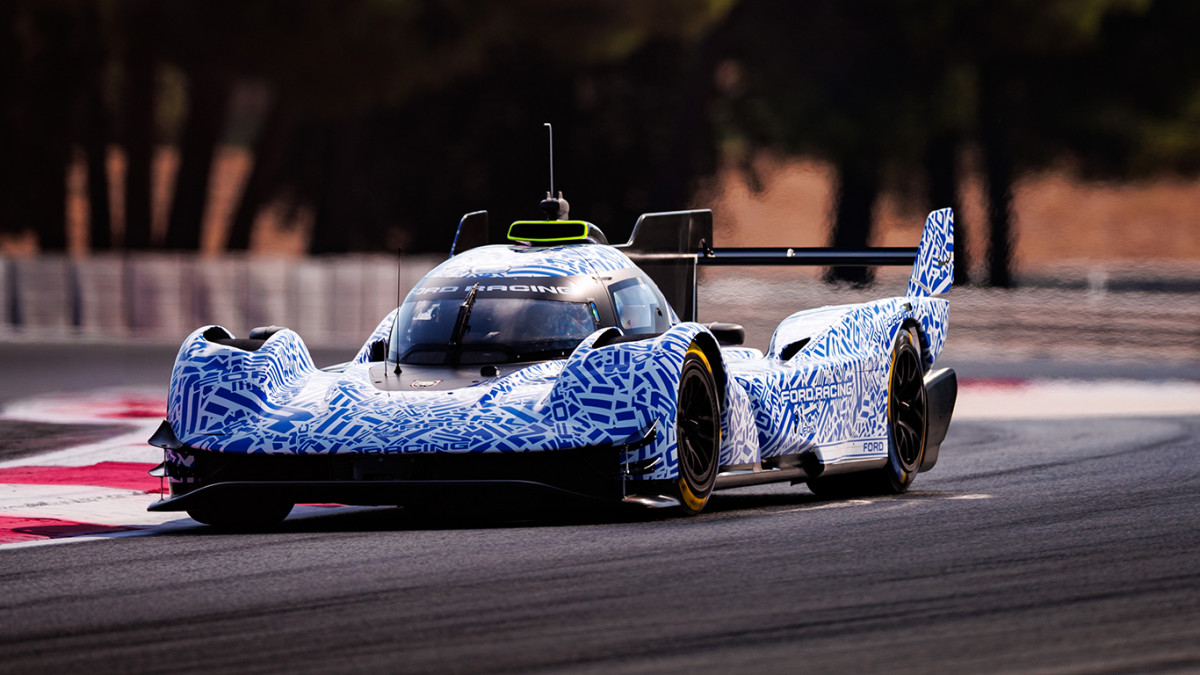
First public images of the new Ford LMDh show a still heavily camouflaged prototype. In Le Castellet, the American manufacturer has begun its first regular test runs. In 2027, Ford wants to fight for overall victories with the new hypercar in the FIA WEC and at the 24 Hours of Le Mans.
Ford Racing is taking the next important steps in building its new hypercar program for the FIA World Endurance Championship (WEC). Following extensive bench testing and initial functional tests, the new LMDh prototype has now publicly completed laps on a race track for the first time. The venue for the test debut is the Circuit Paul Ricard in Le Castellet, France.
The location is no coincidence: Ford is developing the chassis of the new prototype together with the French racing specialist ORECA, whose headquarters are located in nearby Signes. This makes Paul Ricard the ideal place for the new WEC project's first miles.
Successful shakedown as preparation
The first step toward the regular test program was already taken at the beginning of August. On August 5, Ford kicked off a multi-day shakedown, initially checking and commissioning the vehicle's basic systems. According to Ford, this phase went according to plan.
The focus was on the prototype's control and regulation systems. Only after these functions had been fully verified could the team begin actual testing on the racetrack. Ford had previously conducted extensive engine bench testing and prepared the interaction between the combustion engine, hybrid technology, and chassis.
Matt Campbell, Mike Rockenfeller, and Tom Blomqvist were used for the shakedown. For the first regular test sessions in Le Castellet, Campbell and Logan Sargeant took over the wheel. Blomqvist is also scheduled to log miles later on.
Ford is planning an extensive European and, later, American testing program in the coming months. Among other things, this program will test performance, reliability, aerodynamics, and the integration of the hybrid system under real racing conditions.
5.4-liter V8 with Coyote DNA
Technically, Ford relies on an interesting combination for its new LMDh. The chassis is being built in collaboration with ORECA, while the powertrain comes entirely from Ford's own development program.
The centerpiece is a 5.4-liter naturally aspirated V8 engine, which is based on the Coyote architecture. The engine is developed and built in Dearborn and is coupled with a standardized hybrid system of the LMDh category. The Coyote connection also establishes a direct link to Ford's current performance and racing programs.
The engine is therefore a special feature in the future hypercar field. Ford is deliberately relying on a naturally aspirated engine rather than turbocharging. According to the current status, this will make Ford one of the few non-turbocharged vehicles in the hypercar category in 2027.
Still disguised – but with independent aerodynamics
The first published images still show the prototype completely in camouflage paint. The final name of the race car has not yet been determined either. Details such as the final design of the headlights and other design elements therefore remain hidden for now.
However, some interesting aerodynamic features are already recognizable. The design of the front of the vehicle is particularly striking. Unlike other ORECA-based hypercars, Ford dispenses with the prominent, voluminous front opening or fin that catches the eye, for example, in the current concepts from Alpine and other ORECA projects.
Instead, the sharply upturned front splitter catches the eye. This makes the front end appear comparatively smooth and uncluttered. The design of the rear section and the positioning of the rear wing also show that Ford, together with ORECA, is pursuing its own aerodynamic interpretation of the LMDh regulations.
How much of this is ultimately due to the camouflage concept and which elements will actually be adopted in the final version will likely only become clear as development progresses.
Six factory drivers for two cars
Ford has already completed its driver lineup for the hypercar program. For the planned deployment of two vehicles, there are Logan Sargeant, Mike Rockenfeller, Sebastian Priaulx, Matt Campbell, Tom Blomqvist, and Nick Yelloly available.
With Rockenfeller, a former winner of the 24 Hours of Le Mans is also among the lineup. Campbell brings extensive experience from GT and endurance racing, while Blomqvist has considerable prototype experience, including as a two-time winner of the Rolex 24 at Daytona. Yelloly, Priaulx, and Sargeant complete the strong driver lineup.
Ford wants to announce at a later date which drivers will ultimately be put together in the two vehicles.
Goal: Overall victory in Le Mans
Entering the hypercar category is more than just a new motorsport program for Ford. The American manufacturer aims to return to the pinnacle of international endurance racing in 2027 and at the 24 Hours of Le Mans fight for the overall victory.
With this, Ford is building on its great Le Mans history. The brand celebrated its most famous successes with the GT40, which achieved four consecutive overall victories between 1966 and 1969. With the new LMDh, a completely new chapter is now beginning.
However, a lot of development work remains before the first race. The test program is to be continuously expanded in the coming months. The focus will not only be on pure performance, but in particular on reliability, aerodynamics, hybrid integration, and tuning the vehicle to the special requirements of endurance racing.
Ford has thus ushered in the next phase of its WEC project. The new prototype has turned its wheels on a race track publicly for the first time—and the path to a comeback in the top class at Le Mans is thus visibly gathering momentum.