
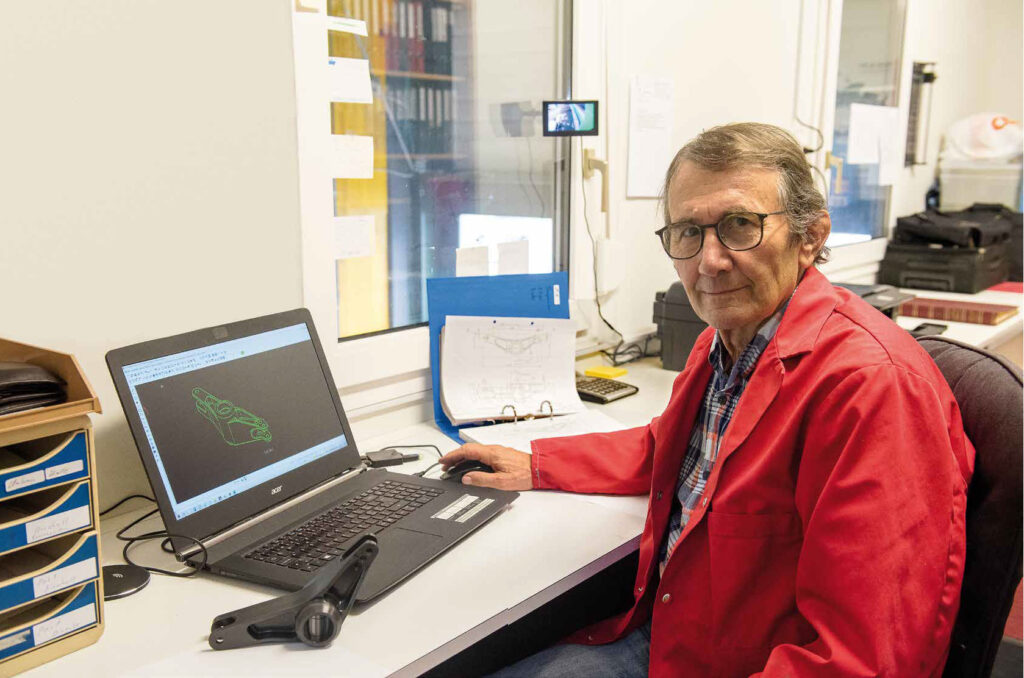
The fellow Swiss Louis Christen was on four wheels: between 1972 and 1981, he was successful as a race driver and constructor in Formula Vau and Formula Ford, but in the meantime had switched to three wheels. His LCR sidecars dominated the motorcycle racing scene between 1979 and 2018, as pilots with LCR chassis won a total of 39 world championship titles, including two by Stefan Dörflinger in the 125cc class for racing motorcycles.
In the success story about his countryman, the racing driver and constructor Louis Christen, noted by Stephan Traber, Traber also describes Christen's burgeoning passion for motorsport: „It began when he was a teenager, when he saw his first race car in person at the age of 16. In his neighborhood, there was a young man from a good family who had several Formula Junior race cars in his barn in Goldach. Louis often rode his Velosolex to this barn, which represented a gateway to a new world for him. When the owner returned from a race, Louis helped him clean the vehicles. The owner of these race cars would later achieve sad notoriety - Walter Stürm, the king of escape artists.“

Louis Christen's drawing board served as his livelihood.
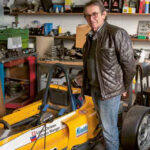
„I count myself among the lucky people whose hobby led to a livelihood,“ says trained draftsperson Louis Christen, who created the first design plans for a Formula car in 1967. In his parents„ garage in Rorschach on Lake Constance, a plaster model of a Formula Vau 1300 was built. Two years later, he had also welded together the matching spaceframe chassis. The LCR P1 (LCR for Louis Christen Racing) was born: “I was eager to contest my first season in the self-built Formula Vau in 1971, but I was held back by the regulations of the Swiss Automobile Club ACS. Obtaining a B license for open-wheel cars required six touring car races.„ Christen bought a Mini Cooper, completed the required entry-level class, and obtained the necessary license at an SAR/ACS course in Montlhéry. His first season in the “LCR-built car" brought not only important insights as a designer but also extremely motivating results: seven podium finishes – including two wins – in 13 races. His own design quickly found a buyer. He contested the following season with a new car.
Into the Super V's with an aluminum monocoque
The LCR P3 with its aluminum monocoque was created in a small workshop in Thal in the canton of St. Gallen. Christen had found a racing partner in Franz Giger, who was extremely skilled in engine tuning and was able to extract additional horsepower from the Volkswagen 1600cc boxer engine. In five races of the 1973 Swiss Championship, the Christen/Giger duo won all races – three by Louis, two by his partner Franz. At the race for the Central European Formula Vee Championship at the Norisring, Christen, in the P2, started from the front row and finished fourth. He particularly remembered the supporting program for the German Grand Prix at the Nürburgring, which Jackie Stewart won at the time ahead of his teammate Francois Cevert. In an accident, again at the Nürburgring in the Schwedenkreuz area, the front end of the car was quite damaged; Christen escaped with minor bruises. Unfortunately, the following year Giger had a crash in almost the same spot, which resulted in severe leg injuries. International assignments in 1974 throughout Europe required a new transport vehicle: an almost twenty-year-old Fiat furniture truck with a top speed of 75 km/h was found. Getting to Keimola or Silverstone with it was an adventure in itself. The season highlight was the Norisring in September, where Christen first overtook Keke Rosberg and also left Kennerth Persson behind. Christen won his first major international race in this LCR self-build with the 7th round of the Castrol-GTX-Trophy. Co-designer Giger, meanwhile, sat in the pits with a leg in a cast (from the Nürburgring accident) and was also able to congratulate him on the fastest lap. In the same race the following year, Christen took fourth place behind Rosberg, Persson, and Miko Kozarowitzky.

After an accident, Louis Christen hung up his helmet.
In 1975, Christen also took on the construction and maintenance of customer racing cars. A total of five Formula Super V were built in 1974 and 1975. As a racing constructor, Christen contested up to 25 races per season – a mammoth program that came to an abrupt end at Silverstone. Lying in a promising position, a competitor spun out in front of Christen. The Swiss driver could no longer swerve and broke an arm after multiple somersaults. Rebuilding his car – a total loss – seemed too expensive for Christen. As a racing driver, he had hung up his helmet. Together with Giger, he now explored the possibilities in racing car construction, where March, Lotus, and Brabham operated on a large scale. It was absolutely illusory to be able to compete with the British. Thus, a proprietary Formula 2 project never got beyond the planning phase, although it was worked out in the smallest detail. Under P12 – Project 12 – a Formula Ford was created in 1980/81, followed by a 2-liter Formula Ford as P14. A Formula 3 project, called SWICA (Swiss Car), at least experienced a long testing phase in Magny Cours and was adopted by the team of Pierre Rechsteiner, who had also entered Christen's Formula Ford.
First motorcycle sidecar racing machine spied
Sidecar racing has enjoyed great popularity in Switzerland since at least 1965/1966, when compatriot Fritz Scheidegger became world champion with Brit John Robinson in the sidecar. Swiss champion Bruno Holzer was looking for a new, competitive outfit for the World Sidecar Championship. Through the mediation of his mechanic and friend, Christen was given the attractive task of building an outfit that would be as good as that of Seymaz designer Eric Vuagnat. When Rolf Biland's successful Seymaz outfit was also shown at a racing motorcycle exhibition near Zurich, Christen and his men had sneaked into the hall in the early morning and completely analyzed the outfit. Christen: „If Vuagnat can do it, I should be able to too. You don't have to be a sidecar professor to know how a sidecar works, it's pure physics.“ By February 1976, Christen was working on an outfit chassis – a monocoque made of aluminum sheets – for a 500cc Yamaha engine. During functional tests in Dijon – Peter Sauber had rented the track for C5 tests with Herbert Müller and allowed Christen to use it – „Stumpen-Herbie“ also climbed into the passenger seat and had a lot of fun. At a race in Rouen before the World Championship, the LCR duo Holzer/Meierhans won both heats right away. The competition was stunned!
World Championship successes already from 1978 for Louis Christen
With a victory at the Belgian Grand Prix in the rain Spa-Francorchamps and third place in the 1978 Sidecar World Championship, the LCR outfit was recommended for higher honors – and it took the world championship title in 1979. With a completely new design for 1981, the LCR P16, Rolf Biland and Waltisberg entered the World Championship, which they then won with a 21-point lead. At the same time, Christen's order books had filled up: 23 LCR chassis orders for 1982 – even from Australia. A small bittersweet note in the success cocktail: in 1982, Werner Schwärzel and Andreas Huberin won the World Championship with a Seymaz. With the move into a large new factory hall in 1984 and an expanded mechanics team, the foundation for an incredible winning streak was laid. LCR designs won all sidecar titles between 1983 and 1994. And this success story continued in 1997 with almost uninterrupted title wins until 2018 – only in 2002 did no LCR riders win the World Championship crown. In 2021, the Swiss Schlosser/Fries celebrated their 33rd title on an LCR-Yamaha (P42), to which four World Cup victories and two solo motorcycle world championships were added. Louis Christen, the man who only got his motorcycle license at an advanced age, is considered the „Trike Pope“ in professional circles. He, who had presented a 1000 hp BMW motorcycle dragster in 1986/87, subsequently offered an electric cabin scooter, the „Stromboli.“ Christen: „In retrospect, we were simply 20 years too early with it.“
Get Curbs #58 delivered right to your door—directly through our Online store
Photos: Louis Christen Archive, Stephan Traber