First published on curbs-magazin.com
Originally published on curbs-magazin.com – now part of slickpix.de.
25 years ago, on July 17, 1995, Juan Manuel Fangio passed away at the age of 84. Fangio remains the greatest for CURBS author Jochen von Osterroth, because achieving 24 wins and five world championship titles in only 51 Formula 1 Grands Prix across four different manufacturers is unmatched. He garnishes his encounter with Fangio and Moss with his drawings of all the racing cars the Argentinian drove – from the Ford Model A, through various Chevrolets, Alfa Romeos, BRMs, Maseratis, and Ferraris, to the „Silver Arrows.“.
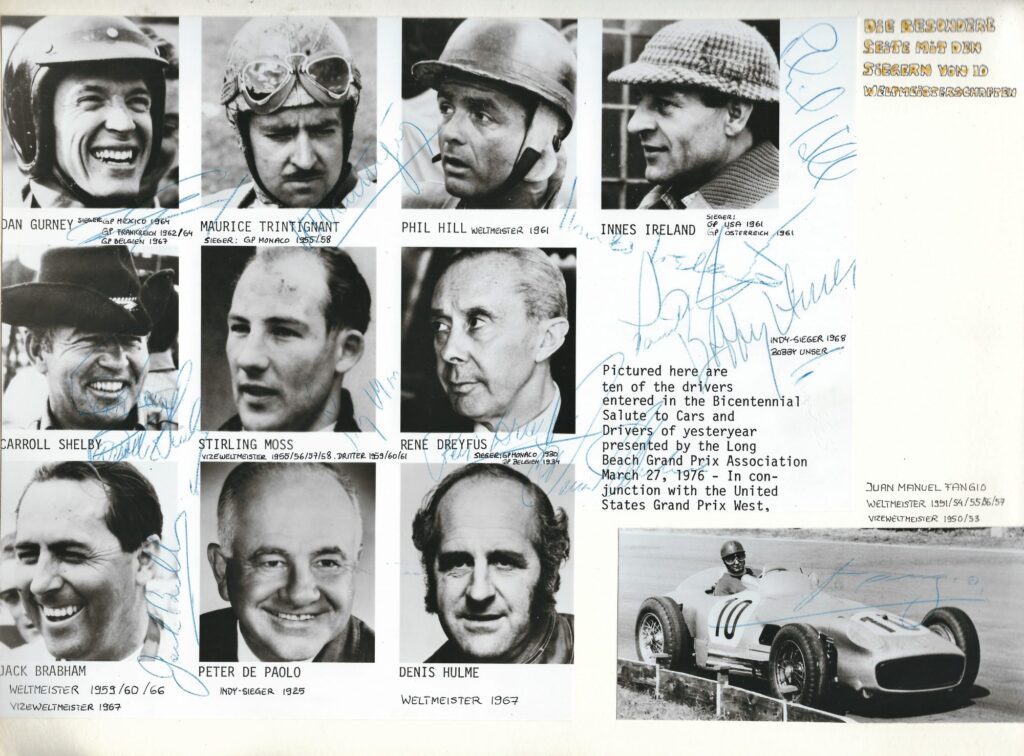
„Next year I'll celebrate the 20th anniversary of my biggest title fight,“ said Juan Manuel Fangio, as I spoke with him in Long Beach on the sidelines of the 1976 US Grand Prix West – next to him his greatest rival, the unforgettable Stirling Moss: „Juan, I know you're referring to the 1957 German Grand Prix at the Nürburgring, but I couldn't pose a threat to you with my Vanwall there.“ Fangio smiled understandingly. When he and Moss were still racing for Mercedes together, such a conversation wouldn't have been possible. Moss: „Juan didn't speak English, and I didn't speak Spanish.“ But when it came to the fair sex, the gentlemen were on the same page. I got to witness firsthand that Moss was no stranger to women, let alone the heartthrob Fangio. Moss: „It did happen that we both enjoyed the favor of the same lady on a weekend.“ Also well-known is the anecdote of Fangio's countryman and competitor, José Froilán González, nicknamed the „Bull of the Pampas“: „When I visited Juan in the hospital after his Monza accident in 1952, he was in bed with a nun. But then it turned out to be a disguised girlfriend, about whom his constant companion was not supposed to know.“.
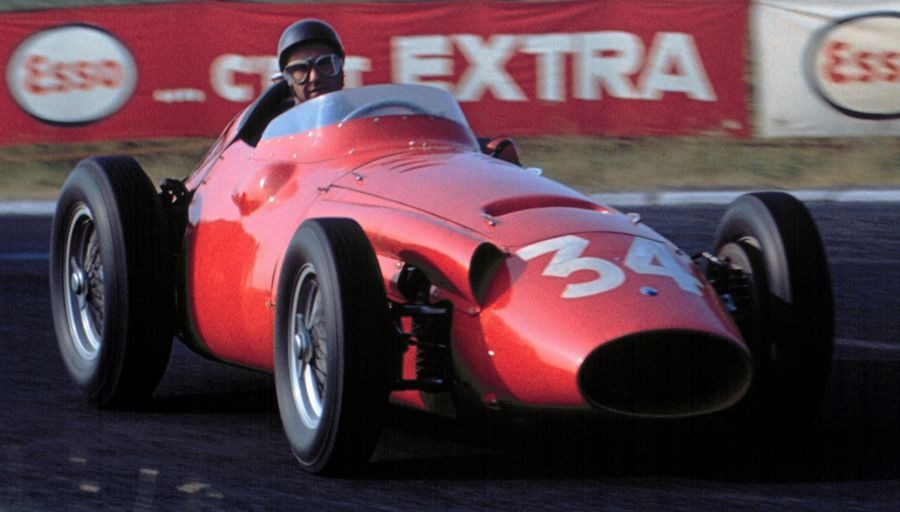
So much for the pleasant side effects, but now back to the Nürburgring, where Fangio had won in 1956 with a Lancia-Ferrari D50 ahead of Moss in a Maserati, despite a Maserati protest claiming he had been pushed after a spin. In 1957, even with a Maserati 250F on his way to his fifth world championship, he had a problem with Ferrari – more precisely with the Type 801, a good 15 hp stronger than the Maserati. But Fangio proved his exceptional class even in practice. He shattered his 1956 lap record by 16 seconds to 9:25.6. The Maserati's 258-liter tank was not enough for the 22-lap distance of 501.82 kilometers, while Mike Hawthorn and Peter Collins„ Ferraris could complete the race without a pit stop. On the third lap, Fangio had shown the much younger Englishmen his exhaust to build up enough of a lead to compensate for the inevitable pit stop. On the 12th lap – with a 28-second lead over the Englishmen, who were preoccupied with themselves – the Argentinian pulled into his pit. In an opera-like pit drama in three acts (rear wheel change, fuel can refueling, brake check), the Maserati crew lost more than half a minute. Just under 30 seconds were planned, but it took more than 56. Afterward, the 46-year-old launched a charge that he later said was the most on-the-limit driving he had ever done in his life. “Normally, Fangio never drives faster than he has to, but always fast enough to control his opponents. I can really judge that." Said Moss, who was runner-up to Fangio three times in a row and won his fourth runner-up title in 1958 behind Mike Hawthorn. 9:17.4 on the 20th lap, the Nürburgring crowd roared when the track announcer trumpeted this new Fangio record lap. Fangio was only two seconds behind the gentlemen, whose combined age was 54 years, and then celebrated a triumphant drive to victory and his fifth title.
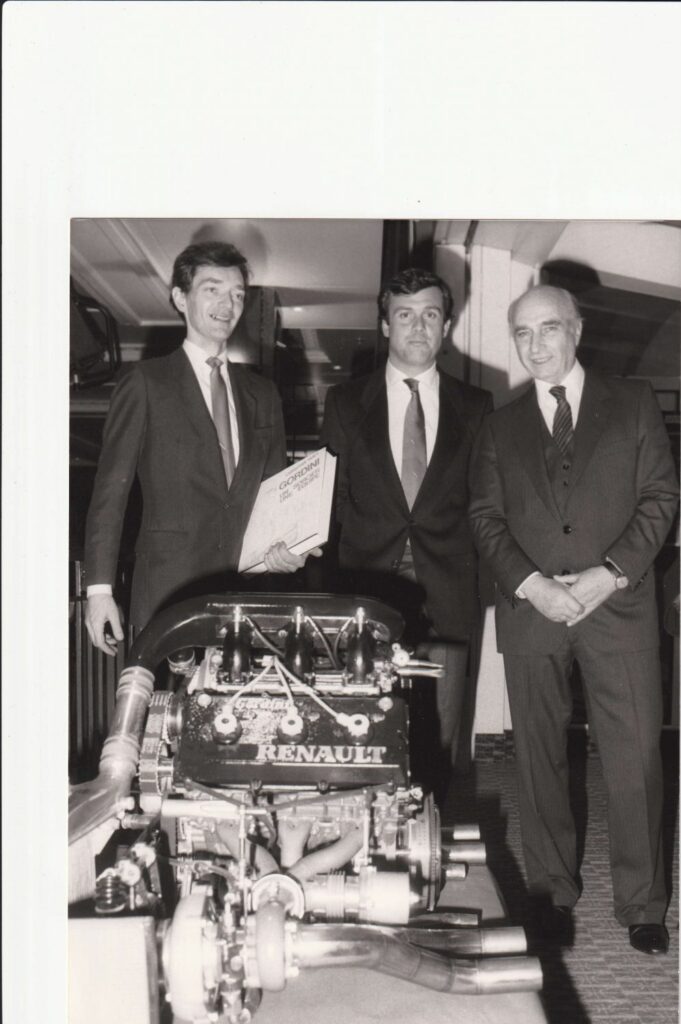
Who is this Juan Manuel Fangio, born on what is known as San Juan’s Day, June 24, 1911, near Balcarce? Herminia and Loreto Fangio had named their fourth of six children Juan after John the Baptist, and Manuel was a nod to Vittorio Emanuele, the king of their Italian homeland. The relatively slight young man, nicknamed „Chueco“ in his soccer club because of his slight bowlegs, worked so skillfully in an auto repair shop that the boss allowed him to take a few trips into the surrounding area and taught him a thing or two along the way. After completing his military service in the 6th Cavalry Regiment, he switched to more horsepower and, on October 26, 1936, under the pseudonym „Rivadavia,“ competed in his first race in a blue 1929 Ford Model A. This Ford was actually used as a taxi, but was then converted for racing and—when necessary—converted back. With the help of friends, a pure racing car was then built: a red Ford V8. In 1940, he competed in the „Gran Premio Internacional del Norte“—a 10,000-kilometer race through South America—in a Chevrolet Coupé, won, and received a hefty prize of 45,000 pesos. Driving a stripped-down Ford Tudor Sedan Coupé as well as red and green Chevy Coupés, Fangio competed in various events and won most of them. After World War II, these races culminated once again in the Gran Premio—but now over 15,000 kilometers from Buenos Aires via Caracas and Lima back to the Argentine metropolis. In Chile, the Chevy coupe missed a sharp left-hand turn and crashed so severely that his passenger, Daniel Urrutia, died. Even the roll bar was of no help. For the 1947 season, Fangio competed—sometimes against European rivals—in a homemade monoposto, painted black with a red chassis. The chassis originally came from a Ford Model T. Under the hood bubbled a 3.9-liter Chevrolet truck engine, powerful enough to secure third place with his „Negrita“ on the Retiro circuit in Buenos Aires. Its successor, a red Volpi-Chevrolet nicknamed „La Petiza,“ felt more like a real race car. And that’s exactly how Fangio drove it. The head of the Argentine Motor Sports Committee, Francisco Borgonovo, handed this promising young driver, Fangio, his Maserati 4CL 1500 so that he could gain experience competing against the stars of the scene at the time. Fangio took on the industry’s leading figures of the day—such as Dr. Farina, Varzi, Villoresi, and Wimille—at the Circuito de Palermo, starting from the front row. Driving a Maserati 4CLT/48, which was later painted blue and yellow, Fangio already outclassed the European competition in Mar del Plata in early 1949. Over the course of that year, the Argentine went on to celebrate victories in Europe at San Remo, Pau, Perpignan, and Albi, among other places. He was thus successful five times in a Maserati and won once in 1949 in a Formula 2 Ferrari 166 SC at Monza. In addition, he had won the Marseille Grand Prix in May 1949 in a Simca-Gordini T 15 from Amédée Gordini’s factory team, and decades later he gladly accepted an invitation to the Gordini anniversary celebration. This was enough to secure him a spot on the Alfa Romeo factory team for the inaugural 1950 Formula 1 World Championship season. And right from its first outing—the 1950 British Grand Prix at Silverstone—this factory team lined up on the front row with Dr. Emilio Giuseppe „Nino“ Farina, Luigi Fagioli, and Juan Manuel Fangio. The revised „Alfetta“ Tipo 158 delivered 350 hp to the wheels and was considered unbeatable. This car won all eleven races of that season, including, of course, the six Grands Prix. Three of these victories went to „Nino“ and three to Juan Manuel. An additional third-place finish by the Italian at the Belgian Grand Prix in Spa-Francorchamps secured him the world championship title ahead of Fangio. With the 4.4-liter Ferrari, whose power output exceeded Alfa Romeo’s by nearly 30 hp, Fangio faced competition in the „Alfetta“ 159 during the 1951 season. At the season opener in Bremgarten, Fangio dominated the Swiss Grand Prix and gave Piero Taruffi in the Ferrari no chance. Fangio also secured pole position and the fastest lap at Spa-Francorchamps, but a technical failure eliminated the Argentine, who never retired through his own fault. Thus, the victory in Belgium went to World Champion Dr. Farina ahead of the Ferrari drivers Alberto Ascari and Luigi „Gigi“ Viloresi. With a driver change, the Alfa duo of Fangio and Fagioli won the 602.140-kilometer French Grand Prix in Reims ahead of the Ferrari pair of Ascari and González. Juan Manuel’s compatriot José Froilán González, who literally filled the Ferrari cockpit to the brim, not only snatched the pole position from Fangio at Silverstone but also relegated him to second place in the race. And Fangio had to settle for second place at the Nürburgring as well, finishing ahead of González but behind Alberto Ascari’s Ferrari. Fangio certainly demonstrated his class with a fastest lap under ten minutes. Pole position but a retirement at Monza, where Alberto Ascari won, made the World Championship duel a close one, yet Fangio won the finale at Pedralbes near Barcelona ahead of González. Ascari finished only fourth, allowing Fangio to claim the title ahead of him. And since González had finished third in the final standings, a state of emergency prevailed in Argentina.
Since Alfa Romeo had withdrawn from Grand Prix racing, only Gordini competed from the factory against the superiority of the Ferrari F2/Tipo 500. Hopeless! Fangio managed to stay unscathed in his blue and yellow Ferrari 166C in his home country and celebrated six victories before coming to Europe. There, a Maserati A6 GCM awaited him. This first naturally aspirated F2 race car was just as hopelessly outmatched in 1952 as Reg Parnell's Formula 1 BRM P 15. Zero points for the world champion! In 1953, three factory teams competed against each other: Ferrari with Alberto Ascari, „Nino“ Farina, Luigi Villoresi, and Mike Hawthorn, Maserati with the three Argentinians Juan Manuel Fangio, Froilán Gonzalez, and Onofre Marimon, the 50-year-old Felice Bonetto, and the Swiss Toulo de Graffenried. Gordini sent five drivers into battle: Jean Behra, Maurice Trintignant, Robert Manzon, Harry Schell, and Roberto Mieres. Ascari became world champion ahead of Fangio, Farina, Hawthorn, Villoresi, and González. The „force bleue“ only earned eight points – four each, driven by Marimon and Trintignant. The new Maserati A6 SSG only performed passably from mid-season 1953 onwards. However, this was not due to its 200 horsepower, fed by three Weber twin-carburetors, but to Fangio's incredible car control, who alone had collected almost as many points as his four teammates combined.
In 1954, the 2.5-liter engines from Ferrari, Maserati, and Gordini were derivatives of the previous 2-liter models. Ferrari's sextet of Farina, González, Hawthorn, Maglioli, Trintignant, and Manzon initially faced seven Maserati men: Fangio, Marimon, Rosier, Prince Bira, Moss, Mantovani, and de Graffenried. Gordini, with Behra, Pilette, Bayol, and Simon, was also present. Lancia also entered, sending the Italian trio Ascari/Villoresi/Castellotti into the fray, for which Mercedes also planned to join. The debut was scheduled for the French Grand Prix with Fangio's move to the Stuttgart-based team. With victories in Argentina and Belgium, Juan Manuel Fangio began his work at Mercedes. Things looked promising! The Argentinian secured pole position in his W196 „Silver Arrow“ and won ahead of his teammate Karl Kling. Lapping behind were the Ferrari of Manzon, followed by the Maseratis of Prince Bira and Villoresi. Incidentally, the fastest lap was achieved by the newcomer Hans Herrmann. Fangio ahead of the Ferrari of González/Hawthorn at the Nürburgring, and then ahead of González and Herrmann at Bremgarten in Bern: The Argentinian also kept Mike Hawthorn at bay in Monza. „Everything went wrong only at the end in Pedralbes,“ Fangio later recalled. „There, Alberto Ascari in the Lancia snatched away my fastest practice time, also set the fastest race lap, and in the race, I also had to yield to Mike Hawthorn in a Ferrari and Luigi Musso in a Maserati.“ Juan Manuel Fangio, World Champion in 1954 ahead of Froilán González and Mike Hawthorn: Argentina was ecstatic with joy. Until Mercedes entered the sports car world championship with the W196 S (300 SLR), Fangio also competed in various sports cars, including the Alfa Romeo 6C 3000 and the superb Lancia D24, with which he was successful in the „Carrera Panamericana.“.
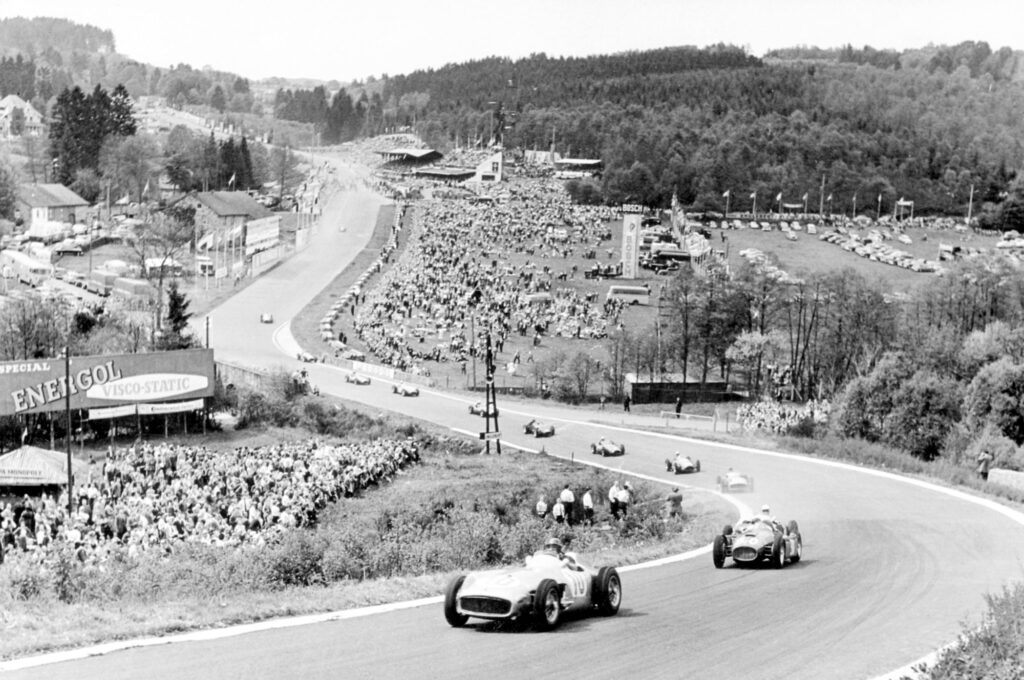
In contrast to the rather heavy and voracious pre-war Mercedes-Benz W154 (the twelve-cylinder consumed 180 liters per 100 kilometers), which Fangio had driven once more in Buenos Aires in February 1951, the W196 R was a „wonder weapon.“ In the scorching heat of Buenos Aires – as in 1951 with starting number 2 – Fangio opened the Formula 1 season with a victory ahead of the Ferrari pairing of González/Dr. Farina. While the Argentinian had completed this 375-kilometer ordeal as a soloist, his teammates Hans Herrmann, Karl Kling, and Stirling Moss shared the fourth-placed Mercedes. In Monaco, on pole position and fastest on the asphalt – just ahead of Stirling Moss halfway through the race – a rear axle defect at the „station corner“ thwarted his ambitions. The then leading Moss also retired: engine failure. Thus, the Frenchman Maurice Trintignant, Ferrari 625, won ahead of Eugenio Castellotti, Lancia D50, and Jean Behra, Maserati 250F. Even though Castellotti was in front in Spa-Francorchamps, Fangio and Moss gave him no chance in the race. The Italian was driving a private D50, as the works team had withdrawn after Alberto Ascari's fatal accident during test drives in Monza. The Mercedes duo Fangio/Moss also dominated in Zandvoort, and in Aintree, Mercedes performed so brilliantly as if they were from another planet. Stirling Moss – exceptionally ahead of Juan Manuel Fangio – and with Karl Kling and Piero Taruffi two other Mercedes behind him: Ferrari and Maserati were out of contention, apart from a third place for Castellotti in Monza once. It was also the Italian who then took third place in the final World Championship standings behind the Mercedes stars Fangio and Moss. Due to the Le Mans disaster, the Grands Prix of Switzerland, France, and Germany had, as is well known, been canceled.
When Mercedes withdrew from motorsport, the paths of Fangio and Moss diverged. The Argentinian formed a powerful Scuderia Ferrari with Phil Collins, Eugenio Castellotti, Luigi Musso, Olivier Gendebien, the Marquis de Portago, and Maurice Trintignant. This team was challenged by factory Maserati drivers Stirling Moss, Jean Behra, and Cesare Perdisa, reinforced by privateers Toulo de Graffenried, the Briton Horace Gould, the Argentinian Carlos Menditéguy, and the already fifty-year-old Frenchman Louis Rosier. Mike Hawthorn and Harry Schell primarily competed in Vanwalls, and Connaught, equipped with Alta engines, fielded Scotsmen Ron Flockhart and John Eric George „Jack“ Fairman. Variety seemed assured, but only a Maserati 250 F driver could truly match the Lancia-Ferrari D50: Stirling Moss. And so, the final championship standings were: Fangio, Ferrari, ahead of Moss, Maserati, Collins, Ferrari, and Behra, Maserati. In a non-championship race at Silverstone, where Fangio's and Collins's D50s retired, Mike Hawthorn led in the early laps in the new BRM, with its superior power-to-weight ratio, but eventually retired with engine failure. Moss then claimed the victory ahead of two Connaughts. The summary of this Formula 1 race on the island: „Very British indeed!“
And the British component in the Grand Prix scene gained importance in 1957. Fangio, in the latest evolution of the Maserati 250F, won in Buenos Aires ahead of his teammates Behra, Menditéguy, and Schell, but in Monte Carlo, Tony Brooks and Stirling Moss suddenly mixed it up in their Vanwalls. Stuart Lewis-Evans finished in fourth place with a Connaught B, and Jack Brabham secured sixth place with a works Cooper T43. In Rouen, Fangio showed three Ferraris his rear bumper – those of Messrs. Musso, Collins, and Hawthorn. Retired on the 48th lap with engine trouble at the British GP in Aintree: not a Fangio day! Stirling Moss, the pole-sitter, drove faster than the entire field and handed his Vanwall steering wheel to Tony Brooks after Brooks„ engine trouble, so Tony could share in the commanding victory over the Ferraris of Musso, Hawthorn, and Trintignant. Once again, we're in Long Beach, where Stirling turned to Fangio: “I will never forget that you were one of the first to congratulate me, and with all your heart." Fangio's performance at the Nürburgring was then unforgettable for Mike Hawthorn and Peter Collins. In Pescara, the Fangio-Moss duel ended in favor of the Briton. Once again, the Vanwall proved to be fast, with a race lap time exactly matching Fangio's Maserati's pole position. The finale in Monza – with three Vanwalls on the first grid row – was won by Stirling Moss, but Fangio secured his fifth title with a second-place finish. Wolfgang Graf Berghe von Trips finished third in that finale, incidentally, driving a Ferrari.
As a privateer, still driving a Maserati, Fangio entered his final season, finishing fourth in the championship in Buenos Aires, where he also set the fastest race lap, and in Reims. The British drivers Hawthorn, Moss, Brooks, and Salvadori dominated this championship. Fangio on the end of his career: „In Reims, I drove my first race in Europe in 1948 in a Simca-Gordini. I was already 37 years old back then. Driving to victory for the first time in that incomparable Mercedes at Reims in 1954 is one of the most beautiful racing successes of my life. So, what was more natural than to retire from racing at the age of 47, exactly ten years after my debut there.“ For this exceptional figure in motorsport, the Nürburgring was his favorite track, and Stirling Moss agreed: „To win there is “something special.'".
Jochen von Osterroth
Images: Jochen von Osterroth, www.start84.nl, Alfa Romeo, Daimler, Ferrari, Maserati