
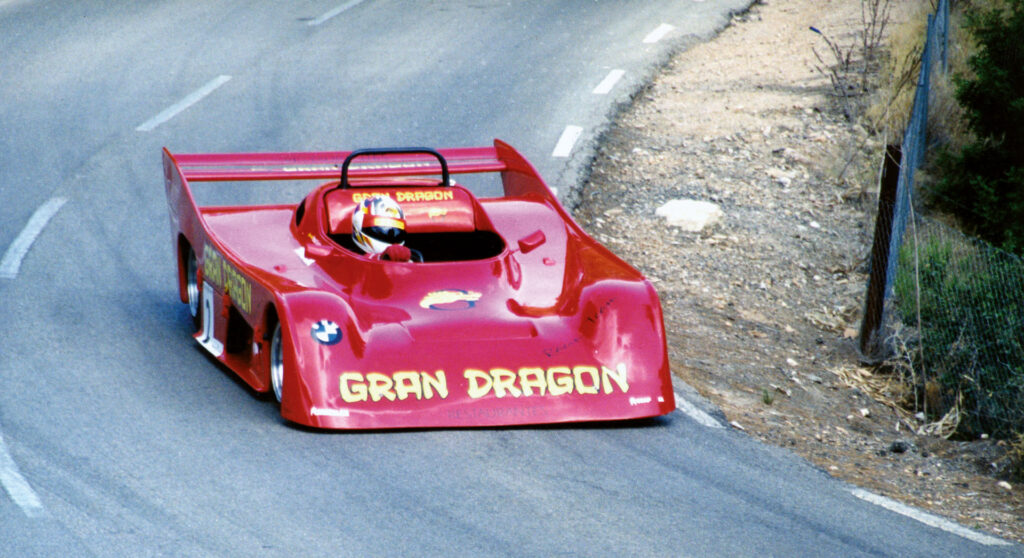
The sporting and intercultural triumphant march of Helmut Kalenborn, born on April 2, 1940, began in the early seventies. He raced for the first time in Mallorca in 1976. Before that, the trained auto mechanic, who owned his own workshop in Euskirchen, had already invested a large part of his savings in racing cars. With them, he participated on weekends in national and international circuit and hill climbs in Germany, Luxembourg, Belgium, the Netherlands, and Czechoslovakia at the time.
Helmut Kalenborn's International Breakthrough on the Nordschleife
With an NSU-Brixner race car, Helmut Kalenborn achieved international breakthrough at the ADAC 500 km Eifelpreis race on September 3, 1972. On the Nordschleife, he sensationally took second place in his 1300 Brixner in the up to 1600 cc class, behind the Englishman John Blankley in a 1.6-liter prototype.
Until 1975, Kalenborn competed in numerous races at the Nürburgring, Hockenheim, the airfield circuit in Mainz-Finthen, and Diepholz.
When in the mid-seventies he also contested numerous Formula Super Vee races, his competitors included, among others, future Formula 1 World Champion Keke Rosberg, as well as a multitude of the top Super Vee drivers of that era such as Prince „Poldi“ of Bavaria, Mario Ketterer, Eje Elgh, Manfred Schurti, Josef Kaufmann, Manfred Trint, Axel Plankenhorn, Arie Luyendyk, and Kenneth Persson.
With a surprise victory in 1975 on his Kaimann Super Vau at the International Hill Climb in Luxembourg, the Straßfeld driver once again made national sports headlines.
Helmut Kalenborn's Escape from Carnival
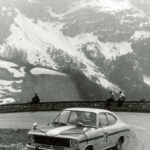
Then came the Carnival days of 1976. „That year, I was determined to escape all the tomfoolery,“ Kalenborn recalls. Through a travel agency, he booked a four-day package tour to Mallorca. On a rather boring excursion to Sóller, Kalenborn suddenly perked up when the bus guide talked about a road that led from the small orange village of Sóller to the island's highest mountain, Puig Major – and on which the final race of the regional mountain racing championships took place every September.
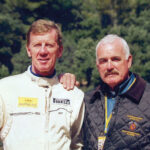
Upon his return, Kalenborn informed his acquaintance at the travel agency in Euskirchen about the possibility of participating in an Autorennen on the island the following autumn. In turn, the acquaintance asked his business partner in Mallorca, Martin Cardona, for support. As luck would have it, Cardona was not only a travel agent but also an enthusiastic mountain racing driver. Furthermore, he was delighted that racing driver Kalenborn would be the first German to participate in Mallorcan „Pujadas“ (mountain races). „Martin was the key to my participation on the island. He spoke perfect German, introduced me to his friends, and later hosted me at his house,“ says Kalenborn. Initially, the German only came to the island in September for the season-ending race at Puig Major with his own race car. And in his second year, he caused a stir: „I had bought the ex-Hans-Joachim Stuck Formula II March BMW from a fellow driver from Luxembourg. Nobody on Mallorca had ever seen a car like that before. People were absolutely thrilled to see it,“ Kalenborn recalls.
However, he did not garner envy or even spite. „Helmut was never a braggart or a show-off,“ says Rafael Abraham, President of the Balearic Motorsport Association, for example. „On the contrary – although at first he could often only express himself through gestures or a few picked-up Spanish words, he offered his help to every driver. And these were never empty promises.“ Numerous spare and accessory parts for the small cars often modified into race cars, as well as rare or high-quality motorsport equipment that was difficult to obtain at the time, made their way to Mallorca thanks to Helmut Kalenborn. From the middle of the 1982 season, Helmut Kalenborn began to consistently participate in the championship races on Mallorca.
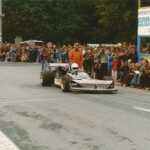
Major successes by Helmut Kalenborn in the 1980s
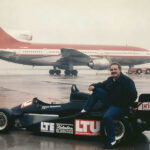
Previously, in 1980 and 1981, he had once again demonstrated his exceptional driving skills on his favorite track, the Nürburgring Nordschleife: with a Chevron B42-BMW and a March 752-BMW M12, both entered by „Escuderia TR Balear,“ Kalenborn participated in races for the Formula 2 European Championship. In 1980, many past, present, or future Formula 1 drivers competed alongside him, including Arturo Merzario, Teo Fabi, and Geoff Lees., Michele Alboreto, Stefan Johansson, Riccardo Paletti, Jo Gartner, Manfred Winkelhock, Christian Danner, Johnny Cecotto, Kenneth Acheson, Roberto Guerrero, Loris Kessel, and Jim Crawford were in the starting field. In 1983, he competed in the entire Balearic Hill Climb Championship. He won the championship that year – after 4 overall victories, a third-place finish at Puig Major was enough for him. Only Juan Fernández and Sebastian Gomez were ahead of him. The following year, Kalenborn secured his first overall victory at the final race at Puig Major. This also brought him to the attention of local businesses. „As is well known, you don't earn money in amateur racing. You do it purely for fun, out of enthusiasm, and it becomes a passion. For example, the prize money for the top three finishers in the Balearic Hill Climb Championship was only between 200 and 300 German Marks. That was often just enough for a shared dinner after the award ceremony,“ explains Kalenborn. The costs of participation, on the other hand, were considerable. In addition to the purchase price of the race car, which already devoured a small fortune depending on the classification and category, significant costs arose over the course of a season for tire and parts wear, repairs, and entry fees. Advertising sponsorship on the vehicle was the only way to mitigate this financial drain. As one of the first German motorsport patrons in Mallorca, the former „rental car king“ Hasso Schützendorf had his company logo placed on Kalenborn's race car. However, he didn't provide any money. „The man gets a rental car from me for life,“ said the eccentric Schützendorf instead. Kalenborn also served as an advertising figure for the former airline LTU.
In the late 1990s, Toni Yoh, an entrepreneur who grew up in Shanghai and emigrated to the island in the 1980s, took notice of Helmut Kalenborn. By then, Kalenborn no longer owned his own race car. Yoh, who ran the „Gran Dragón“ Chinese restaurant in Palma and was also fascinated by motorsports, let Kalenborn take the wheel of his bright red TOJ BMW Group C sports car. In addition to „Gran Dragón,“ three other well-known restaurants also appeared as sponsors on the hood of Kalenborn's racing vehicles: „Celler Sa Premsa“ in Palma, „Casa Manolo“ in Ses Salines, and “Moli des Torrent„ in Santa Maria. In 1999, a radical change of course occurred in Kalenborn's life. In addition to a spectacular accident at the “Pujada de Son Más" near Andratx in June, which he astonishingly survived with only two broken ankles, Kalenborn had to say goodbye to his terminally ill mother a few months later. Even before the turn of the millennium, he sold his house and business and moved to the island permanently.
In 2002, Kalenborn, who by then was working as a consultant for the event racetrack in Llucmajor – and where he met, among others, the later multiple motorcycle world champion Jorge Lorenzo – became the Balearic Hill Climb Champion for the last time at the proud age of 62.
Three years later, he made his last start at Puig Major with a Radical V 8. There, since 2014, a memorial plaque erected by the Balearic Motorsport Federation, carved in stone, commemorates the sporting achievements of the German, who is currently retired and living in Mallorca.
Get Curbs #51 with the Helmut Kalenborn Special and ALL images conveniently home – directly via our Online store
Photos: Kalenborn Archive