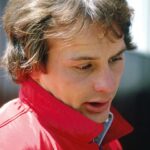
Behind his „angel face“ with almost girlish features, there was a hard-nosed fighter at the wheel of a race car who shied away from no risk and paid for his gamble on the „last inch“ with his life: that was Gilles Villeneuve on May 8, 1982, in Zolder. Jochen von Osterroth followed the Canadian's Grand Prix races and had a personal „good connection“ with him.
Gilles Villeneuve – The Wolf in Sheep's Clothing
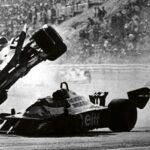
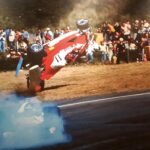
Kyalami Ranch, March 3, 1978: A Fiat came barreling around the corner, bouncing over a bump with groaning shock absorbers in front of this traditional watering hole for Formula 1 teams, and enveloped a Black hotel employee in so much dust that his face turned ashen with fright. An encounter with a „speed demon“ or a „hoodlum“? The completely flustered man didn't know, muttered something in his Nguni-Bantu dialect to himself and beat a hasty retreat. A „cherubic face“ emerged from the Fiat, my interview partner Gilles Villeneuve. With a mischievous grin, he said, „Sorry, hope I didn't keep you waiting too long. I still went for a bit of a spin around town after practice, and that was incredibly fun.“ Over a cup of ice cream, I asked him, „Did you have to do that?“ „Yes, I somehow had to blow off steam about my tire problems in qualifying. I didn't see the hotel employee,“ was his reply. This episode, of course, was nothing compared to his previous, hair-raising activities on the track. I'm not thinking about his Formula 1 debut at the 1977 British GP in a McLaren M23, where he immediately qualified in fifth row alongside Ronnie Peterson in the Tyrrell P34, but rather about the encounter with the Swede at the World Championship finale at Fuji Speedway. Gilles' Ferrari 312T2 touched the rear of the Tyrrell in the braking zone of the right-hand turn after the long straight, was catapulted into the air, landed upside down, was thrown up again, and smashed into an earth bank behind which – admittedly in a restricted area – spectators stood alongside a track marshal and a photographer. The Franco-Canadian was able to extricate himself from his Ferrari wreck unharmed, but the grim toll was: two dead and seven seriously injured. While Gilles couldn't recall how the accident had happened – likely due to brake problems – the race simply continued.

Gilles Villeneuve: Bulldozers and MGA Antics
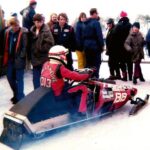
So much for the second Ferrari deployment. He didn't exactly have a fortunate debut with Scuderia at his home Grand Prix in Mosport, after a practice crash. Back to the Kyalami conversation with Joseph Gilles Henri, that's the full first name combination, born on January 18, 1952, in Saint-Jean-sur-Richelieu, in the Canadian province of Quebec. Relaxed, because he had just narrowly beaten the team veteran, Carlos Reutemann, he recounted: „I wanted to become a race car driver when I was just ten years old. Nothing else interested me, no books, and no music. Maybe some soul, blues, or even Dixieland jazz.“ At 15, he was given an MGA, with which – as well as with his uncle's bulldozer – he caused a stir in the area. Without a driver's license, mind you! „That satisfied my horsepower hunger and was more fun than going to the conservatory, where I was supposed to be trained as an orchestral trumpeter. My dad, a piano tuner, would have liked that. My lips couldn't handle the stupid blowing at all. Then at the beginning of winter, I became aware of the snowmobile races that are very popular in our province. “This is it,' I thought."
From snowmobile to the circuit

„At 17, I competed in my first snowmobile races. They didn’t cost much, and if I did well, they paid off handsomely.“ Gilles—who, by the way, raced his Alouette snowmobile with the number 13 on it—was so successful that, as a two-time snowmobile champion, he pocketed around 16,000 Canadian dollars in prize money. With the earnings from „winter sports,“ he was able to finance his regional summer racing activities in 1973—initially in Formula Ford. There, he won seven out of ten races. The following year, he founded his own Formula Atlantic team, with which he finished fifth in the Canadian championship in 1975. „I did everything myself, was my own mechanic, and even overhauled the engines myself.“ In 1976, he dominated this international formula in the U.S. and Canada to such an extent that, in addition to a lucrative advertising contract with Marlboro, he received an F1 offer from Teddy Mayer in September for the 1977 British Grand Prix. He kept himself in shape with four Can-Am starts for Walter Wolf and, after Silverstone, a World Sportscar Championship race at Mosport—where he finished third overall alongside Eddie Cheever in a Faltz BMW 320i. „It’s actually funny that I ended up at Ferrari and my friend Patrick Tambay, who had negotiated with the old Enzo before me, then went to McLaren.“ Gilles and Patrick, rivals on the racetrack, were best friends. When Gilles moved to Europe, he initially settled in the charming town of Plascassier near Cannes. „It was convenient, since Patrick lives practically around the corner, and Walter Wolf also resides in the neighborhood—albeit quite poshly up on the mountain at the “Bastide en plein Ciel,„ a celebrity retreat with its own security. Although I now live in the land of my ancestors, the French way of life doesn’t suit me.“ His English—a bumpy American slang where the letter „R“ practically rolls off the tongue—was something Gilles had only picked up during various Atlantic races in the U.S. As a true „Quebecois,“ one speaks only French, or rather, what they consider to be French there. It’s a difference akin to that between Cologne dialect and Saxon. “On the Côte d’Azur, I searched in vain for food stands serving burgers and steaks. I couldn’t care less about the expensive, posh restaurants. For the racing season in Europe, I’ll need a motorhome where my Joanne can really cook up a storm.”

Mirage on the pole, tank in the last starting row
Gilles, married to Joanne since 1972 and father to a son named Jacques and his two-years-younger sister Melanie: „I just need my loved ones around me. That's the only way I can truly relax. Parties and all the fuss before and after the races are an abomination to me. Not to mention social events with tuxedos and bow ties. Publicity is limited to what's necessary for me, completely unlike Jackie Stewart, whom I admire.“ He said this and ordered another portion of ice cream for us. „So your lips don't dry out and you can finally put down your pen.“ At these words, he looked like a nice little boy, almost like an „innocent lamb,“ whose tough racing pro persona you couldn't see at all. But in the Ferrari cockpit, as the coming years would show, his girlish face would freeze into an incredibly determined expression. As a father, however, he was exemplary. I still remember June 2, 1978, in Jarama: I had scratched the outlines of the race track into the sand in front of Gilles„ large motorhome. Gilles had promised me an in-depth conversation, tied to a small condition: “While I shower and Joanne cooks something for us, please play Jarama racing with Melanie a little." The little girl had placed a Mirage sports car in pole position and a tank in the last starting row using Jacques' Corgi Toys and Solido collection. Since there was no Ferrari model on hand, she was later allowed, to the astonishment of the Ferrari mechanics, to take a seat in Papa's 312T3 (034) and cranked the steering wheel wildly. Upon entering the Villeneuve motorhome, the rule for everyone was naturally: street shoes were as taboo as Gilles' racing slippers.
Gilles Villeneuve's first F1 win was at home
It was in Montreal that Gilles Villeneuve celebrated his first Grand Prix victory, with his future teammate, Jody Scheckter, in the Wolf-Ford WR6, and his current teammate, Carlos Reutemann, in second and third. A big, passionate kiss between the Villeneuves on the podium was in order. His second Formula 1 success came in 1979 in South Africa – ahead of a somewhat disappointed Jody Scheckter. Gilles said to Jody after the race: „I really would have begrudged you the win in front of your home crowd.“ But Jody, despite the Ferrari team order to Gilles not to jeopardize the win, had only managed to get within three and a half seconds of the Canadian. Villeneuve ahead of Scheckter also in Long Beach – and with a significant margin and a new lap record. Jody was more annoyed about qualifying: „You toil away for an hour and a half, using up one set of tires after another, and get sent to the second row by your own teammate.“ A new lap record also in Zolder, then the Ferrari stopped with a completely empty fuel tank! With Gilles on pole and taking the win: For Jody, the world was back in order in his adopted home of Monaco. With a second place in Dijon, Villeneuve had moved up to second place in the championship standings behind Scheckter. Despite a completely botched Silverstone weekend for Ferrari, this order did not change. With no points in sight due to tire problems in Hockenheim, Ferrari designer Mauro Forghieri ordered Gilles to pit, fit super-soft tires, to at least set the fastest race lap. Gilles did just that. In Zandvoort, a tire failure destroyed the left rear suspension of the Ferrari 312T4. Gilles stated: “That's the championship gone for me!" Thanks to second places in Austria, Italy, and Canada, he had at least managed to secure the title of Vice-World Champion behind Jody Scheckter.
Ferrari drove behind
A forgettable start: not finishing the first four races in 1980, and a sixth place in Zolder – Gilles Villeneuve and Ferrari were in a slump. Gilles: „Since Jody has only collected two points so far, the Scuderia will have to put in overtime to be competitive again.“ World Champion Jody Scheckter only fourth from last on the Monaco grid, Gilles at least fifth, a lap down on winner Reutemann: „That's not even a consolation prize.“ But then came the bombshell, as Ferrari, Renault, and Alfa Romeo withdrew from the start in Jarama due to the dispute between the so-called FOCA and FISA teams. However, even with a reunited field in France and England, it was clear: Ferrari was among the backmarkers. Jody Scheckter, second to last on the Brands Hatch grid: „It's a shame,“ and Gilles: „Hopefully, the fact that Ferrari is currently the second-to-last marque in the Constructors“ Cup hurts Forghieri too!„ And that’s how things looked after the 12th WDC race in Monza. Third to last on the Montreal grid, but fifth at the finish: “At least there was something positive to report from home with us Villeneuves, as my younger brother Jacques had won the Formula Atlantic race in the support program.„ His season summary: “Even if our T5 wasn't spectacular, I hope for a sensible 'ground effect' chassis with plenty of turbo power next year, although as a passionate racer, I'm fundamentally against skirts." And it was precisely this skirt issue that had led to the dispute between FOCA and FISA.
Only two wins but eight retirements in 1981
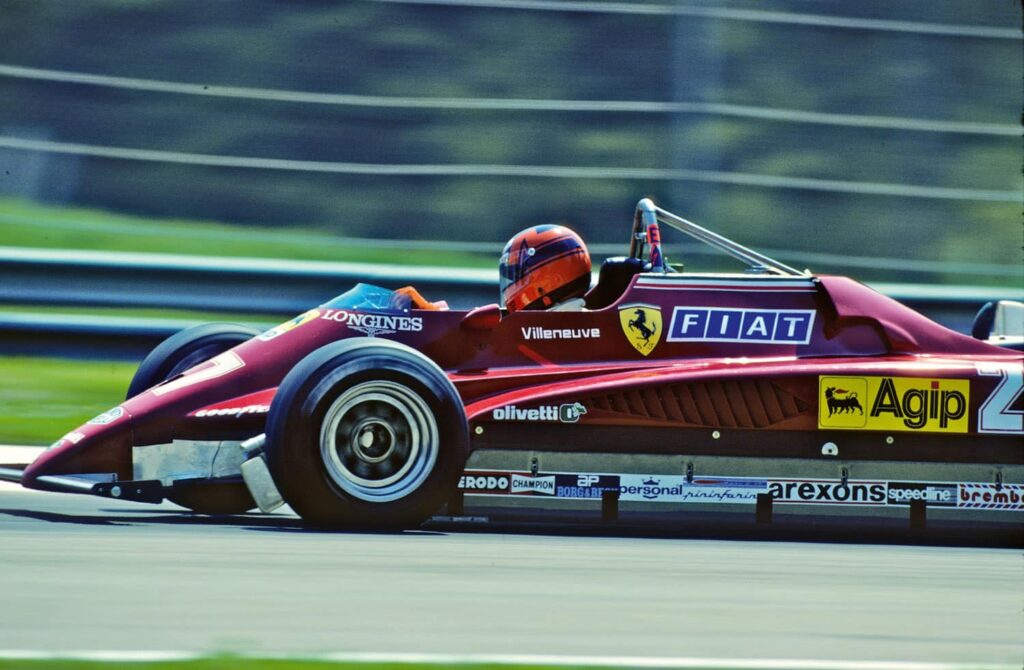
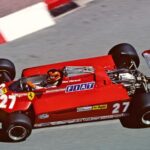
The promising Comprex supercharger hummed in the new Ferrari 126C, thrilling the new driver combination of Gilles Villeneuve and Didier Pironi. However, it didn't see action at the season's start in Kyalami because the FOCA had only agreed late to the FISA's skirt ban. Since Kyalami therefore didn't have World Championship status, the real racing began in Long Beach, but Ferrari's points tally after three GPs was „0.“ After the qualifying session in Rio-Jacarepagúa, which was sunny unlike the race, he told me, „I drove my heart out, look where Didier is – ten places behind me!“ Gilles had to retire after 26 laps due to lack of turbo boost. Partially driving beyond his limits, he acted as a lawnmower several times on the side of the Autódromo de Buenos Aires track in Argentina. Pole position at the Autodromo Dino Ferrari in Imola, Gilles said, „Finally, we are where we belong.“ A tactical error cost him the victory, as the leading Gilles switched from rain tires to slicks too early and actually unnecessarily. It had barely started raining again when he did so. In Monaco, the tide finally turned! Gilles won, and narrowly beaten by Jacques Laffite, John Watson, and Carlos Reutemann, he also piloted his Ferrari 126/CK (52) to victory in Jarama. Only retirements and a tenth-place finish in the following six Grands Prix: A disaster! The conclusion to the crazy rain battle in Montreal was a bit more forgiving, with a third place despite three collisions. Here, Jacques Laffite was the only driver without spins, off-road excursions, or crashes. Didier Pironi on Gilles Villeneuve: „Privately, he's a nice guy you can get along with well, but when it comes to the Ferrari, he has problems with the technology, no wonder with that crappy hydraulics.“ Gilles: „It's way too hard, driving it feels like being in an oversized go-kart.“


Trouble with Didier Pironi
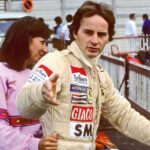
Gilles„ 1982 began completely off the rails: second on the grid but engine failure in Kyalami. Second fastest in Rio but, leading the race, he was unsettled by eventual winner Nelson Piquet and spun into the barriers off the track. Third in Long Beach but disqualified after a Tyrrell protest concerning a two-piece rear wing on the Ferrari. The fact that skirts were back “in„ bothered Gilles immensely: “Shit, the centrifugal forces... the spectators want to see drifts. If something goes wrong now, you can hardly react; it's damn dangerous.„ Gilles had a completely different kind of anger in Imola, namely with Didier Pironi, who ignored the team's intended finishing order and crossed the line ahead of Gilles. Correspondingly angry – “I'm not speaking another word to Didier„ – Gilles entered the Zolder practice session, wanting to make it clear with “kamikaze„ laps who was in charge here, after Pironi had undercut his previous best time. Ferrari team manager Marco Piccinini: “We don't have any team orders, at most recommendations."
The end
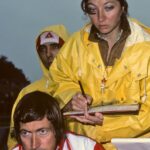
With used qualifying tires, Gilles thundered over the crest behind the pit lane chicane on the track and caught up with Jochen Mass's RAM March 821 at the „Butte,“ a fast left-hand turn. Jochen immediately moved right to let the Ferrari through on the inside—the racing line. However, Gilles apparently wanted to pass on the outside and catapulted the Ferrari into the air over the March's left rear wheel. At around 270 km/h, there was no time to react! The Ferrari first crashed sideways into the guardrail, was thrown back up, and broke apart upon impact with its front end. Gilles—still strapped into the aluminum seatback—flew with his seat against a track fence post with full force. The emergency ambulance from the University Clinic of Leuven determined that, in addition to cervical fractures, his spinal cord had also been severed. There was no chance of survival! At 9:21 PM on Saturday evening, Gilles, kept alive only by machines, died in the presence of his wife Joanne, who had been flown in from Monaco. After being transported to Canada, he was laid out in an open coffin with his helmet on the shroud. Gilles looked as he was known, with a slight smile on his lips.