
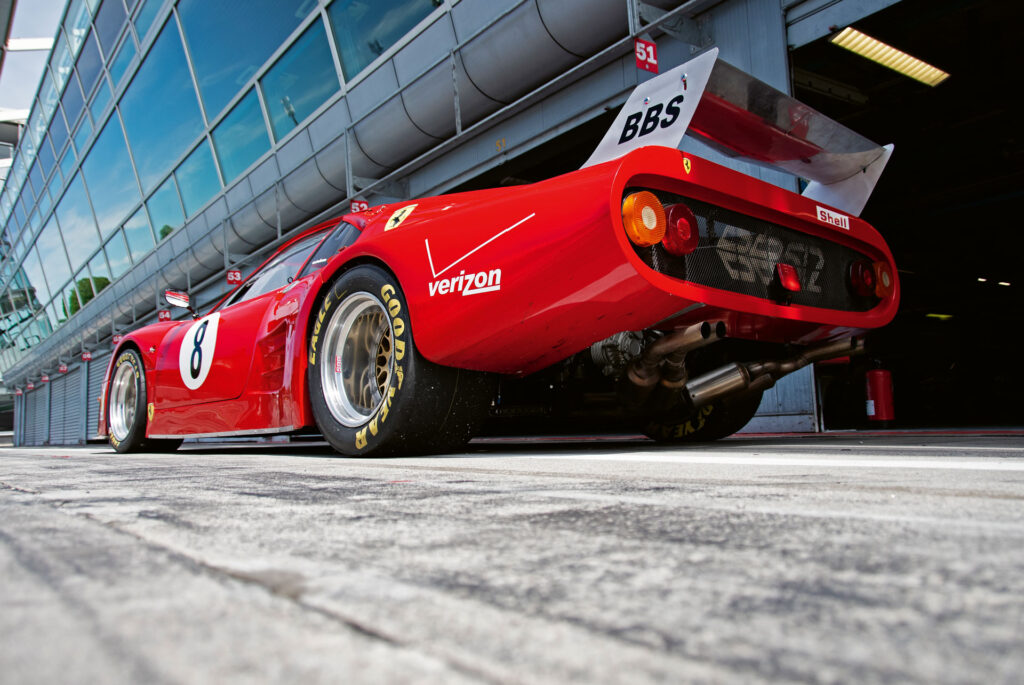
Whether successful in motorsport or not, a Ferrari always holds a special place with car fans. Especially here, in Italy's Monza, the royal park, is that noticeable, as on this still slightly damp May morning, heads turn upwards and gather around the trailer.
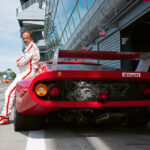
The sun rises over the ancient trees of the royal park, and people in the paddock look up as a car is rolled out of the trailer, though only its rear is visible at first. The Ferrari 512 BBLM slowly sees the morning light in Monza, its chrome BBS rims sparkling as it's pushed out into the sun. I have the pleasure of driving the Ferrari 512 BBLM on the traditional Monza race track. The combination couldn't be any better. However, the track is still damp from the rain during the night and Fredy Lienhard asks me for a little more patience. Logically, one doesn't want to take any risks with such a valuable car, and I only have new slicks with me. At noon, the time finally comes, and I get to climb into the cockpit of the Ferrari. I'm supposed to do just two laps first and then come in for a quick check because the car has just been serviced, as it's mostly on display at the «autobau Erlebniswelt» in Romanshorn. And Fredy Lienhard doesn't do things by halfmeasures, which is why the 512 was thoroughly checked before its outing in Monza. And his cars always have new tires when they go on a race track. His successes in motorsports and business didn't come by chance.
Naked Technology in the 512 BBLM
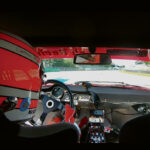
Now I'm getting strapped into the Ferrari. Naked technology in the interior with plenty of visible meters of steel tubing from the chassis make the first impression in the cockpit. Switches and plenty of cables round off the overall interior look, a bit of the «Grande Casino.» Then it's time to turn on the fuel pumps and ignition, and start. Behind me, the twelve-cylinder begins its service at a steady RPM. Slowly, I go through the two prescribed laps, warming up the new tires, monitoring the engine temperatures and pressures; it runs smoothly and roundly. Unfortunately, I notice that the tachometer has a mind of its own. Shortly before reaching maximum RPM, the display drops, even though the engine continues to rev. It's simply uncomfortable when you're not sure how many revolutions the engine is actually making. In the pit lane, a quick report and check, then it's back out onto the track.
Lamborghini GT3 doubles
A car from the 80s feels quite different from a modern race car. The chassis is softer, the gear shifts feel extremely long, and the engine, despite its nearly 500 hp, doesn't rev up as quickly. The steering isn't as direct either. When driving faster, the gears don't always go in smoothly when downshifting. Even with a dogleg gearbox, they aren't always easy to engage. On this track day, I suddenly found myself in the middle of a crowd of cars. Modern cars, Porsche GT3 Cup, Lamborghini GT3, etc., were ahead of me. And suddenly, I got a comparison to modern times. As slow as it seemed at first in the 80s car, it can't be that slow. I'm probably used to the laps with the Ferrari 333SP (see Curbs Issue #55) a little spoiled by the fact that I was allowed to drive earlier. Because now I'm driving past some of these modern sports cars. In the great tumult, we're heading for the «Lesmo» corners. The first Lamborghini surrenders when I appear in the mirror and stays on the outside in «Lesmo 1.» I accept the invitation and pass him on the inside. The Ferrari steers well, I get to the inner curb nicely and leave the «Lambo» on the outside. Then I accelerate in third gear towards «Lesmo 2.» While braking, I get quite close to a Cup Porsche, steer in and, thanks to the momentum, overtake the Porsche directly after the corner itself. Then I shift to fourth gear, and it heads towards «Curva del Serraglio,» a slight left kink that leads into a dip. There, in fifth gear, it goes under the old banked wall. From there, it goes uphill again towards the «Variante Ascari» chicane, named after the famous Ferrari driver who unfortunately lost his life here in a Ferrari in 1955. Then it's time to find the braking point before the chicane and downshift, fourth gear, third gear, and steer into the first left-hand turn of the chicane. Again, good steering, good grip on the front axle, I can ease back on the gas early and accelerate slightly into the right-hand turn. Through the corner, I maintain partial throttle to avoid going too fast for the following left-hand turn. Only at the exit of the corner, on the outside right curb, do I accelerate fully again and shift into fourth gear shortly after the steering is straightened. Now accelerate fully again and shift into fifth gear, and so it goes at full throttle towards «Parabolica.» When braking, I feel the rear end getting a bit «light.» I downshift all the way to third gear and bring the Ferrari back to the inner curb nicely. There I'm already back on the gas nicely and let myself drift out all the way to the left.
With a lot of momentum onto the start-finish straight
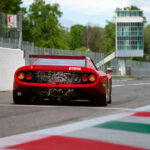
You really need to build up a lot of momentum here for the long start-finish straight. By the time I reach the corner exit, I’m already closing in on a modern Porsche—the line is good, the speed is building—and as I approach the corner exit, I shift into fourth gear before the corner even ends. But then modern technology takes over, and the Porsche pulls away. At the pit lane entrance, I shift into fifth gear and now keep it wide open all the way to the braking point of the first chicane. The tachometer is acting up a bit again, and I don’t know exactly how high the engine is revving. But don’t worry—there’s a rev limiter in place to prevent costly engine damage should the RPMs get too high. But I can tell the twelve-cylinder loves higher RPMs as soon as I exit the pits; the engine really picks up speed there, and I feel a surge as if I’d engaged a turbo. Then I brake for the first chicane and shift cleanly down through the gears, all the way down to second gear. Under braking, the 512 is a bit light and «nervous» at the rear. By the turn-in point, I’ve closed in on the Porsche again, so despite being built in the 1980s, the whole thing handles very sportily. Then another good turn-in, and the transition into the left-hand curve goes smoothly, as grip is good on the front axle. It’s only at the exit of the turn, when I’m already on the gas, that the rear end gets a bit light again and there’s a slight «wheel spin.» So the traction could be a bit better. Overall, the car handles very well on the front axle but has some minor shortcomings on the rear axle. A light rear end in fast sections or at the exit of a corner at higher speeds, or as just now, when you’re hard on the gas at the exit of tight chicanes—that’s where traction is lacking. But I much prefer a car that’s good and precise on the front axle and has a slightly light rear end to annoying understeer. Because a car that oversteers slightly is always more fun than one that understeers. And the Ferrari is fun! The sound of the 12-cylinder engine is a big part of that.
Beautiful machine, beautiful Italy!
Never miss an exciting article about historic motorsport again! Get your Curbs subscription. ALL images conveniently home – directly via our Online store