
Your father was the builder of the Nürburgring
It is the year 2016.
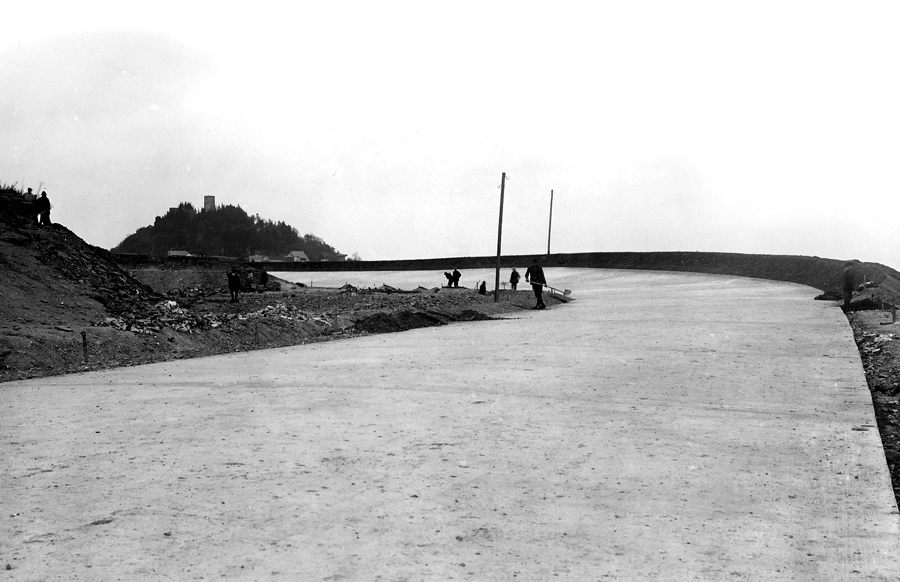
A lady in a red suit receives us in a house in Pforzheim. She lives in a spacious apartment. At the first Eifel Race, which Rudolf Caracciola from Remagen won. Gisela Creutz was there, head of district administration. Then it was off to Berlin, where my father worked in the Interior Ministry before becoming district administrator in Adenau. There was news that a race track was to be built near Münstereifel to help the poor Eifel region – in Berlin they called it ‘Prussian Siberia‚. Through his good connections in the capital, Berlin, he managed to have the race track built in the Adenau district instead, around the Nürburgring. Engineer Gustav Eichler Ravensberg was the actual designer of the then 30-kilometer-long race track with an altitude difference of about 300 meters. My father had the idea of building the race track without any crossings, so that race cars would not drive through the Eifel villages at high speed. He repeatedly traveled to Berlin to get new funding for the construction of the Eifel race track. I was five years old at the inauguration in June 1927.‘


We are not talking about the death of the district administrator, but Kurt Schumacher, Nürburgring historian and master barber from Müllenbach (located south of the Nürburgring), has unearthed a poem that was recited at the funeral in 1951 at the grave, and he reads it to the old lady. She didn't know it.
Albums and „Modern Era“
Gisela Herbstrith, who received her new name through marriage to the Pforzheim jewelry manufacturer Theodor Herbstrith, has always remained connected to the Nürburgring. When there were anniversary years, she was invited by Dr. Walter Kafitz, the longtime manager of the Nürburgring. She stayed overnight at the Dorint Hotel and spent the evenings in the Cockpit Bar, with its many exhibits and pictures from Nürburgring history. There she also met Kurt Schumacher, who subsequently acquired the guest book of the Creutz family.
„Once I had to realize that my father's memorial stone at the foot of the Dorint Hotel was overgrown with weeds. I got a pair of shears and cleared all the memorial stones there. There was a complaint to the Dorint general manager, Moret, and after that, the memorial corner was always well-maintained,“ said Gisela Herbstrith. She hopes that she will also be invited by the new owner when the 90th anniversary is celebrated in three years.
A Journey into the Past at the Nürburgring
The family albums show unique pictures from the Dr. Creutz era, such as her father driving on the still unpaved race track in an Opel, a picture of her parents in front of a huge new Horch car, or Rudolf Caracciola in the paddock; there is also a picture of her with her parents and brother Rolf in a beach chair. They were beautiful and happy years in her childhood.
Summary
The Nürburgring is arguably the most famous race track in the world with „character.“ Its construction is thanks to regional council chairman Dr. Otto Creutz. It is to be hoped that the legendary race track will remain a part of motorsport for a long time to come, even after the turbulent recent years. Incidentally, the estimated financial volume was also exceeded many times over in 1926/27, and the local press still supported the unique undertaking. Why can't that be done today?
Numbers and Facts about the Nürburgring (As of 1927)
- The construction of the Nürburgring cost around 6 million Reichsmark (for the North Loop with 22.8 km and the South Loop with 7.7 km of track).
- In the summer, between 2,000 and 2,500 workers were employed simultaneously.
- 3. Highest point of the track: 620 meters at the start and finish area
- 4. Deepest point of the track: 320 meters at Breidscheid
- 5. Track Length: Total Length 28.265 km, North Loop 22.810 km, South Loop 7.747 km, Start and Finish Loop 2.292 km
- 6. Track width: Start and finish 20 m, track 8 m
- 7. Gradients: up to 17%, steepest section 27%
- 8. Gradient: up to 11%
- 9. Number of turns on the 28.3 km total route: 89 left turns, 85 right turns
- 10. Tightest turning radius: approx. 33 m (carousel)
- 11. Longest Straight: 2.6 km (Döttinger Höhe to Tiergarten)
Note: The sum of 6 million Reichsmarks is listed in the program of the opening race, while other later published sources mention 14 million Reichsmarks.
Caracciola won the opening race at the Nürburgring
The opening race in 1927 took place partly in the rain. Both the Nordschleife and the Südschleife were used, with a total track length of 28.3 kilometers. The powerful sports car Mercedes S (white elephant) won the first race on the legendary racetrack with Rudolf Caracciola and an average speed of 96.5 km/h. The larger displacement sports cars were faster than the lightweight racing cars. The second fastest was Christian Werner with an average speed of 92.57 km/h in a racing car. It was already evident here that Rudolf Caracciola was an exceptional talent, capable of driving fast and gently on the materials. The winning vehicle is today owned by Peterhans Kern from Neuwied and is still driven by the over-80-year-old at vintage car events. When the Mercedes is not out and about, it is safely housed in the Nürburgring Museum.

Opening Speech: Nürburgring, the First German Mountain Race and Test Track for Motor Vehicles in the District of Adenau
„Only two years have passed—though they have been eventful and filled with nerve-wracking struggles—since the initial plans to build a motorway in the Adenau district of the Eifel region began to take shape. Anyone who has made their way today to the nearly completed Nürburgring and seen what human hands have created there in an incomprehensibly short time will have to marvel at how it was possible to conjure up such a monumental project of global significance from the Eifel Mountains. Only a small fraction of those who admire this colossal achievement today will have the slightest inkling of the superhuman drive and work ethic, the mountain-moving energy that paved and found the thorny path to the set goal. Certainly, only the very special circumstances of the desolate and depressed German labor market created the conditions for providing the necessary cheap labor, and only within the framework of the legally regulated productive unemployment relief was it even conceivable to raise the funds for a project that stands alone in the entire world. Nevertheless, it required tireless and skilled administrative officials to draft the necessary extensive memoranda so convincingly that, despite the gravest reservations, the relevant ministries surprisingly quickly provided a meaningless and „credit-unworthy“ district with the funds for a project whose value or worthlessness was not even the subject of a unanimous opinion. There were only a few loyal supporters on whom District Administrator Dr. Creutz could rely in this grueling struggle for his district. All the more grateful recognition must be given to the fact that, with far-sighted vision, leaders of the provincial and state administration recognized the extraordinary economic significance of this daring and truly extraordinary plan for the Adenau district. It goes without saying that the idea of creating better living conditions for the Eifel residents, who were struggling hard for the meagerest of bread, through the construction of an automobile racetrack had to be brought into the Adenau district from outside.“
Memorial Stone for Dr. Otto Creutz at the Nürburgring
On September 27, 1925, the cornerstone for the Nürburgring was laid. Seventy-seven years later, people commemorated the man who, with visionary courage and energetic drive, pushed through the construction project and thereby created better economic prospects for the people of the Eifel region: Dr. Otto Creutz, district administrator of what was then the Adenau district. Luki Scheuer, a well-known journalist and Ring expert, wrote in an article in the Rheinzeitung: „History does not always treat those who write it kindly. This is also the case with Dr. Otto Creutz, the ‚Father of the Nürburgring.‘ There were times when the historically verifiable achievements of the last District Administrator of the Adenau district were simply hushed up, while others were hailed as the builders of the Nürburgring, because Creutz did not fit into the image of the rulers of the time, because he did not conform to the Nazis. The man to whom the Eifel owes so much was to be silenced. That he was nevertheless always fondly remembered by the people is evidenced by an artistically crafted certificate bearing the signatures of 250 Adenau citizens, which was presented to him upon his departure following the dissolution of the Adenau district in 1932. And the great sympathy shown by the people and the words of tribute spoken at his funeral in 1951 at the Adenau Cemetery are further signs that Dr. Otto Creutz has his place in history and in people’s hearts. This was made clear once again with the unveiling of a commemorative plaque honoring the builder of the Nürburgring. Nürburgring CEO Dr. Walter Kafitz could not have chosen a better date for this ceremony than the 77th anniversary of the laying of the racetrack’s cornerstone. And he could not have invited a better, more deserving, or more open-minded guest of honor than Gisela Herbstrith, née Creutz, the daughter of Dr. Otto Creutz. The 80-year-old lady traveled from her home in Pforzheim, 290 kilometers away, in her own car, in pouring rain, and one day before the celebration in honor of her father. She stayed at the traditional inn ‚Zum Wilden Schwein.‘ ‚That’s where my parents used to go, too.“
Never miss an exciting article about historic motorsport again! Get your Curbs subscription. ALL images conveniently home – directly via our Online store