
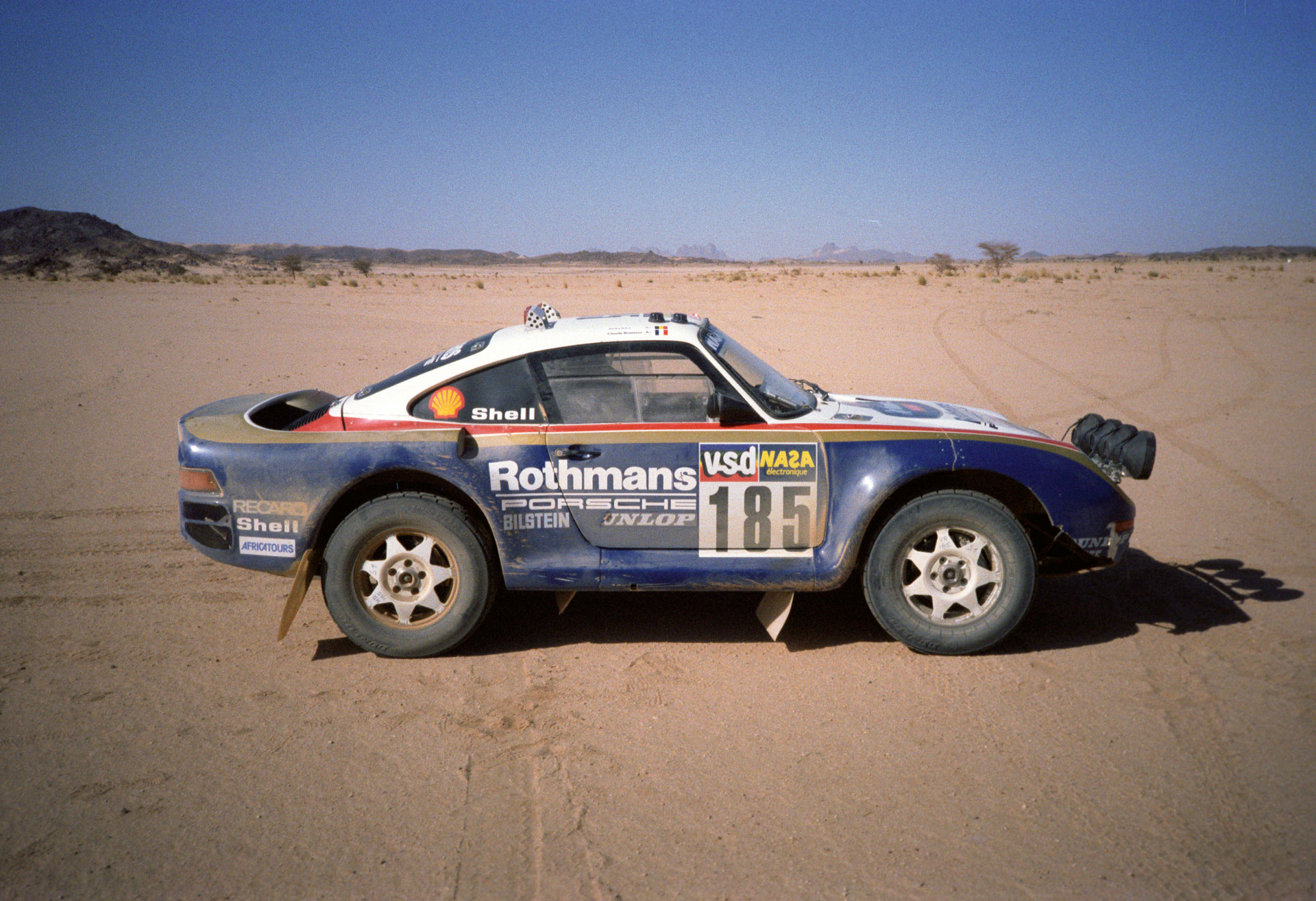
13,643 kilometers over gravel and desert sand, following ancient caravan routes in scorching heat: the 1986 Paris-Dakar Rally pushed vehicle technology to its limits – also with tremendous wear on tires and shock absorbers. For the three factory-built Porsche 959s, repurposed as „off-roaders,“ it was a material test that was mastered with flying colors: a one-two finish, and the accompanying technical support 959 placed sixth. Now celebrated Jacky Ickx a reunion with the successful Dakar Porsche - in a snow-covered gravel pit.
Let's take a look back. „After our three cars retired from the Paris-Dakar in 1985,“ said Porsche's Head of Development, Prof. Helmuth Bott, „it was so crushing that we told ourselves we had to compete again, even though we were fed up.“ And so Porsche plunged into the desert adventure once more. René Metge, already a Paris-Dakar winner in 1981 on a Range Rover and in 1984 on a Porsche 953, and Jacky Ickx, successful here in 1983 on a Mercedes, formed an experienced driver roster, which was completed by Porsche development engineer Roland Kußmaul. After all, Kußmaul had gained valuable experience as a co-driver for Björn Waldegård in the Monte Carlo Rally. Of course, North Africa presented entirely different challenges.
Co-driver experiences in the Porsche 959
Rallyeracing staff member Bernhard Schmidt, who was trapped in the 959 behind driver Kußmaul and co-driver Handrik Unger for over 834 kilometers on the 14th day of the rally during the stage from Bamako through Mali to Labe in Guinea, recalls: „That was the equivalent of the distance from Hamburg to Munich, covered not on highways but on dirt roads.“ And he adds, „Of course, German dirt roads are like gold compared to this Sahel desert, littered with undergrowth full of thorns. These things are five centimeters long and hard as steel. As we tried to follow the Lada Niva driven by Lartique/Giroux, one of these thorns pierced the Dunlop Kevlar tires of our Porsche in the darkness.“ Back then, the only truly Russian thing about the Ladas—which were powered by Formula 2 engines—was their exterior. Thus, this socialist vehicle finished ahead of Kußmaul’s Western high-tech machine in the car classification. In the truck category as well, the Russian Kamaz—simple and therefore built to last—remained one of the dominant trucks right up until 2022: with a total of 19 victories, seven of them with Vladimir Chagia behind the wheel. In 1986, however, the truck competition was dominated by German technology. Hans Heyer, with co-pilot Manfred Winkler and the Sport-Auto journalist Yörn Pugmeister—a Frenchman also fluent in foreign languages—took second place in a MAN 14240 SAEG behind a Mercedes Unimog. Hans Heyer at the time: „At some point, following “Pug’s„ directions, we reached a dry riverbed to continue our journey and were surprised to see the entire rally caravan pass us by—but in the opposite direction. Even the Porsche factory team!“ A smiling Yörn: “After the riverbed, we drove straight across the terrain and just barely made it to the stage finish within the grace period, while the rest of the rally trickled in with a huge delay and was slapped with a ten-hour penalty.“ Clay Regazzoni, confined to a wheelchair, did not experience these final days of the Dakar in his truck, which had been converted to hand throttle. He had already been stranded in the Ténéré Desert.

The desert claimed its toll
Here in the Ténéré, the notoriously infamous southern Sahara region in Niger, the founder of the Paris-Dakar Rally, Thierry Sabine, also crashed his helicopter in a sandstorm on January 14, 1986. He, his pilot Francois Xavier-Bagnoud, the radio operator Jean-Paul le Fur, the singer Daniel Balavoine, and the journalist Nathalie Odent had no chance of survival. Sabine had still initiated the top football match of Mali, namely Gao against Mopti, and therefore only started at nightfall. Four-time Le Mans winner Henri Pescarolo, who held a pilot's license and was in the helicopter for French television during the rally, stated: „That was irresponsible!“ Even without a sandstorm, this „desert of all deserts“ - larger than the Federal Republic of Germany - is a special kind of challenge. Jacky Ickx: „Theoretically, you can drive at speeds of 200 here in some parts, but in practice that would be far too dangerous, as a dune hole suddenly appears in front of you.“ Only between Agadez and Dirkou is „full speed“ recommended. Riding over the crests of sand waves is probably only a specialty of Stéphane Peterhansel, who has won the Dakar 14 times - six successes on two wheels and eight on four wheels. A record for eternity! And the absolute desert fox Stéphane is still on the move - in 2022 with an Audi RS Qetron. Sad conclusion: The Ténéré has swallowed up many a participant - mostly on two wheels - of the many Dakar fatalities.
Mandatory break for the Porsche 959
When Roland Kußmaul arrived at the stage finish in Labé at night, the next morning brought an unpleasant awakening: passports and money had been stolen, and there was still no sign of the support trucks. The departure for Kayes, scheduled for eight o'clock, was cancelled anyway, as many participants had not even arrived yet. Patrick Verdois, Sabine's successor as race director, had to take a one-day break until the support vehicles had also arrived. On the last major loop to Dakar, the four-wheel-drive Porsche 959 once again demonstrated its superiority. Even the helicopters following the rally convoy had trouble keeping up. The duos René Metge/Dominique Lemoyne and Jacky Ickx/Claude Brasseur left nothing to chance and clearly relegated the Mitsubishi Pajero and the Lada of Lartique/Giroux to their places. Honda also dominated the scene with the XLV 750 in the motorcycle category with equal confidence.
Recommissioning 2023
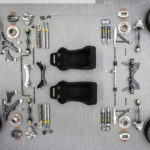
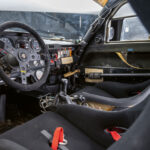
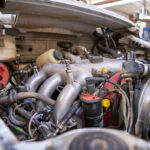
While the Dakar winning vehicle remains untouched—„we're keeping it in a time capsule, so to speak,“ says Kuno Werner, head of the Porsche Museum workshop—the Ickx 959 was disassembled and rebuilt. Werner continued, „We want to maintain its used condition and only gently overhaul the vehicle, yet it should remain technically flawless.“ This rally car, with a boxer turbo engine reduced to 400 hp for the Dakar due to insufficient fuel quality, was dismantled, overhauled, and reassembled by Porsche Classic. All components were only slightly damaged, and neither major deformations nor corrosion damage were found. To preserve as much of the original as possible during the restoration, extremely careful work was required to bring the car back to its original curb weight of 1260 kilograms. This was achieved through doors and hoods made of Kevlar and, not least, through perforated brake discs. During the disassembly of the 959, desert sand, dirt, and mud-like residues from river crossings, where water had entered the interior, were carefully removed. Minor areas of corrosion, where body parts had rubbed against the metal frame, were not repaired but only conserved. Uwe Makrutzki, head of the Porsche Classic department, stated, „The 959 Paris-Dakar is a technology carrier, and for that reason alone, its recommissioning is emotionally charged. In 1986 the car was challenged, now it's our turn!“ His transmission specialist Klaus Kariegus added, looking at the Sahara sand remnants inside the 959, „The vehicle has proven its quality and robustness; even sand and dust from the tough rally use couldn't harm the technology.“
Jacky Ickx: Porsche 959 - Rollout in the Snow
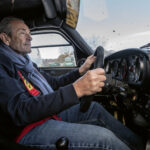
Porsche had invited Jacky Ickx to once again be the first to pilot the gently revised, second-place 959 from the Paris-Dakar Rally. The „crime scene“: a snow-covered quarry that also serves as a scrap yard for old construction machinery of various origins. On board: Porsche factory driver Timo Bernhard. The FIA World Endurance Champion of 2015 and 2017 raved about the ride with his even more famous racing colleague. Jacky Ickx summarized this first drive after almost four decades in three words: „Memories, emotions, passion!“ Given today's staffing requirements, it's hard to comprehend that the entire Porsche operation on-site at the time was handled by just 18 people. „A great team!“ Ickx added regarding this 959: „Everyone wanted to drive the car on the road back then, but then Porsche decided to send the 959 on a desert rally. It's fantastic that I was, and still am, a part of this story. It was an incredible challenge and at the same time a perfect test track for the all-wheel-drive transmission.“ "The desert is like the sea; no dune and no wave is like the other," Ickx outlines the track conditions of the time, spoke, and let the snow swirl.

Get Curbs #54 featuring the Porsche 959 Paris-Dakar & All images conveniently home – directly via our Online store
Photos: Dr. Ing. h. c. F. Porsche AG