
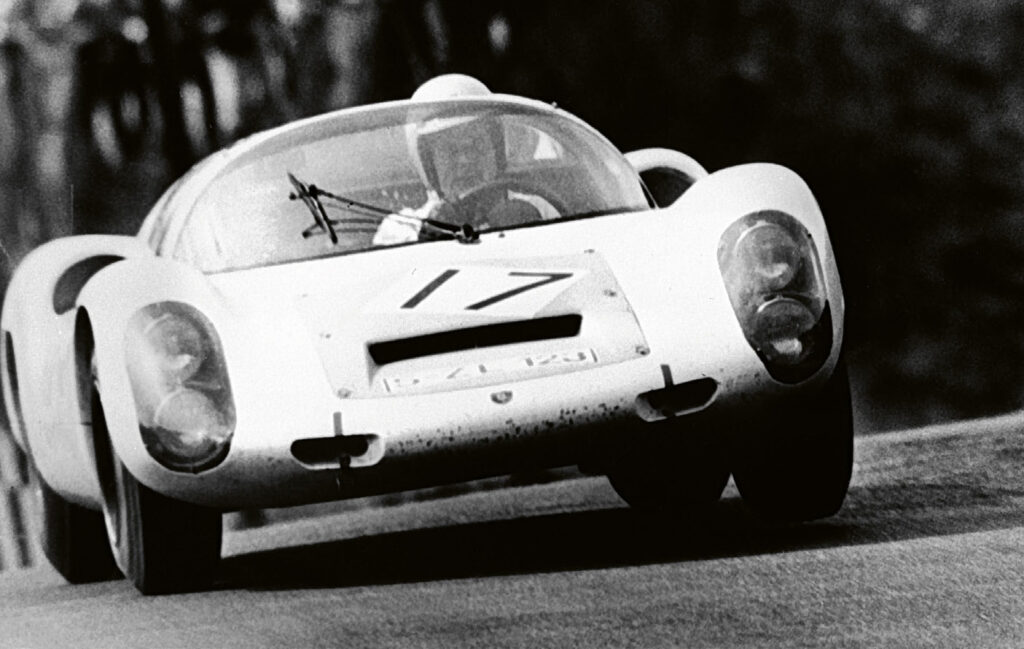
Right in the middle of the Ford-Ferrari duel, Porsche burst onto the scene with ambitions for the manufacturers' world championship. These ambitions were significantly fueled by a first overall victory at the 1967 1000 km race at the Nürburgring – essentially on their home turf without their two major rivals nipping at their heels.
The World Sportscar Championship, founded in 1953, was dominated in the mid-1960s by the Ford vs. Ferrari duel. After the American corporation's failed takeover of the Italian sports car manufacturer, the two companies engaged in an exciting rivalry for over four years.
Showdown centered on the prestigious 24 Hours of Le Mans. Ferrari had dominated there for six consecutive victories between 1960 and 1965, then Ford achieved its first triumph at La Sarthe in 1966 with Bruce McLaren and Chris Amon. In 1967, Ford focused on the American races at Daytona Beach and Sebring, as well as the season highlight at Le Mans. The 24 Hours of Daytona ended in a photo finish between the three leading Ferrari 330 P4s. In Sebring, Ford secured an undisputed victory because Ferrari did not participate in the race.
The following World Championship races also showed that the outcome of the 24 Hours of Le Mans was completely open. With another victory in Monza, Ferrari took the World Championship lead, in the Belgian Spa a Mirage-Ford from John Wyer's team won, and the Targa Florio ended with a triple Porsche success.
Manufacturers' World Championship: Shrinking field at the Nürburgring
For the upcoming 1000-kilometer race at the Nürburgring, which took place just two weeks before the season's highlight, the Manufacturers' World Championship at Le Mans, Ford did not compete, focusing entirely on France. Ferrari registered at least two prototypes, and so the organizing ADAC remained optimistic despite everything, as the following entries were received for the classes over 2000 and 3000 cc:
- 1 Lola Aston Martin (5.1 Liter) with John Surtees/David Hobbs
- 1 Ferrari 330 P4 (4.0 Liter) with Ludovico Scarfiotti/Mike Parkes
- 1 Ferrari 2.4 Liter
- 1 Chaparral 2 F (7 Liter) with Phil Hill/Mike Spence
- 2 Mirage-Ford (5.8 Liter) with Jacky IckxRichard Attwood and David Piper/Dick Thompson
- 2 Ford GT 40 (4.7 Liter) with Jo Schlesser/
- Guy Ligier and Henri Greder/Jean-Michel Georgi 6 Porsche (2.2 and 2 Liter)
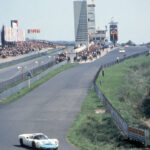
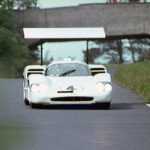
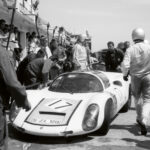
With this lineup, the organizing ADAC hoped to still be able to thrill the audience, especially since Porsche also had a chance of winning this year.
But the entry list continued to shrink. The Ferrari 330 P4s had retired from the Targa Florio, and the damage sustained purportedly could not be repaired by the time of the Eifel race. Furthermore, the Scuderia had to contend with the loss of Lorenzo Bandini, who had fatally crashed during the Monaco Grand Prix. Scarfiotti/Klass's 2.4-liter factory Ferrari suffered an engine failure during practice. As no replacement engine was available, the Ferrari team departed early.
The Scuderia Filipinetti's 2-liter Ferrari Dino also did not survive the practice session. In the first practice laps, Frenchman Jean Guichet went off the track in the Hatzenbach section. The Ferrari caught fire, causing Guichet to jump out of the car without activating the fire extinguisher located next to the driver's seat. As the marshals were inadequately equipped with fire extinguishers, the Dino burned out completely. Guichet later confessed in the paddock: „I immediately had the burning Bandini in Monaco in mind, was overcome by paralyzing fear, and was incapable of rational thought, even though I probably would have had enough time to reach for the fire extinguisher.“ The incident at least led to significantly more fire extinguishers being available the next day. Nürburgring were available.
This settled it: the 1000 km race, in which Ferrari had already achieved six overall victories, would take place in 1967 without the Scuderia. As editor-in-chief of the motorsport magazine „powerslide,“ the later Porsche race director Rico Steinemann assessed this development as follows: „The 1000 km of the Nürburgring, and the ADAC officials surely know this too, have entered an acute crisis. What was missing at the Nürburgring was the united top-tier endurance racing field, the Ford stable, the fully-fledged Scuderia Ferrari, and the Ferrari prototypes from the traditional semi-official Ferrari private teams. For comparison: at Le Mans (where not all entries are accepted), 30 prototypes over 1600 cc started – at the Nürburgring, a dozen, and even that only thanks to the 6-car Porsche force.".
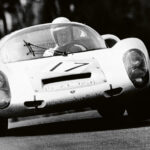
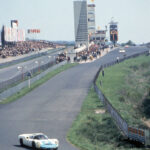
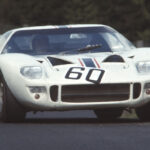
More so than the other «smaller» endurance races, in which at least one of the big names was present, the 1000 km race gets caught between the millstones of the two main players who want to save their strength for Le Mans. The Nürburgring disrupts the Le Mans preparations because it takes place just fourteen days before the 24 Hours, and it's not important enough. It offers too little resonance, meaning: a Nürburgring victory doesn't achieve much; it doesn't offer the prestige of a Le Mans or Daytona success.“
The ADAC reported the number of spectators who arrived in warm summer weather as 108,665, who were pleased with moderate ticket prices. A seat in the first three rows of the main grandstand for the World Sportscar Championship cost DM 40, while a simple standing spot along the track was available for DM 5. For all those who stayed home, the Second German Television (ZDF) offered a special service. The presenter Rainer Günzler and the Belgian racing driver Paul Frère had already, in 1966, with a Porsche 904 at the 1000-kilometer race participated at the Nürburgring and broadcast live footage of the race from the moving car. A Bundeswehr helicopter served as a relay station so that the TV signals could reach the outside broadcast van. In 1967, they repeated this operation, but were only allowed to participate in the practice sessions with their Porsche 906. Today, this car is part of the Porsche Museum's collection in Stuttgart, where it is occasionally exhibited.
Restructuring at Porsche for the Manufacturers' World Championship
Porsche had achieved many successes on international race tracks since the early 1950s, primarily in smaller classes. Only occasionally did they manage to secure an overall victory in one of the major long-distance classics, and even then, only where the track characteristics suited the Zuffenhausen-based company, such as at Sebring or the Targa Florio. After Ferdinand Piëch became head of the development department at Porsche in 1965, this changed fundamentally. He aspired to win the previously unattainable World Sportscar Championship, which became possible through an agreement between Volkswagen and Porsche. Piëch, in his „Auto-Biography“: „VW sales director Carl Hahn, later the head of the entire company, signed an agreement with us that would allow Porsche, under my development leadership, to continue and expand this racing commitment. Volkswagen took over two-thirds of Porsche's entire racing budget, with no upper limit. The only condition: all forms of Porsche racing had to take place with air-cooled engines.“
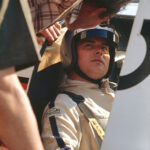
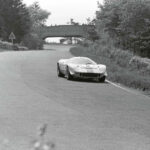
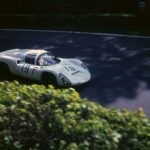
With considerable technical and personal effort, the quest for the stars in the makes„ world championship, winning the makes“ world championship, was undertaken. Huschke von Hanstein, Porsche's old-school racing director, lost more and more influence. No longer were the racing strategists at the pits in charge, but the technicians, led by Piëch and Dr. Helmuth Bott. Porsche works driver Udo Schütz summarized it thus: „When Piëch arrived, Porsche was a tinker's workshop. That changed thoroughly.“ Racing driver Hans Herrmann: „In the first year, Piëch never made an appearance. He just looked at all the departments. Department by department, he was a chess player." Not only was the technology optimized, but all other processes were also scrutinized. Herrmann described one example: "When seatbelts first appeared, we weren't enthusiastic at first. But it was increasingly enforced. So, at the start, an official stood at each car, checking if the car door was closed and the safety belts were fastened. The article goes on to detail the specific car assignments, with the first car being driven by Siffert/Hans Herrmann, Rolf Stommelen/Kurt Ahrens, and Gerhard Mitter and Lucien Bianchi. Three additional 6-cylinder, 2-liter cars were entrusted to Udo Schütz/Joe Buzzetta, Jochen Neerpasch/Vic Elford, and Gerhard Koch/Paul Hawkins.
Insightful dress rehearsal
A good week before the race, the Zuffenhausen team conducted a two-day pre-test at the Nürburgring, during which Neerpasch and Herrmann completed the full 1000-kilometer distance in 6 hours, 43 minutes, and 26 seconds. As the ever-faster racing cars approached the Dunlop Tower during their pass of the start-finish straight, the responsible committees decided to reduce speeds in this area. Thus, a chicane was incorporated before it, which later received the name ’Hohenrain Chicane.“ It forced the drivers to ease off the throttle at the end of the long straight at Döttinger Höhe before the new sequence of corners.
Three days before official practice, Porsche held another test day, giving all works drivers the opportunity to familiarize themselves with the race cars and the recently rebuilt track. For the first time, rear spoilers were tested on the vehicles, which significantly improved handling and were therefore used by almost all teams in the race. Only Jochen Neerpasch and Vic Elford refrained from using them because the spoilers reduced top speed on the straights by 10-20 km/h. In official practice, all six works Porsches were among the top nine fastest in practice, the slowest of them (Koch/Hawkins) at 8’58.8’ still faster than the 5.7-liter Ford Mirage driven by Ickx. The 8-cylinders were consistently faster than the 6-cylinders. The best time was set by Siffert in 8’41.4’, surpassed only by Phil Hill in the 7-liter Chaparral 2F at 8'31.9" and Surtees in a 5-liter Lola-Aston-Martin at 8'39.6". Pleasingly, the six works Porsches were consistently among the fastest vehicles in official practice.
Favorite's Demise in the Brand World Championship
The classic Le Mans start was won by the Porsche drivers, as both Hill and Surtees and Ickx got off to a bad start. It took nine laps for the Chaparral to catch up to the leading Porsche, then Hill passed Siffert. At this point, Surtees' Lola was already at Metzgesfeld; a broken spring had thrown him out of the race on lap six while in seventh place. The joy of Hill's lead, however, did not last long for the American team. During a lengthy first stop, Hill handed the wheel over to Mike Spence, who drove off with a sputtering engine and returned to the pits via the concrete loop. The race was then over for the Chaparral team, as technical problems were now compounded by disqualification for leaving the track.
Porsche also encountered problems. Herrmann had just completed a lap when a valve failure took the now leading Porsche out of the race. The same fate befell Kurt Ahrens and Rolf Stommelen after a timing belt for the fuel injection pump had to be replaced on the track on their Porsches. Gerhard Mitter and Lucien Bianchi then took the lead. They remained at the front initially, when the battery had to be changed after the 35th lap due to alternator failure. However, its capacity was not enough until the end of the race. The last 8-cylinder stopped on the last lap before the Klostertal corner with a dead battery, whereupon Buzzetta and Koch, who had been driving behind Mitter in the last laps following team instructions, rushed to the finish line one after another. Joe Buzzetta crossed the finish line 0.2 seconds ahead of Koch. Jochen Neerpasch and Vic Elford, who drove the last eight laps with a broken valve spring, came in third. Mitter/Bianchi were still classified fourth, one lap behind, ahead of the first Alfa.
The Porsches delivered an exciting finale.
Two weeks later, Ferrari had to accept another bitter defeat. Ford, with Dan Gurney and A.J. Foyt, won the 24 Hours of Le Mans again, leaving only second and third place for the team from Maranello. With victories at the Nürburgring and the Targa Florio, along with numerous good placings, Porsche had stepped into the role of the "Ferrari hunter" and had good prospects in the still-open battle for the World Championship title. The decision came in the last race of the season, the 500 Miles of Brands Hatch. It ended with a victory for Phil Hill and Mike Spence in the Chaparral, but crucial for the World Championship was the second place for Formula 1 drivers Chris Amon and Jackie Stewart in a Ferrari 330 P4. This secured the Scuderia the 1967 Manufacturers' World Championship title, ahead of Porsche.
But the Zuffenhausen team had arrived at the peak performance of this championship in 1967 and proved it in the following four years. Their record: two Le Mans victories, three world championship titles, and 26 wins in the 38 championship races contested.
Get Curbs #48 delivered right to your door with the Brand World Championship Special—directly through our Online store
Photos: Porsche AG, Kuniberth Söntgerath, Helmut Wittwer, Archive, Ruwisch, Archive Ruwisch, Dr. Benno Müller, Hans-Peter Seufert