
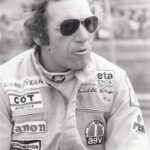
Sometime between two adventurous off-road races, he had earned the nickname „Gorilla,“ a characterization that wasn't entirely fitting, as gorillas are considered peaceful herbivores by scientists. But Vittorio Brambilla's rather stocky build, coupled with occasional uncontrolled aggression, must have evoked associations of an agitated ape here and there, bursting through the undergrowth, snorting with rage.
In the 1976 season, the March Formula 1 mechanics tallied over 40 Brambilla crashes in practice and races, nearly one per event day. At the Nürburgring, the orange-painted front hoods wore out, forcing him to drive a plain white one in the race. In one practice session, he had just left the pits, rounded the „Südkurve“ – and immediately spun the March into the catch fencing in the second corner, the „Nordkurve“. In 1977 with the Surtees, 22 accidents were still registered, 18 in 1978, but that was the season he didn't finish. The dowry from his sponsor, the touching Signor Beta, barely covered the damage he caused. And team boss John Surtees ruefully stated: „It hurts to see how lovingly the mechanics prepare the car, polish it, it goes out and... bang!“
Aside from Vittorio Brambilla's fascination with racing car technology, sheer speed was also his passion outside of racing for a long time. On a South African country road, he was once clocked at 128 mph (205.82 km/h), and during the two Japanese Grands Prix in 1976 and 1977, he loved to try out the 300 km/h trains in the Land of the Rising Sun after racing hours. When a race in Israel in 1970 was accidentally rescheduled to a Saturday, Vittorio, mounted on a donkey, started a race against fellow drivers Derek Bell and Xavier Perrot on camels and placed the long-eared animal second between the humped creatures. Often, he himself found it difficult to slow down and sometimes simply forgot to do so in the race car...
Ski downhill racing was too dangerous for Vittorio Brambilla
Born on November 11, 1937, Vittorio Brambilla must have heard the roar of racing engines from the cradle. After all, his family’s three-story home was located right next to the historic Monza racetrack. The fact that his father ran an auto repair shop further influenced the career choices of his sons Ernesto, born in 1934, and Vittorio; they apprenticed with him and became mechanics. Very soon, the older Ernesto caught the racing bug and hopped on a motorcycle. After numerous chases with the local „Policia,“ 19-year-old „Tino“ channeled his impetuous drive into motorsports in 1953. He racked up an impressive 80 victories on two wheels before switching to Formula Junior racing cars in 1962. In 1963, driving a Wainer-Ford, Ernesto achieved his first significant result—one of international importance—at Collemaggio. Three years later, he became national champion in Formula 3 in a Birel—an Italian copy of the Brabham BT 21. In 1967, he competed as a Tecno factory driver in international Formula 3 races; midway through the 1968 season, he became a Ferrari factory driver in Formula 2. He entered the ongoing European Championship late but with determination. With two victories, at Hockenheim and Vallelunga, and a third-place finish in Enna, Sicily, he catapulted himself to third place in the final championship standings. He set the fastest lap three times.
Vittorio had long emulated him. He had given up downhill skiing, however, because it had become too dangerous for him. After winning the Go-Kart World Championship in 1959, he initially tried his hand on two wheels from 1962 onwards, ultimately not less successfully than his brother. He himself became an Aermacci factory rider and was able to celebrate winning the Italian road racing championship in the 250cc class in 1967. Subsequently, he set several new world records for Moto Guzzi, which remained valid for years. Because the top rider there, Giacomo Agostini, intervened against his takeover into the MV Agusta team, Vittorio temporarily turned his back on the motorcycle racing world. During all this time, he had repeatedly helped out as his brother's race mechanic and became a true expert who remained fascinated by the technology of four-wheeled racing cars. In the year Ernesto caused a sensation in Formula 2, Vittorio took over his somewhat aged Formula 3 Birel and immediately became Italian vice-champion, which he confirmed once more in 1969.
Vittorio Brambilla - the terror of the competition
In mid-1969, Ferrari withdrew from Formula 2, leaving Ernesto temporarily without a car. But a consortium of Italian businessmen deemed the brothers highly worthy of promotion. Braito garden machinery, Frigerio aluminum parts, and Gariboldi wholesale home building joined forces to finance the „Ala d'oro“ Formula 2 team („the golden wings“). A certain Signor Angeleri became team manager. Ernesto Brambilla, in a dual role, concentrated the functions of coordinator, lead driver, test pilot, and mechanic. Vittorio Brambilla was hired as the second driver and also contributed his skills as a mechanic. The team relied on the latest Brabham Formula 2 creation, the BT 30-Cosworth, a mature and highly competitive design based on the manufacturer's long-standing commitment to this racing car class.
The Formula 2 team „Ala d'Oro“ formed to the horror of the competition, as the Brambilla brothers sometimes displayed a cheeky, rough driving style. There were even collisions after which they sought to settle the blame at the side of the track in fistfights. Although they occasionally raced at the front, the overall sporting results remained meager. Driver-wise, the younger Vittorio increasingly pushed to the forefront, finishing second at Salzburgring and Munich-Neubiberg airfield. In the 1971 season, the sponsors parted ways with the brothers because they felt cheated regarding the self-tuned engines. In return, Ernesto kept an F2 March 712 M, which had replaced the Brabham in the team, as settlement for outstanding bills and continued with the support of smaller sponsors from the accessory industry.
For once, Vittorio accepted a lucrative offer from the two-wheeler scene as a Moto Guzzi factory rider. At the end of the 1972 season, brother Ernesto retired to the position of team manager, as several accidents had given him cause for thought. For 1973, he concentrated all activities on a one-car team in Formula 2. The tool manufacturer Beta financed Vittorio's efforts as a driver in a March 732-BMW in the Formula 2 European Championship. The brothers' team lived modestly; a single mechanic took care of preparing the car. Already the
The brothers had to drive the transporters themselves.
Formula 2 1973: Vittorio showed unusual discipline
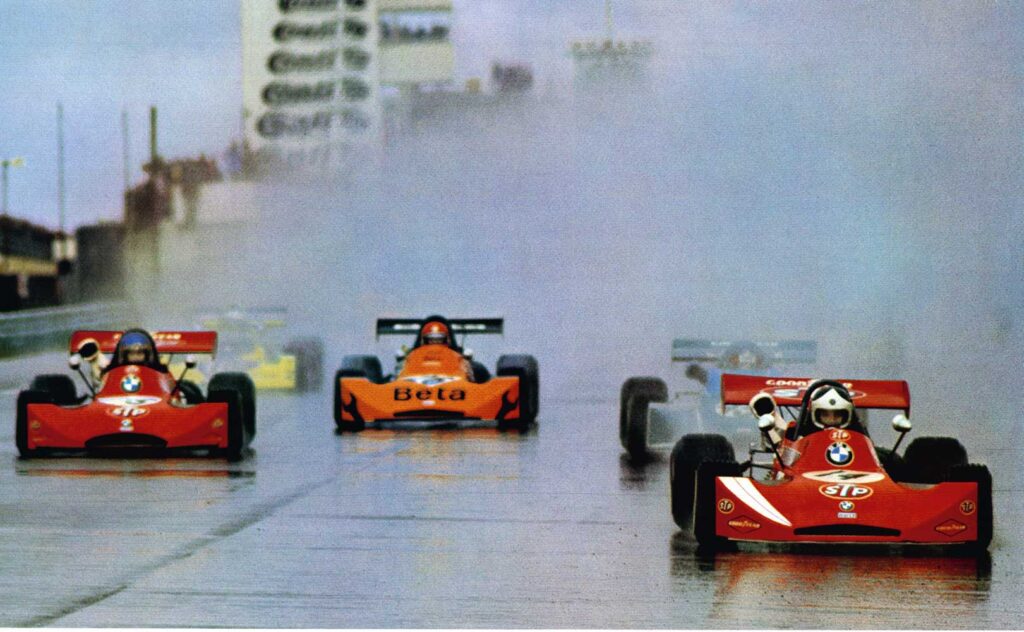
The company achieved surprising success. With the March-BMW, which was slightly superior to the competition equipped with Ford units in terms of engine power, the Italians had bet on the right horse. Furthermore, Vittorio showed unusual discipline. Even on the extremely difficult Nürburgring-Nordschleife, in pouring rain at the Eifelrennen, he made no mistakes. Throughout the season, he successively improved. Just before the end of the season, he took the lead twice in a row in the European Championship races at Salzburgring and Albi and ultimately finished third in the final standings.
At Beta, there was great joy over the unexpected advertising medium – now the tool manufacturer wanted to go into Formula 1 with Vittorio. A good opportunity arose at the start of the 1974 season with March, where the American oil company STP had pulled out after four years of sponsorship and increasingly poor results. For the moment, a driver's dowry counted more than his reputation there. And Vittorio could offer a bit of everything at that time. Thus, his sponsors could buy him into a team for the equivalent of around DM 450,000, a team that was struggling to keep up both sportingly and economically. At 36 years of age, he was a decidedly late bloomer in the Formula 1 scene of the early 70s. And March was not exactly the team of unlimited possibilities.
This starting situation built up some pressure within him, which manifested in an increasingly aggressive driving style, bordering on and exceeding the limits of „crashing.“ He was the one who would „decahedrally“ brake his tires before corners, trying to stay with the leading group with all his might, and who repeatedly came back without the front of his car. „A thoroughly respectable man, as long as he's not in the cockpit,“ the Austrian motorsport journalist and multiple book author once characterized him, „only then do all his fuses blow, and madness seizes the steering wheel.“ Vittorio himself, however, stated in the mid-70s: „I have no problems, and I don't create problems for myself. My wife, my two sons, and my daughter are proud of me – what more could I want?“
Vittorio Brambilla achieved a Grand Prix victory with his car's nose on an angle!
He likely had a greater share in advancing the cars technically, up to and including pole position at the 1975 Swedish Grand Prix in Anderstorp. And undoubtedly, he also drove good races. But the bottom line was few quantifiable results. It was symptomatic of the course of his Formula 1 career that he achieved his only victory – at the 1975 Austrian Grand Prix with the March 751-Ford Cosworth V8 – in a race that was prematurely stopped due to numerous accidents in heavy rain and was only awarded half points. And for him, too, the checkered flag came none too soon: he crossed the finish line with the car's nose angled…
His move to Surtees in 1977 improved neither his situation nor, even less so, that of the Surtees team. The wreck would have found a new parking spot, malicious tongues soon sneered. However, at the Belgian Grand Prix in Zolder, he drove one of the best races of his career in the Surtees TS 19-Ford Cosworth V8, even leading for four laps in changing weather conditions, and finally finished fourth – a rather flattering result for the Surtees-Ford. His seemingly endless series of accidents, on the other hand, made his respected team boss, John Surtees, turn gray. When his „wild soul“ was massively stopped in the infamous starting pile-up at the 1978 Italian Grand Prix in Monza, Vittorio was not to blame for once. Hit by a flying wheel, he was recovered with a fractured skull and bruised brain and was in mortal danger for some time. While the accident did not mark the immediate end of his racing career, his return in 1979 in the cockpit of the second Formula 1 Alfa Romeo clearly lacked its former brilliance. In 1980, after the Italian Grand Prix in Imola, he retired from racing as a driver. After his retirement, he continued to run his car workshop in Monza and served for years as a motorcycle escort rider in the Giro d'Italia.
His childhood sweetheart Daria had married Vittorio in 1962. She became the mother of his daughter Dormatella and his two sons Carlo and Roberto. In 1983, he founded a Formula 3 team for the 21-year-old Carlo to compete in the Italian Championship and some European Championship races. However, Carlo did not have a particularly notable career in motorsport thereafter. On May 26, 2001, Vittorio Brambilla died at the age of 63 while mowing the lawn in the garden of his home in Monza after suffering a heart attack.
Never miss an exciting article about historic motorsport again! Get your Curbs subscription. ALL images conveniently home – directly via our Online store