„Rodriguez sets the example, and we followed.“
The relentless advancements in race car technology also saw average speeds at Spa-Francorchamps increase horrendously throughout the 1960s – on a circuit of closed-off public roads that had fundamentally remained unchanged since 1951. By the end of the decade, the average lap speeds of the fastest racing cars of that era were between around 230 and 240 km/h, and at the end of „Masta Straight“ before the village of Stavelot, they reached top speeds of 300 km/h and more, whizzing past a row of telegraph poles standing immediately at the roadside – no further words needed.
„It was with great satisfaction that I achieved a perfect round there.“
Even limiting the Formula 1 engine displacement to its lowest value in history at a „small“ 1,500 cc (1961-1965) and consequently initial engine outputs of 80 HP or more, could not slow down the speed increases at Spa for long. Even the average race speed of the winner of the 1961 Belgian Grand Prix, Californian Phil Hill in the „shark-mouth“ Ferrari Tipo 156 V6, at 206.2 km/h was less than ten km/h slower than the winner of the previous year, Jack Brabham in the 2.5-liter Cooper T53-Climax 4. And just one year later, the qualifying record of Englishman Graham Hill in the 1.5-liter BRM Type 57 V8 at an average of 214.2 km/h was already very close to Brabham's 1960 race average (215.4 km/h). Phil Hill, the winner in 1961, was among those who apparently felt particularly comfortable on the fast track. „I really loved that track,“ he once explained, „because it was very fast and required high precision at the wheel. It was incredibly satisfying to nail a perfect lap there. I only raced at Spa in the Ardennes Forest a handful of times, similar to the Nürburgring woods, but it was just as beautiful as it was challenging.“ In stark contrast, Scottish driver Jim Clark, the benchmark driver of that Formula 1 era, always harbored a strong aversion to Spa, having narrowly missed crashing into his fellow racing driver Chris Bristow, who lay dead on the track, in his very first Formula 1 Grand Prix there in 1960. In his eight Formula 1 appearances at Spa between 1960 and 1967, he only started from the front row twice – yet he still won the Belgian World Championship race in Lotus-Climax V8 versions from midfield starting positions, even four times in a row, twice in the rain in 1963 and 1965, and in 1963 with an almost unbelievable 4 minutes and 54 seconds lead over New Zealander Bruce McLaren in the Cooper T66-Climax V8.

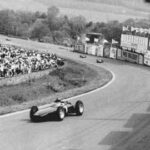
In the 1960s, the stars of two Belgian local heroes also rose in top-level motorsport at Spa-Francorchamps. The first to gain prominence was Willy Mairesse, born in 1928 in Momignies, near the French border, who had already won a GT race at Spa in 1957 with a Mercedes 300 SL. In 1961, he triumphed again as the GT winner in the „Grand Prix de Spa“ with a factory Ferrari 250 GT SWB, achieving an incredible average speed of 193.6 km/h. The following year, as a works Ferrari driver, he entered the Belgian Formula 1 Grand Prix in a „shark-nose“ Tipo 156 V6. He had surprisingly won the non-championship Formula 1 races in Brussels and Naples at the start of the 1962 season in identical cars, and now he was in Spa – in front of his home crowd, full of determination – starting from sixth place on the grid, two-tenths of a second slower than reigning world champion Phil Hill in a Ferrari.
„THEN THE FERRARI SAVED MY LIFE“
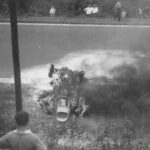
In the race, he then had a devastating collision with the Briton Trevor Taylor in the factory Lotus 24-Climax V8, which Taylor described years later: „I was leading for a few laps until my rear brakes locked up and I had to go into the runoff area at ‚La Source‘. Clark in the new Lotus 25 passed me, and I subsequently got into a fierce battle for second place with Willy Mairesse behind me. He was a bit faster up the hills from ‚Stavelot‘ towards ‚La Source‘, and on one lap he got very close to me in the last left-hand bend before ‚La Source‘. His car's nose nudged my gearbox, which shifted into neutral, my engine revs shot up sky-high, and the car spun out to the side. Then the Ferrari saved my life, touching me on the inside once more and pushing my car straight again, otherwise I would have flown directly into an embankment. Instead, I spun into a ditch, while Willy hit a telegraph pole, the Ferrari somersaulted several times and burst into flames.“
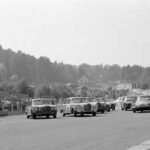
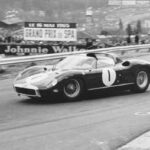
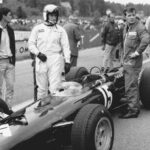
Trevor Taylor was able to limp away, but the driver Mairesse, who was rescued, spent several weeks in the hospital until his complete recovery. „He lived in his own world, do it or die,“ Taylor shouted after the Belgian, who took his own life in Ostend in 1969. „He was a good driver, but he wanted to become champion too quickly.“ The American Peter Revson, also a repeated Mairesse competitor at Spa, described him as follows: „He sat in the car at Spa with a furrowed face, protruding eyebrows, and eyes that changed color – a bit like the devil himself.“ Willy Mairesse achieved two major overall victories at Spa in the 500 km race in 1963 and 1965, in a Ferrari GTO and a Ferrari 250 LM respectively, with a race average of 203.7 km/h in the latter. However, he also caused further accidents in the rain-soaked 1000 km races in 1967 in a Ferrari 330 P3/4 and in 1968 in a Ford GT 40, both entered by Ecurie Francorchamps.
ER „SHARED“ WATERFRONTS LEGALLY
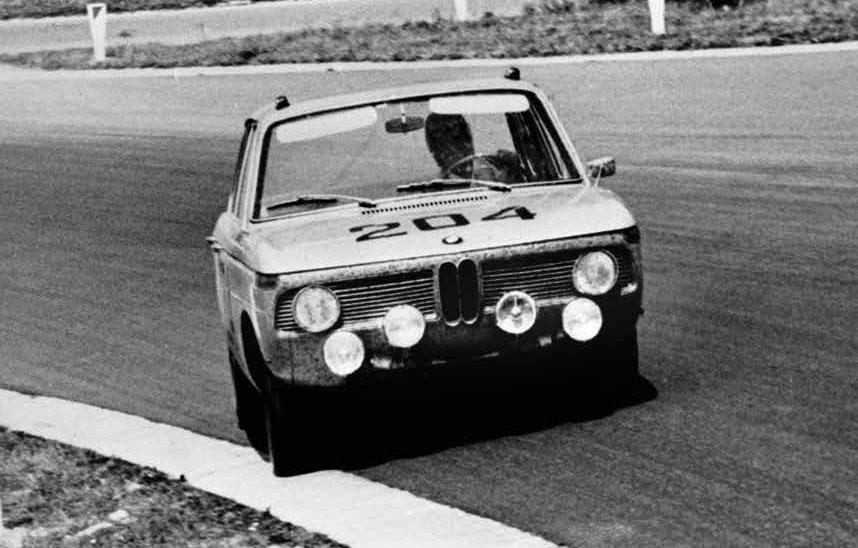
As his star was already setting, Jacky Ickx, born in Brussels in 1945, became the new Belgian national hero in his early twenties, performing in these very two 1000km races with a masterful driving style that seemed like a twilight of the gods – he practically „divided“ the watery track sections. With the Mirage M1, he already won the overall classification in irresistible fashion in 1967, supported by the American Dick Thompson, with the Gulf team fully utilizing Ickx's allowed maximum steering time per turn of three hours straight, as per regulations; ultimately, Ickx was in the car for over four hours in total until the checkered flag... In 1968, in the Gulf-Ford GT 40, he essentially outdid himself again in pouring rain. He returned from the first lap with a 30-second lead, after the second with a minute (!), and after 20 laps, he had lapped all competitors except for second place, Gerhard Mitter in a Porsche 907. He and the Englishman Brian Redman won completely unchallenged by a lap and a half over Mitter/Jo Schlesser in the factory Porsche 907. Additionally, Ickx triumphed alongside Hubert Hahne in the 1966 24 Hours of Spa in a factory BMW 2000 TI, and he won the „Coupes de Spa“ for touring car racing three times on a Ford Mustang and Ford Falcon Sprint in 1966, '68, and '69.
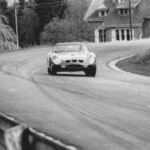
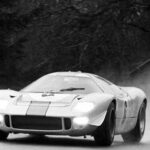
Adverse or changing weather conditions already presented particular challenges at Spa due to the track's approximately 14-kilometer length; one of these was the slippery manhole covers on the roads when it rained. Legendary is the opening lap of the 1966 Belgian Grand Prix, when the field went into the race on dry tires at the start-finish straight, but then in the Malmedy-Stavelot section of the track, a thunderstorm downpour „washed“ eight cars – nearly half the starting field – off the track. By some miracle, only one driver was more seriously affected—Jackie Stewart, who had finished second to Jim Clark in the same spot the previous year. He was trapped in his bent BRM for 30 minutes and had the great fortune in his misfortune that other drivers rushed to his aid. „I was trapped in the car, doused in gasoline,“ he once described. „There were no marshals, no medical assistance. Graham Hill and Bob Bondurant, who had also skidded off, unscrewed my steering wheel with borrowed wrenches and helped me out of the car. I had to wait another half hour for the ambulance, and on the way to the hospital in Liège, the driver even got lost... In my case, this accident motivated me to make the sport safer.“
„WHEN I FIRST CAME TO SPA, I THOUGHT, ‚YOU'RE IN THE WRONG BUSINESS.‘“
The Englishman Brian Redman, who always „woke up soaking wet with sweat“ on a race morning in Spa, nevertheless became a Spa specialist at the end of the 60s with three consecutive wins in the 1000 km races and a win in the 500 km in 1970. „When I first came to Spa in 1966 to drive a Ford GT 40 with Peter Sutcliffe, I was close to retiring from motorsport after Friday practice,“ he declared. „I thought I could drive anything anywhere. But when I came to Spa, I thought, ‚You're in the wrong business.‘ I couldn't believe the speed, over 300 km/h on public roads without guardrails.“ In the 1968 Belgian Grand Prix, on the seventh lap in the fast „Les Combes“ corner, the suspension on his Cooper-BRM broke on the front right. The car slid along a concrete barrier, Redman's right arm getting trapped between the barrier and the car, and crashed into a Vauxhall Velox in a parking lot. Marshals, however, recovered him alive. „I was already in the half of the drivers who wore seatbelts, otherwise I would have been dead,“ Redman continued. „In the hospital in Liege, the doctor told me, ‚We most likely won't be able to save your right arm.‘ I thanked him and laughed. ‚Why are you laughing?’ the doctor asked. ‘Because I'm here,’ I replied.“ The badly broken arm was indeed saved by surgery with steel parts, and Redman was able to continue his very successful racing career from 1969 onwards – and, among other wins, won the 1000 km Spa again in 1972 in a Ferrari 312 PB...
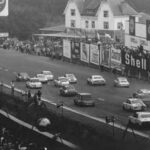
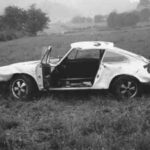
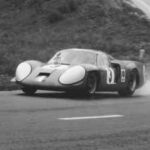
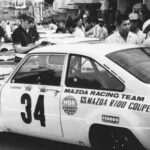
In 1967, his compatriot Mike Parkes had also survived a serious crash at Spa, in a Formula 1 Ferrari Tipo 312 during the Belgian Grand Prix. But the circuit also claimed victims in this decade, beyond motorcycle racing on four wheels: in 1964 Pierre Frescobaldi in a Lancia Flavia (24h Spa), in 1965 Tony Hegbourne in an Alfa Romeo Giulia TZ (500 km Spa), in 1967 Karl-Heinz Thiemann in a Formula Vee Apal, Wim Loos and Eric de Keyn in their Alfa Romeos (24h Spa), and in 1969 Léon Dernier („Elde“) in a Mazda Coupé (24h Spa). In 1969, the Grand Prix Drivers Association (GPDA), the club of Formula 1 drivers, achieved the cancellation of the Belgian Formula 1 Grand Prix and demanded improvements to track safety. When they returned in 1970, Jochen Rindt drove the track with Austrian journalist and author of the yearbook series „Grand Prix Story,“ Heinz Prüller, and dictated into his notepad: „Spa is stupid at any speed. Until a year ago, the track safety was zero. If something goes wrong with the car, there's oil on the track, or something else happens, we'll hit the embankment or the forest with one hundred percent certainty. The chance of survival is very low. That's why the GPDA arranged for guardrails to be installed and for us not to race in the rain. Unfortunately, only 70 percent of the required minimum was met. But Spa will never be safe; it will only be safe when we move to another racetrack.“

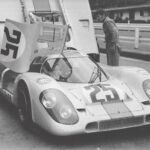
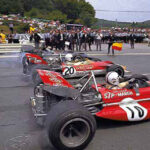
The Mexican Pedro Rodriguez in the BRM P 153 V12 won this 1970 Belgian Grand Prix, the last Formula 1 race on the old Spa-Francorchamps circuit, with a race average of no less than 241.3 km/h. Three weeks earlier, he had completed the first lap at Spa in under 3:20 minutes during practice for the 1000 km of Spa, clocking in at 3:19.8 with an average speed of 254.1 km/h. In that very same practice session, the Germans Helmut Kelleners and Jürgen Neuhaus secured fourth place on the grid with a private Porsche 917 in 3:29.7. „Pedro Rodriguez showed us how it was done,“ Jürgen Neuhaus once explained, „and we simply followed suit.“
Perhaps that's how the cockpit perspective had to be, or could have been, back then; there was simply no alternative for success at Spa.