
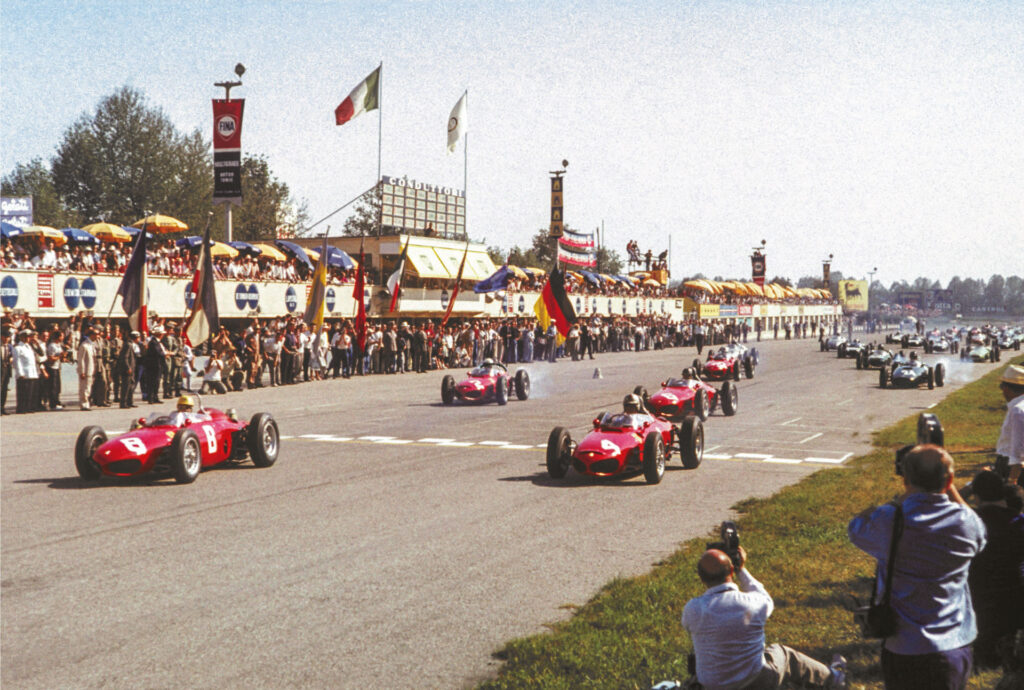
One of the most beautiful Formula 1 cars ever Ferrari 156 Sharknose is remembered by most motorsport fans. This is mainly because not a single original example survived, the car was virtually unrivaled in the 1961 season, and the car is tragically associated with the memory of Wolfgang Graf Berghe von Trips for many enthusiasts. However, since 2017, two authentic replicas of the Ferrari 156 Sharknose have been revitalizing the classic motorsport scene - these are the vehicles of Jason Stuart Wright.

Foreword: Commendatore Enzo Ferrari long adhered to the classic concept of the front-engined racing car. It was not easy for him to abandon his company's technical tradition and start from scratch with mid-engined racing cars without relevant experience. The well-known Italian trade journalist Gino Rancati, biographer and close confidant of the Commendatore, knew his favorite saying: „The horse must pull the cart, not push it.“ Therefore, Ferrari lost valuable time in the development towards the changed drive concept. Rancati: „Ferrari did nothing to advance the rear-engine idea; he initially kept looking for new reasons to delay its appearance.“ As a preamble to the Ferrari 156 Sharknose, it should be noted that long before the laws of aerodynamics and restrictive regulations dictated the design of a Formula 1 car to the point of uniformity, the constructions of the racing teams differed greatly.
Among the most striking Grand Prix racing cars is undoubtedly the Scuderia Ferrari's Tipo 156 Sharknose. The legendary car's story, strictly speaking, began on October 29, 1958, the day Ferrari driver Mike Hawthorne was honored for winning the Formula 1 Drivers' World Championship, and Tony Vanderwell accepted the trophy for the best team, Vanwall. As soon as the applause from those present died down, Auguste Perouse spoiled the evening for the predominantly British guests.
The Sharknose consumed one liter less
The CSI president announced what a seven-member panel had previously concocted behind closed doors: Starting in 1961, the maximum cylinder capacity of Formula 1 engines would no longer be 2.5 liters, but rather 1.5 liters. The decision was made by a vote of 5 to 2. The new formula was met with rejection only by the British and – not insignificantly – also the Italian representatives. While the England-based teams didn't quite believe the prescribed upgrade to the voiturettes, Ferrari straightforwardly tackled the new project from then on: designer Carlo Chiti initially focused on a second generation of the in-house Formula 2 engine, which had originated in 1957 as a „reduction“ of the 2.5-liter six-cylinder. In 1960, the engine was put to the test in Monte Carlo as the power source for a mid-engine design – a „prototype“ of the Tipo 156. It was the 246P, with a tubular frame and independent suspension. The V6 engine had a displacement of 2417 cc and produced around 280 hp. The car was only used in the Formula 1 World Championship race on May 29, 1960, in Monaco.

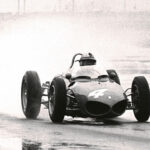
Test driver Richie Ginther finished sixth in his GP debut. A week later, at the Dutch Grand Prix in Zandvoort, Trips drove the 246P in practice, but started the race with the front-engined dinosaur, a Type 246 F1. Prior to this, Wolfgang Graf Berghe von Trips had driven this car to victory at the Formula 2 Gran Premio di Siracusa on March 19th. And the Rhenish nobleman also secured first place at Solitude. Behind him followed an armada of four Porsches – Trips' teammate Phil Hill finished seventh.
Last Triumph of the Front Engine
In Zandvoort, Ferrari wanted to get a taste of Formula 1 air again with the „little one,“ but a fire put an end to the engine before the race. Of course, besides the race entries, there was diligent testing in Modena, where in addition to the works drivers, Ferrari's test pilot, the Italian Martino Severi, was also used. At the home Grand Prix in Monza, Commendatore Enzo Ferrari initially wanted to rely on sheer power and therefore forgo the comparatively less powerful 1.5-liter car. But when the British teams boycotted the Italian Grand Prix, there was room for another „test under race conditions“ due to the lack of competition. The car was entrusted to Graf Trips, and he did his job well. His Belgian stablemate Willy Mairesse pulled the mini-racer out of the opponents' reach in the slipstream. The race would have ended with a quadruple triumph for the Scuderia if von Trips had not made an unnecessary pit stop to check the tires. Thus, the last triumph of the front-engine dinosaurs.
Even with the Sharknose, engine power isn't everything.
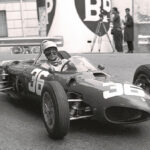
On October 2nd of that year, the imperial count drove the interim car to third place in Modena. Despite the satisfactory test phase, Carlo Chiti began again in the winter of 1960/61 with a blank sheet of drawing paper: the 65-degree V6 engine was replaced by a new unit with a cylinder angle of 120 degrees. This not only lowered the center of gravity but also provided sufficient space between the cylinders for carburetors from various manufacturers or, alternatively, an injection system. Designed as a pure 1.5-liter, metal could be saved on many components, which accordingly reduced the weight. The 65 and 120 were used in 1961 and 1962, each in two variants with different bore and stroke ratios. In parallel, the 156 took on its final form with the characteristic front end, which quickly earned it the nickname „Sharknose.“ Before the start of the 1961 World Championship season, the Monaco Grand Prix, seven F1 races took place without championship status. Scuderia Ferrari was conspicuous by its absence each time. Then, in mid-May, the Italians let the cat out of the bag in Monaco. Theoretically, neutral observers had to bet on „red,“ as the three Tipo 156 cars for Phil Hill, Wolfgang Graf Berghe von Trips, and Richie Ginther had engines that developed approximately 15 percent more power than those of their rivals. However, despite the power disadvantage, Stirling Moss drove his Lotus-Climax to victory thanks to superior driving skill.
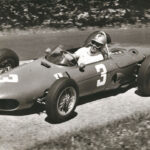
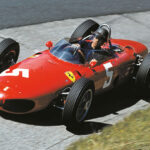
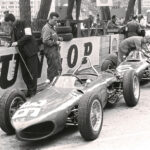
Quadruple victory for the 156 „Sharknose“
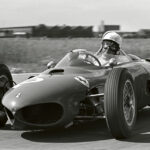
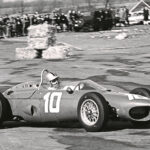
But Ferrari did not leave that Sunday winless. On the Posillipo Circuit, Giancarlo Baghetti, which should once again attract positive attention in 1961, at the wheel of a 156, the Grand Prix of Naples. In Zandvoort, the Netherlands, on the extremely demanding dune circuit, Moss could not repeat the feat shown in Monte Carlo. Trips won ahead of his teammate Hill, and it became clear that the Ferrari pilots would fight for the world championship title among themselves. Anyone who initially did not want to follow considerations of this kind was, at the latest, on the then still 14.1-kilometer-long street circuit of Spa-Francorchamps corrected in the Belgian Ardennes: Ferrari fielded the Belgian Olivier Gendebien in addition to the three named works drivers, to whom Enzo Ferrari entrusted a 156 painted yellow. The rivals stood no chance against this quartet: Hill, von Trips, Ginther, and Gendebien crossed the finish line in first to fourth place, respectively, in their four shark noses after good two hours.
Ferrari newcomer wins
On the ultra-fast track of Reims in Champagne, under scorching heat, all evil forces seemed to have united against Ferrari. Instead of delivering another power-demo à la Spa, the favorites faltered: Trips retired with an overheated engine after a stone had smashed his Ferrari's radiator. Hill spun on molten asphalt at Thillois, stalled the engine, and was consequently set back decisively. Ginther took the lead, but then came into the pits fearing a major engine failure. The team sent him back into the race. Shortly thereafter, the American's fears came true. But Ferrari still had an ace up its sleeve, the Naples winner Baghetti, who was allowed to fight for points in the World Drivers' Championship for the first time. In a memorable duel, the newcomer prevailed by a tenth of a second (measurements were not more precise back then) against the Porsche driver Dan Gurney.
Climax: Competition arrived
With a one-two-three victory in the rain-drenched British Grand Prix at Aintree, Ferrari made up for the near-miss at Reims at the very next opportunity. The finishing order was Trhips, followed by Phil Hill and Ginther. On the Nordschleife came into play at the Nürburgring, the most demanding of all race tracks, the Moss factor, just as it had in Monte Carlo. The Brit showed the two Ferrari drivers, Trips and Hill, that virtuosity in the cockpit can make up for a lack of horsepower. Moss won the race convincingly ahead of the local hero and his American teammate. In the shadow of the duel between the two red title contenders, the future knocked on the door of the pit lane. Jack Brabham, with a Climax eight-cylinder engine – the English answer to the Ferrari engine – at his back, secured the second-best starting position. However, he was unable to demonstrate the potential of the new engine in the race, as the Australian slid off the track a few kilometers after the start in the Hatzenbach section.
Monza Drama and Disappointments for the Sharknose
What followed was the tragedy at Monza. On September 10, von Trips, the championship leader who had secured his first F1 pole position the day before, was killed in a crash caused by a momentary lapse in concentration. Phil Hill won the race and secured the title. The Scuderia, still in shock, did not compete in the season-ending U.S. Grand Prix. Of course, the British were „not amused“ by Ferrari’s dominance, and many believed they had fallen victim to a conspiracy. What the proponents of this conspiracy theory forgot, however, was that the Italian CSI delegate had originally spoken out against the 1.5-liter formula… In retrospect, one thing is clear: The car’s handling weaknesses were masked in 1961 thanks to the superior engine. Here, too, those in charge should have intervened, but Forghieri later said on this subject that, for him, the engine had been the focus of his interest at the time. As for the chassis, the transmission, and other components of the package, the years 1962 through 1965 were a „learning period.“ In any case—compared to the gala performance of the previous year, the results the following year were bitterly disappointing. Even when Innes Ireland was allowed to drive a Sharknose in Walker colors at the International Trophy in Silverstone before the start of the 1962 season, the Scot criticized the Ferrari’s handling—at least on a wet track—as rather modest. Stirling Moss had been forced to end his career shortly before following a serious accident. The racing season turned into a nightmare for the defending champions. Rob Walker, Stirling Moss’s team boss, could not imagine that the British manufacturers would be able to mount a swift counterattack against the red dominance. He reached an agreement with Enzo Ferrari and ordered a „Haifi schnase“ for 1962, to be painted in Walker colors. Even before preparations for the upcoming season were in full swing, racing director Romolo Tavoni, engineer Carlo Chiti, and key staff members left Scuderia Ferrari following a dispute to establish their own team, ATS.
„Industrial problems“ held the Sharknose back in two Grand Prix races.
Angelo Bellei and the young Mauro Forghieri, who actually wanted to earn his money in the US as an aircraft engineer, took on the modification of the Tipo 156 for 1962. The focus was on a new cylinder head for the 120-degree engine, a revised six-speed gearbox, a slightly altered rear end, and minor changes in the rear suspension area. Swept aside by the reawakened British, the grapes were too high for Ferrari. Consolation prizes were won in Zandvoort, where Phil Hill finished third, in Monte Carlo, where Hill and Lorenzo Bandini were allowed onto the podium alongside the victorious Cooper driver Bruce McLaren, and in Spa, where Hill secured another third place. Otherwise, mediocrity in the midfield and the absolute low points: In France, the Scuderia had to forfeit because Italian metalworkers were on strike. In Aintree, the frustrated Italians competed with only Phil Hill instead of the planned three drivers, and he didn't finish. At the Nürburgring, numerous chassis modifications initiated by Forghieri did not bring the hoped-for breakthrough. Only Ricardo Rodriguez provided a bright spot in driving when he took a car with the original 65-degree engine to sixth place. The one-two finish by Lorenzo Bandini and Giancarlo Baghetti, achieved at the non-championship GP at Enna-Pergusa, could not make up for the disappointment, especially since none of the five Ferrari aces shone at the home GP in Monza. Willy Mairesse still finished fourth, followed by his teammate Giancarlo Baghetti in fifth place, but this was nowhere near meeting the demands of the employer and the Tifosi. A few days later, the Ferrari drivers received a letter from the Commendatore. He informed them that the Scuderia would forgo participation in the Grands Prix in the US and South Africa due to „industrial problems.“.
Bring Curbs' #50 and the Goodwood Revival right to your home—directly through our Online store
Photos: Bernard Cahier, Josef Reinhard, Jörg-Thomas Födisch Archive, Jochen von Osterroth, Hartmut Lehbrink