
First published on curbs-magazin.com
Originally published on curbs-magazin.com – now part of slickpix.de.
The 300 SLR
When Mercedes-Benz entered the 1955 sports car world championship with the 300 SLR at the Mille Miglia on May 1, 1955, two races for the championship had already been run. However—and this would prove to be not disadvantageous for Mercedes-Benz in retrospect—there had already been different winning marques. It was also the case that the first race, the 1000 km Buenos Aires on January 23, had hardly been the focus of works teams. Only Ferrari and Gordini had competed from this circle, but Aston Martin, Jaguar, and Maserati, for example, had not, particularly with regard to the valuable overall classification points. Furthermore, since only the four best results from each marque out of the six championship races at the end of the season would be taken into account for the final point standings, Mercedes-Benz's starting position with its late entry and exactly four remaining races was indeed not as bad as it might have appeared on paper.
In Buenos Aires, Ferrari earned the first eight championship points for a victory, with private local teams and drivers exclusively occupying the podium places; Enrique Saenz Valiente/José-Maria Ibanez in a 375 Plus and Carlos Najurieta/César Rivero in a 375 MM celebrated a Ferrari one-two finish. Third place went to their compatriots José M. Faraoni/Ricardo Grandio in a two-liter Maserati A 6 GCS. The 80-car field for the 12 Hours of Sebring on March 13 also consisted, *de jure*, of more than 90 percent private teams. However, *de facto*, they often had some factory support, at least in terms of being equipped with the latest sports car creations and receiving advisory expertise, if not even support with the occasional factory driver. This also applied to the overall winners, Englishman Mike Hawthorn and American Phil Walters, in a Jaguar D-Type from Briggs Cunningham's professionally run US racing team. Second place went to Americans Phil Hill and Carroll Shelby in the new Ferrari 750 Monza from Allen Guiberson's racing stable, ahead of their compatriots William Spear/Sherwood Johnston in the also new Maserati 300 S, which the former had entered privately. Ferrari now led the championship with 14 points, followed by Jaguar and Maserati with eight points each.
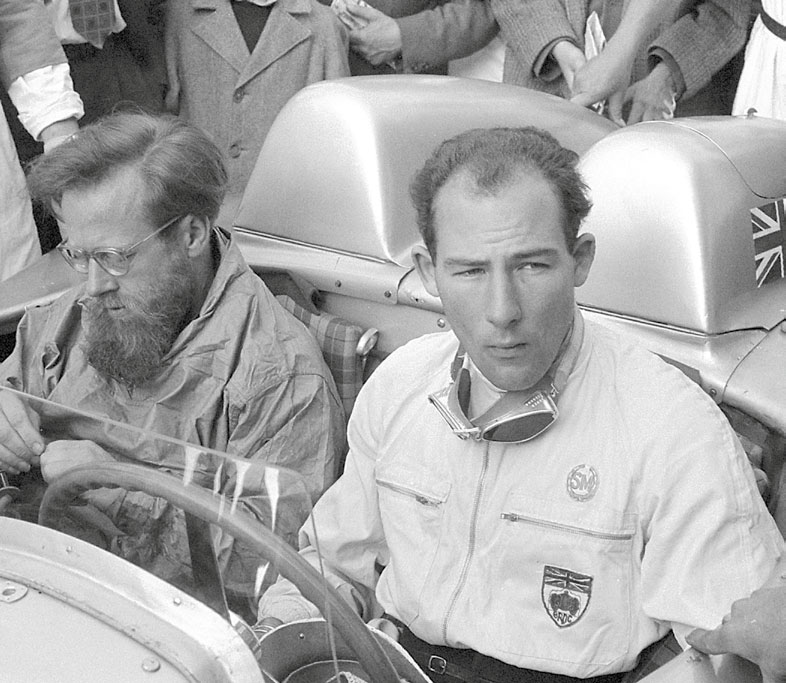
signals the next curves from his paper roll with hand gestures
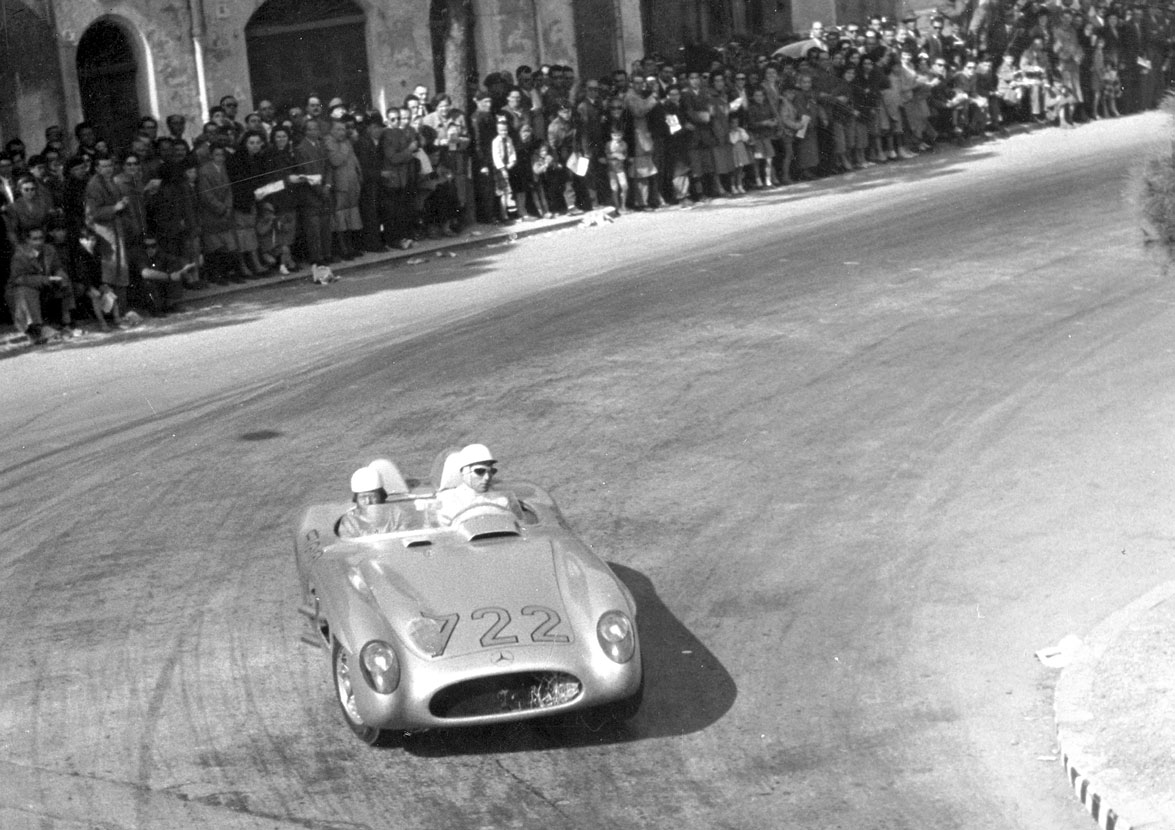
Then Mercedes-Benz appeared for the infamous 1000-mile race over public roads between Brescia and Rome, starting and finishing in Brescia, bringing no fewer than four 300 SLRs with them. In the traditional „race against the clock,“ where the 534 starters (!) in twelve classes were individually sent off the starting ramp in Brescia one after another on May 1, 1955, the young Italian Eugenio Castellotti initially took the lead in a privately entered 4.4-liter Ferrari 121 LM. In Ravenna on the Adriatic coast, he already had a two-minute lead over the new Mercedes star Stirling Moss. Although it was already Moss's fifth Mille Miglia start, he almost blindly trusted his compatriot next to him, the journalist Denis Jenkinson, who tirelessly signaled the upcoming corners to him by hand from his paper roll as they drove. In contrast, the also Mille Miglia-experienced Juan Manuel Fangio and Karl Kling drove their Mercedes 300 SLRs alone, while Hans Herrmann, no longer a Mille Miglia novice either, also trusted co-driver Hermann Eger with the route details in his notebook.
On the way to Pescara, Castellotti's battered Ferrari had enough of its driver's „kicking,“ and Moss took the lead. By this time, Paolo Marzotto's well-started factory Ferrari 118 LM had already retired due to a tire failure. This left the factory Ferrari 118 LM driven by the Italian Piero Taruffi as the only serious Mercedes competitor at the front. He promptly set a new Mille Miglia record on the sprint leg to Pescara with an average speed of over 209 km/h. In L'Aquila, Moss was 35 seconds ahead of Herrmann, followed by Taruffi, Fangio, and Kling, all Mercedes among the top five. However, engine problems were starting to show for Fangio. At the „turning point“ in Rome, Moss led by one minute and 15 seconds over Taruffi. A little later, Karl Kling swerved to avoid some spectators, crashed into a tree, and broke several ribs.
In the mountains on the way to Siena, Taruffi dropped out with a broken oil pump, leaving only the three Mercedes teams to compete among themselves. Moss/Jenkinson were five minutes and 40 seconds ahead of Herrmann/Eger. The Mercedes mechanics checked Fangio's car, whose engine was only running on seven cylinders due to a broken fuel injection line. On the way to Florence, Hans Herrmann attacked Stirling Moss again, who could only increase his lead by another eight seconds on this stage. However, Herrmann/Eger's fuel cap had not been properly closed during the last refueling stop in Rome. On the way to Bologna over the feared Futa Pass, it popped off, and Herrmann and Eger were increasingly showered with fuel. When Hans Herrmann got a splash of fuel in his eyes, he scraped a rock face, spun, and was out. Thus, Moss/Jenkinson won with a new Mille Miglia record of ten hours and seven minutes, ultimately 32 minutes ahead of Fangio and 45 minutes ahead of the factory Ferrari 118 LM of Italians Umberto Maglioli/Luciano Monteferrario. New standings in the World Championship: Ferrari 18 points, Maserati 11, Jaguar and Mercedes 8 each.

In the lead, but leaving at 2 AM
The 24 Hours of Le Mans on June 11-12 was then severely overshadowed by what is recognized as the biggest disaster in motorsport history. Mercedes-Benz entered three 300 SLRs driven by the teams of Juan Manuel Fangio/Stirling Moss, Karl Kling/André Simon, and Pierre Levegh/John Fitch. Hans Herrmann was recovering from serious injuries sustained in a practice accident with the Mercedes Formula 1 car at the Grand Prix of Monaco and would miss the rest of the season. The hiring of the French drivers Simon and Levegh, who were not regulars behind the wheel, with Levegh also being famous for nearly winning the 1952 Le Mans race alone for 23 hours in a Lago Talbot, was a tribute from Mercedes-Benz to the French public.
Two hours after the start of the race, which was characterized in the early stages by a hard duel between Fangio in the Mercedes and Mike Hawthorn, who was then leading in the Jaguar D-Type, an unfortunate chain of individual reactions occurred on the finishing straight among a pack of cars. In the heat of battle with Fangio, Mike Hawthorn had likely also missed several pit signals that should have ordered him in for his scheduled refueling stop. At the beginning of the 35th lap, after overtaking Lance Macklin's Austin-Healey on the finishing straight, he suddenly braked abruptly and steered across in front of him into the pit lane, which was not yet separated at the time. Macklin was forced into a spontaneous and unpredictable evasive maneuver to the left, thereby touching the Mercedes 300 SLR of Pierre Levegh, which was already halfway alongside him. Levegh's car crashed into the trackside barrier, sending the car and parts of it into the spectators. The leaking fuel caught fire, setting the entire accident site ablaze. The Frenchman and over 80 spectators lost their lives.
Fangio, who was closely behind Levegh, miraculously passed the accident site unharmed. He later explained that Levegh had warned him with a hand gesture. At midnight, the two Mercedes cars driven by Fangio/Moss and Kling/Simon were leading. However, at two in the morning, Mercedes engineer Rudolf Uhlenhaut received a call from Stuttgart ordering the cars to be withdrawn from the race. The Jaguar D-Type driven by Mike Hawthorn/Ivor Bueb won, followed by the Aston Martin DB 3 S of Peter Collins/Paul Frère and another D-Type driven by Belgians Johnny Claes/Jacques Swaters. In the standings, Ferrari was now leading with 18 points, followed by Jaguar with 16, Maserati with 11, and Mercedes with 8.
Three laps before the checkered flag fell, the Jaguar stopped with engine damage.
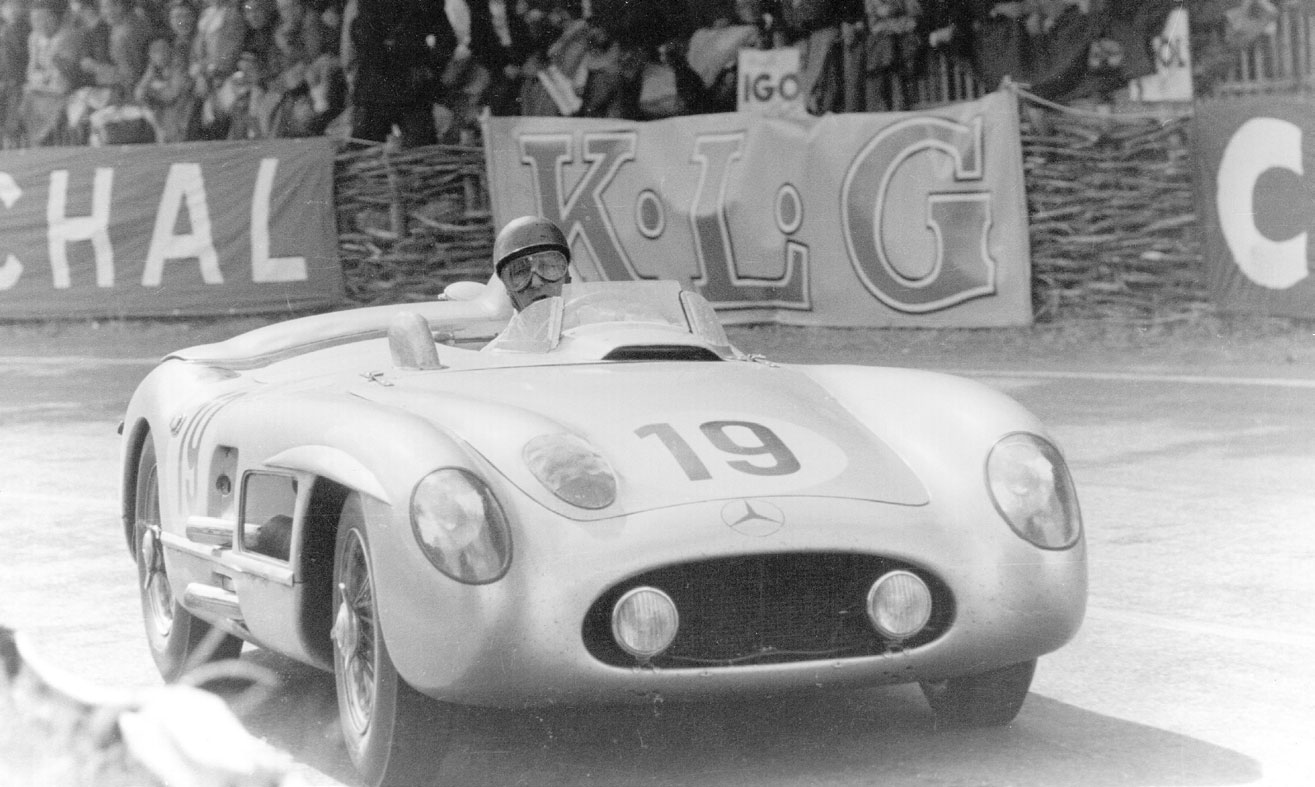
For the RAC Tourist Trophy on September 18th, on the nearly twelve-kilometer, challenging, and dangerous narrow road circuit around Dundrod in Northern Ireland, Stuttgart entered three 300 SLRs, crewed by Fangio/Kling, Moss and the American John Fitch, as well as André Simon and the young, talented German Count Wolfgang von Trips, who here received his first chance in a top-class racing car in a World Championship race. In a field of 55 cars, 15 manufacturers were already factory-engaged. The practice results also heralded another Mercedes-Jaguar duel. Moss/Fitch (4:48.0 minutes) had captured pole position ahead of Mike Hawthorn/Desmond Titterington in the D-Type (4:49.0). Von Trips/Simon started the race from seventh grid position.
The race was scheduled for 84 laps, covering a total distance of nearly 1,000 kilometers. It started in good weather, but later on, increased rain added to the danger on a track with no room for error. After the flag dropped, Moss in the Mercedes and Hawthorn in the Jaguar were in a world of their own, pulling away from everyone else. Hawthorn set the fastest lap of the race with an average speed of over 150 km/h, madness on that circuit. When Moss was leading by a minute and a half, his right rear tire burst, damaging parts of the bodywork as well. However, he somehow made it to the pits, where the mechanics changed the tire and removed the flapping body parts.
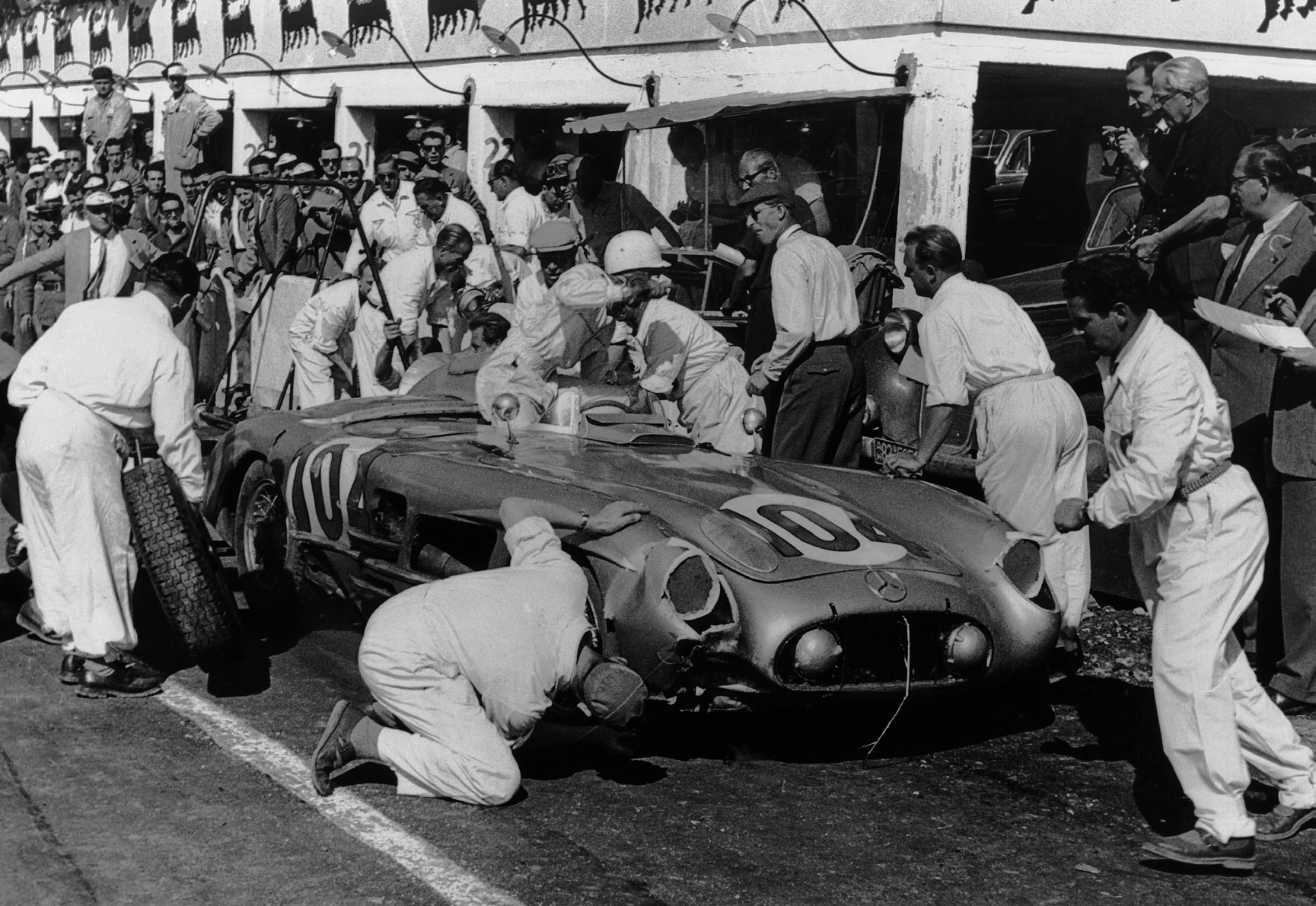
In the end, Moss/Fitch got everything out of the car, eventually reclaimed second place, but they couldn't have caught up to Hawthorn/Titterington's D-Type – then three laps before the checkered flag, it stopped with engine failure. Mercedes even celebrated a triple triumph, with Moss/Fitch winning ahead of Fangio/Kling and von Trips/Simon/Kling. However, the joy could only be contained within very narrow limits; three race drivers had died in fatal accidents. Once the rain started, nine accidents occurred. The race was not held for the next two years. From 1958 onwards, the organizer moved the event to Goodwood, to a permanent race track in relatively open, flat terrain.
„Even though we had actually done everything on the way to butcher the car“
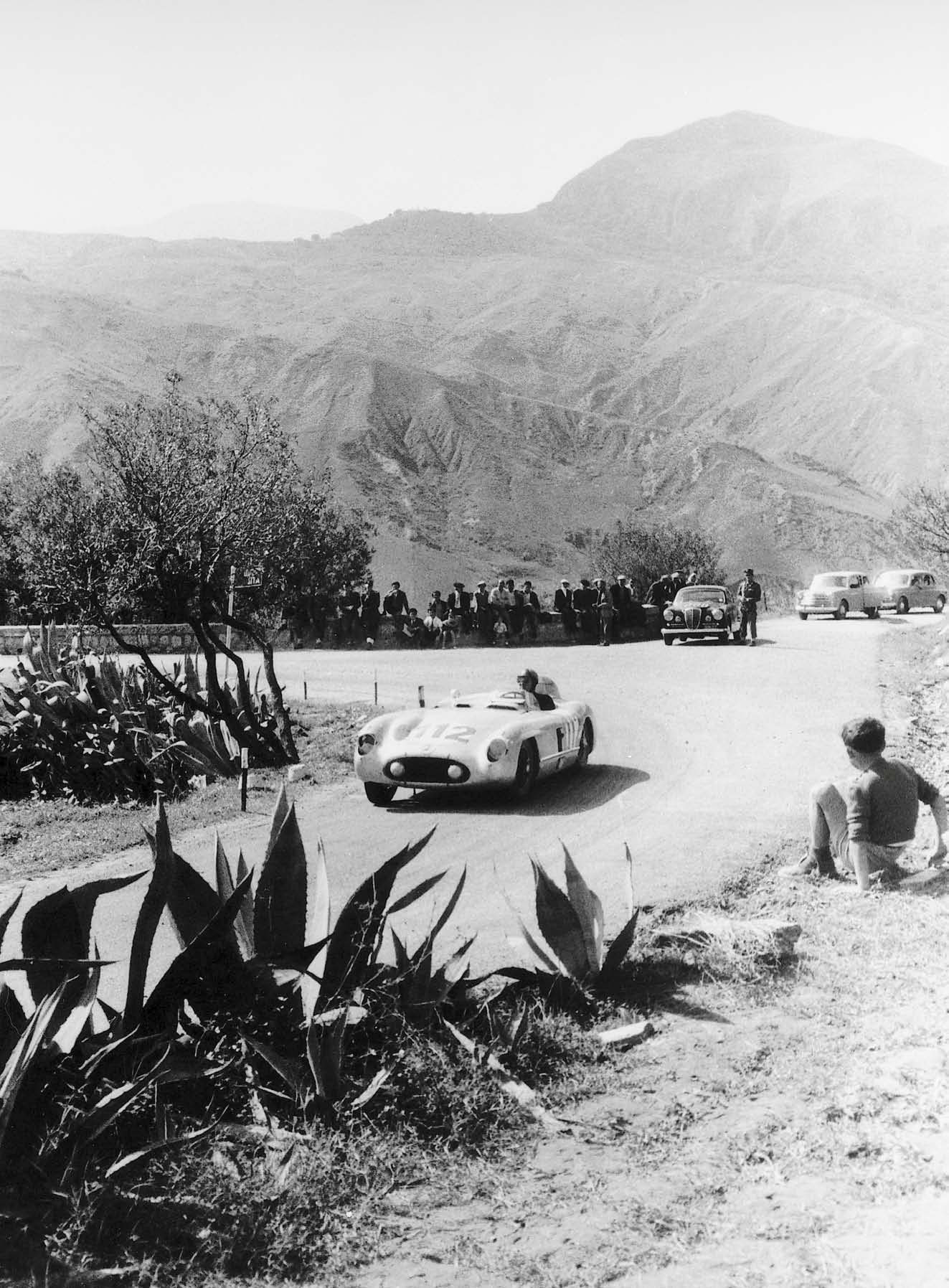
By the summer of 1955, the decision had long been made at Daimler-Benz to withdraw from motorsports at the end of the season. However, with the current standings in the championship – Ferrari 19 points, Jaguar and Mercedes 16 points – the World Sportscar Championship title was still very much up for grabs. A preliminary decision was made when Jaguar did not enter factory cars for the final race, the Targa Florio on October 16th in Sicily. This focused the title decider on a duel between Ferrari and Mercedes-Benz. The Stuttgart-based team entered three 300 SLRs one last time, with Stirling Moss/Peter Collins, Juan Manuel Fangio/Karl Kling, and John Fitch/Desmond Titterington at the start. Like Titterington from Jaguar, Collins, who had been with Aston Martin, which also did not compete with factory cars in Sicily, had received permission to race for Mercedes.
In a very exciting 13-lap race on the 72-kilometer course – again „against the clock“ with individual car starts – Eugenio Castellotti in the Ferrari 860 Monza initially put strong pressure on the Mercedes, was in second place between Moss and Fangio, and took the lead at the end of the fourth lap. By then, an accident had relegated Moss to fourth place. Collins took over and, in an otherwise intact car with several bodywork injuries, continued the chase. Fangio overtook the Ferrari and handed over to Kling. Collins also hit a wall, lost a front wheel, but was able to have the car put back in shape in the pits. In the final phase, Moss got everything out of the battered car and, together with Peter Collins, even won ahead of Fangio/Kling and the Ferrari of Eugenio Castellotti/Robert Manzon, „even though Stirling and I,“ as Peter Collins later said, „had actually done everything we could to wreck the car out there.“
Ultimately, Mercedes-Benz won the sports car world championship by a two-point margin over Ferrari; only four races with the 300 SLR had been enough. At the end of the year, after winning two Formula 1 world championship titles with Juan Manuel Fangio in 1954/55 and achieving triumphs in long-distance races, the covers were symbolically draped over the cars. For a few years, Mercedes-Benz withdrew from factory-backed motorsport.