

Writing regulations is an ungrateful task. Organizers want to see their ideas implemented and spectators want to be entertained. Some participant is always unhappy with their classification. And then there are the participants who read even more closely and find the dreaded loophole. This was also the case in 1994, when Porsche had already committed to the GT class and won the overall victory at the 24 Hours of Le Mans with a new edition of the Porsche 962.
Jochen Dauer – Racing Driver and Team Principal
Jochen Dauer's racing career began in 1973 in hill climbs with an NSU TTS. Ten years later, he focused on the new Group C. After a few races for Gebhardt-Motorsport and Zakspeed, he bought his first for the 1987 season Porsche 962C by John Fitzpatrick, who had disbanded his team at the end of the 1986 season. In the Interserie, the Supercup, the World Sports Car Championship, and also in the IMSA Series he brought his race cars to the starting line. The highlight of his career as a race car driver and team principal up to that point was starting in the 24 Hours of Daytona in 1991. On two improved Porsche 962s, he pitted the Andretti and Unser racing dynasties against each other. However, an important chapter had yet to be told.
A crazy idea
At the same time, Jochen Dauer was also driven by the idea of developing a road version of the Porsche 962 and offering it to affluent customers. With the assistance of Porsche designer Achim Storz, he succeeded in creating the „Dauer 962 Le Mans,“ as it was designated on the registration documents and TÜV report, a perfect synthesis of genuine race car technology, comfort, safety, and everyday usability. In Hermann Rüttgers from Nuremberg, he found a competent partner and Porsche expert for the construction of the prototype.
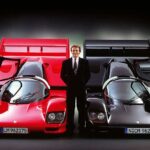
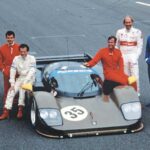
A second seat was installed inside the Porsche. The dashboard and the interior were lined with leather. A hydraulic suspension system was installed to adjust the ground clearance. Power steering assisted the driver in steering. And there was a reversing camera - standard today, innovative at the time. The 3.0 liter six-cylinder turbo engine was revised by Herbert Ampferer and could breathe freely without the annoying air restrictor. This gave the engine a significantly higher output than in Group C times. The claimed output was 537 KW / 730 hp. According to the TÜV report, the Dauer 962 Le Mans accelerated from 0 to 100 km/h in less than three seconds and reached a top speed of 402 km/h. In 1998, 404.6 km/h was measured at the VW test site in Ehra-Lessien, which secured it an entry in the Guinness Book of Records. Until the super sports car hype began in the 2020s, the Dauer 962 Le Mans was the one to beat for a long time.
Starting in 1991, intensive work was carried out on the road version. Two years later, the Dauer 962 Le Mans GT was presented to the public at the IAA in Frankfurt. The interest was enormous, and well-heeled customers immediately placed their orders. Among them was the Sultan of Brunei, Hassanal Bolkiah for short (full name: Kebawah Duli Yang Maha Mulia Paduka Seri Baginda Sultan Haji Hassanal Bolkiah Al-Mu’izzaddin Waddaulah ibni Almarhum Sultan Omar Ali Saifuddien Sa’adul Khairi Waddien). He was so enthusiastic that he ordered several copies directly.
Dauer 962 Le Mans: A New Era Dawns
A new era began in Le Mans in 1993, as the legendary Group C was merely a shadow of its former self. Officials of the Automobile Club de l’Ouest (ACO), led by Alain Bertaut, recognized the signs of the times and opened the 24 Hours of Le Mans race to GT sports cars, which were destined for the future. GT sports cars already made up half of the starting field. As a first cautious step, the factory Porsche team sent a Porsche 911 Le Mans GT with Hans-Joachim Stuck, Walter Röhrl and Hurley Haywood at the wheel into the race.
In November 1993, the ACO presented the new regulations. Group C race cars were granted a reprieve and allowed to compete one last time. At the same time, the GT class was divided. It was created specifically for super sports cars such as the Bugatti EB110, Ferrari F40, Venturi 600 LM, and also the McLaren F1 GTR. The new GT1 race cars were also intended to be capable of fighting for overall victory. Therefore, they were allowed to use a fuel tank 40 liters larger with only 50 kg more weight compared to prototypes. Furthermore, they were also permitted to use a larger air restrictor.
Since there weren't many of these supercars yet, the prerequisites for participation were minimal. To be homologated, a sales presentation simply had to have taken place in an ACO-approved country and a single road-legal vehicle had to be presented – a clause that opened up a field of possibilities!
The gap in the development of the Dauer 962 Le Mans
In Weissach, they soon realized that with the 911 Le Mans GT based on the 964 model, even in a modified version, they would have no chance of winning their class in GT1, let alone an overall victory. Returning to a modified Group C vehicle was not an option. The chosen path into the GT future was to be maintained. A radically redesigned GT1 vehicle, for example, with a mid-engine layout like the McLaren F1, would have been too complex and would have required even more lead time. As it seemed at first, Porsche was therefore left empty-handed.
In November 1993, however, Porsche racing director Max Welti and Norbert Singer presented an idea to Horst Marchart, the board member responsible for development - bold, courageous and ingenious at the same time. According to their interpretation, the Dauer 962 Le Mans presented at the IAA was also a road-going GT racing car and also entitled to compete in the new GT1 class. The technical challenges involved in this conversion to a GT1 car were enormous. In racing, the tires had to be significantly narrower than in Group C times. This was noticeable in the corners and in the top speed. Even with a larger air restrictor and more power, the car would be slower on the long straights than the modified Group C cars. In Weissach, however, Norbert Singer's engineers had calculated that this disadvantage could be compensated for by fewer refueling stops. In theory, there was therefore a chance of great success. Chief Development Officer Horst Marchart gave his approval.
Carefully dressed
There were only six months to go before the vehicle was ready for use and there were a lot of specifications to work through. Although Jochen Dauer had already done the groundwork with his design, road approval was still pending. This had to be done by March 31, 1994 in accordance with the Sports Act. The revised version of the Dauer 962 Le Mans now had to meet two requirements at the same time: Road approval and at the same time suitability for racing. Norbert Singer and his team were faced with a mammoth task. The Porsche 962 was developed for the race track in 1984, converted for the road by Jochen Dauer and brought back to the race track in Weissach in 1994 - all on the same basis. Alain Bertraut and the ACO were informed of the plans in parallel with the preparations. The French were only cautiously enthusiastic about the idea because they wanted to see other vehicles in the GT1 class. A Group C racing car in disguise would not be in the spirit of the regulations. Nevertheless, they were open to this project, as otherwise they feared that the powerful Toyotas would go it alone and the race would be rather monotonous.
Everything back to zero – almost
In January, the ACO published an amendment to the regulations to reduce the cornering speeds of GT1 cars. All cars in that class had to have a flat underbody between the front and rear axles. Only then was the diffuser to begin. However, in the original version of the 1984 Porsche 962, the diffuser began far in the middle between the two axles. It developed strong negative pressure, was fundamental to the car's handling, and guaranteed comprehensive success in many Group C racing series of the 1980s.
During the first wind tunnel test, Norbert Singer and his team were almost shocked. The Dauer 962 Le Mans experienced lift in the front axle area with a flat underbody and was extremely unstable. The 962 Le Mans was reworked under high pressure. Due to the many parts, it was almost a new car, as the new regulation affected many areas in detail: the front section was now pulled further forward. The lack of downforce on the „mini-diffuser“ at the rear axle was compensated for by an additional wing element below the rear wing. The lack of downforce, for example, also led to significantly higher brake loads. Therefore, carbon fiber brakes, which had been tested in other projects, were now used.
Many accounts claim the ACO intended to obstruct Porsche with the rule change to prevent their participation. It may read better dramatically, but it doesn't reflect reality. Max Welti even strongly disagrees: „These are defamatory insinuations against the ACO. We had many constructive conversations beforehand. The ACO actually looked more closely at us because the Dauer 962 Le Mans wasn't quite the GT car they had hoped for.“
A gauntlet
It turned out to be a stroke of luck that the complex TÜV approval had not yet been carried out and that it was possible to react accordingly to the change in the regulations. With the TÜV Rhineland, outstanding issues such as noise development, lighting, fuel and exhaust emissions were resolved. The last point was cleverly argued: the design of the Dauer 962 Le Mans dated back to 1982, so the legal basis from that year had to be used as the basis for approval. To everyone's astonishment, this argument was accepted. After lengthy negotiations, the TÜV sticker was affixed to the license plate on March 15, 1994 - two weeks before the first deadline! The second problem arose on April 21, 1994, when the vehicles had to be presented to the ACO in Le Mans. The fear of unexpected objections was great. But Norbert Singer had prepared well for this eventuality and was able to dispel the last reservations. The six months of preparation were like running a gauntlet.
No underdogs with the Dauer 962 Le Mans
In mid-April, the Dauer 962 Le Mans had its roll-out on the in-house test track in Weissach. The test drives at the Goodyear test site, in Paul Ricard, and during the 24-hour test in Magny Cours all proceeded without major issues. Confidence began to spread.
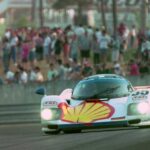
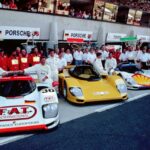
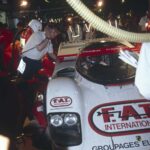
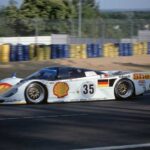
The two vehicles were officially entered by Jochen Dauer, while the on-site expertise was provided by Norbert Singer, Max Welti, and their engineers from Weissach. The on-site operation was effectively managed by Reinhold Jöst's team, although their name is not mentioned anywhere – in short, a professional factory effort. Both cars featured some of the best sports car drivers of the time. The car with starting number 35, in a striking Shell livery, was driven by Hans-Joachim Stuck, Danny Sullivan, and Thierry Boutsen. The second car, with starting number 36, sponsored by FAT-Express International, was driven by Mauro Baldi, Hurley Haywood, and Yannick Dalmas.
During practice, the two Dauer 962 Le Mans cars were significantly slower than the modified Group C prototypes, the Courage C32 LM, the Kremer-Porsche K8, and the SARD Toyota 94 C-V. The Japanese had been trying to win at Le Mans since the mid-1980s and were considered the overwhelming favorites. Fifth and seventh place on the grid were nonetheless reassuring results, as different laws apply at Le Mans. The lead over the remaining GT1 competitors was enormous. The next best GT1 car was 12 seconds slower. Officially, they had only set their sights on winning the GT1 class.
The first few hours revealed a different opportunity. Both Dauer 962 Le Mans cars could keep pace with the favored Toyota 94C-V and were significantly more economical. The modified Group C prototypes raced with a weight of 950 kg and an 80-liter fuel tank, while the Porsches had 1000 kg and a 120-liter tank. While the Group C prototypes had to pit for refueling every 11 laps, their fiercest competitors from Stuttgart-Zuffenhausen only needed to pit after 14 to 15 laps. However, thanks to their larger diffuser, the prototypes from Toyota, Courage, and Kremer could overall be easier on their tires. They only had to change tires at every second stop, whereas Porsche had to change them at every stop.
The race at the front was like a sprint, combined with tactical games, luck, and bad luck. In the first two hours, surprisingly, the two Dauer 962 Le Mans cars led the race. Danny Sullivan had a tire failure immediately after entering the pits, forcing him to complete a full lap on a flat tire. He lost almost two laps to the leader. Shortly thereafter, Thierry Boutsen ran out of fuel 50 meters before the pit entrance and had to be pushed. At four o'clock, at 186 mph (300 km/h) in the Tertre Rouge corner, his headlights failed. The Belgian remained calm and managed to switch the lights back on while driving slowly. In the pit lane, for safety, they changed the front end. Later, a tie rod also had to be replaced.
Headaches, on the other hand, were caused by the half-shafts on both vehicles. Excessive grease leaked from the bellows. The shaft on Mauro Baldi's Porsche was replaced, costing him three laps. The half-shafts were checked at every pit stop from then on, but they held up for the rest of the race. It was due to the professionalism of the drivers that both Dauer 962 Le Mans cars were able to catch up to the Toyota 94 C-V repeatedly. However, these also had problems from time to time.
At midnight, everything pointed to a clear Japanese victory. In the early morning hours, Steven Andskär, George Fouché, and Bob Wollek's NISSO Trust-to-yota experienced major gearbox problems. The second Toyota, from SARD, driven by Jeff Krosnoff, Eddie Irvine, and Mauro Martini, took the lead by noon. Then, as so often at Le Mans, the „gremlin of defects“ struck mercilessly: an hour and a half before the end, a weld seam on the Toyota tore, causing the shift linkage to detach. However, Jeff Krosnoff managed to nurse the Toyota slowly around the track in the stuck third gear. Both Dauer 962 Le Mans cars were now in the lead. In a final sprint on the last lap, Eddie Irvine managed to catch up to the #35 Porsche. However, Mauro Baldi, Yannick Dalmas, and Hurley Haywood were long gone and won by just under a lap.
The 1994 race once again showed that whoever can read the rulebook has a clear advantage! The courage to exploit loopholes can pay off.
Never miss an exciting article about historic motorsport again! Get your Curbs subscription. ALL images conveniently home – directly via our Online store