
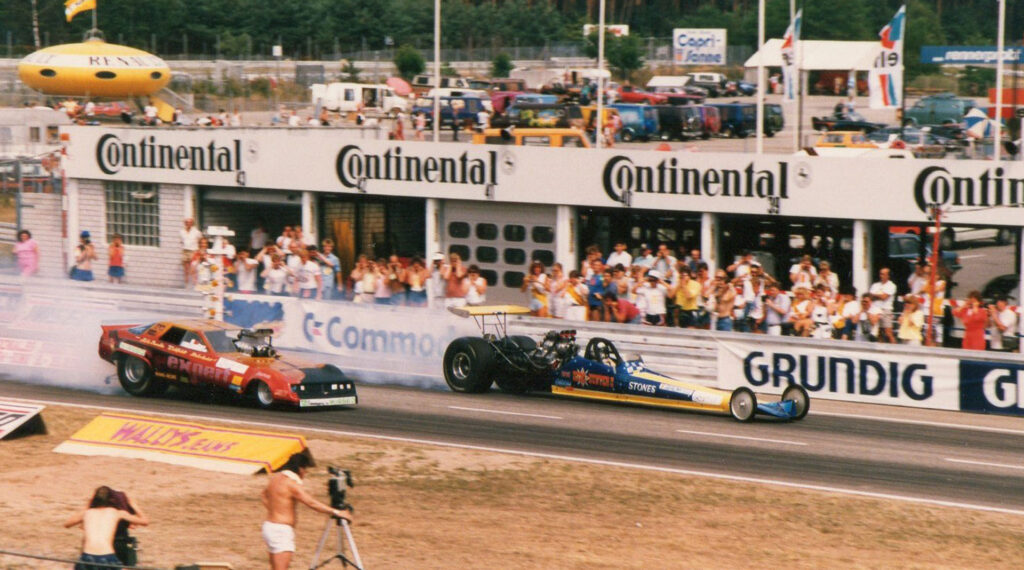
Drag racing – this form of motorsport originated in the 1930s. Over the decades, it evolved from the „hot rodding“ of rebellious American teenagers into a million-dollar business. An insight into the fastest motorsport in the world, where speeds exceeding 500 km/h are commonplace.
Drag racing, a unique acceleration race
If you've heard of drag racing, you might picture flame-spitting Top Fuel dragsters tearing down the quarter-mile in just over 4 seconds. Long, „cigar-shaped“ cars with massive rear wings. Strange to a fan of traditional circuit racing at first. How did it all begin?
The sport originated in the 1930s in the United States of America, specifically in California. Teenagers would grab discarded Ford Model Ts and other contemporary vehicles that their parents no longer wanted. These were then modified. These were the origins of tuning. Hot rodding was born. Engines were worked on to extract more power. Anything that could save weight was dismantled. Fenders, seats, anything that didn't serve to increase performance was considered unnecessary ballast and removed.
There were no aftermarket parts yet, no speed shops/tuning workshops where you could have your vehicle souped up. Everything was done by DIY. Discussions about tuning measures took place in car clubs, which were popping up everywhere. The test tracks for these modifications were public roads, and from 1937 onwards, the dry lakes of El Mirage and Bonneville in the state of Utah. World War II put a temporary end to these activities.
After that, a real plague developed on the Californian streets. Young hotheads with their flying machines duelled preferably in the evenings on the main streets of their cities. „American Graffiti“ and „Rebel Without a Cause“ capture this era cinematically. The events were now moved by the police and various organizations to „race tracks“. It started with a flag, without timekeeping; whoever reached the finish line first won. The first official race took place in 1949 at Goleta Airfield in California.

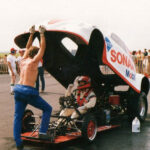
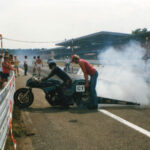
It's no longer precisely possible to determine why the ¼ mile became the classic distance for a drag race. A US city block was ¼ mile long, and other track lengths were attempted, but perhaps it was simply the distance available on landing strips when a passable braking zone for runoff was also considered. In any case, it ultimately became the ¼ mile, 402 meters and 34 centimeters, on which drag races are held.
The Rise of Drag Racing
Organizations like the National Hot Rod Association (NHRA) and others propelled the burgeoning sport to ever-greater popularity in the 50s and 60s. There were more and more races, championships in ever more diverse classes, to offer a field for fair competition, bridging the gap between street vehicles and highly developed special constructions with nitromethane, nitrous oxide, and superchargers.
In the 1960s, Funny Cars and dragsters, with their nitro-fueled, supercharged V8 engines, rose to become the kings of the sport. Corporate America entered the game. Model car manufacturers, cigarette companies, beer brands, fast-food chains, „you name it,“ everyone invested in top teams and tried to leverage the sport's popularity for their company. Prize money soared into the millions.
How drag racing came to Europe
The wave washed over Europe in 1964 when a delegation of top teams from the States embarked on a short tour of England.
Some viewers in England knew the NHRA Drag Stars from back home, as many US soldiers were stationed at airfields in southern England during the „Cold War.“ Quite a few American boys had already been active on the quarter-mile „back home,“ and now they often had boredom and huge runways on their bases in England and other NATO countries. It wasn't long before the first soldiers started „hotting up“ their classic American cars and engaging in duels on the concrete strips. The whole thing was also supported by US military and cultural organizations, as it kept morale high and celebrated the "American Way of Life.".
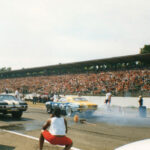
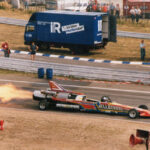
In Southern Germany alone, over 250,000 GIs were stationed, and garrison towns in the province often had the nickname „Little America,“ with special offers, car dealerships, repair shops, music clubs, etc. for the affluent US clientele. German-American friendship was part of everyday life there, and it was also easy for civilians to visit the PX supermarket on US bases to buy „Hot Rod“ magazines (and drinks in half-gallon bottles).
Sometimes it got loud on the US airfields on weekends. The noise didn't come from jets or propeller planes, but from V8 engines with short exhaust pipes when soldiers raced their club races over a quarter mile. Some German motorsports fans also liked this, and it wasn't long before the first German drivers started competing with „souped-up“ family cars or lightweight race cars specially built for the quarter mile.
The first drag race in Germany
The first documented drag race in Germany took place in 1965 at the US base in Ramstein. Soon, drag racing was also held at other airfields in the Palatinate region, such as Sembach and Pirmasens. In the Rhine-Main area, it was held at Mainz-Finthen and at the Erlensee airbase near Hanau. The cars were built and motorized very differently, but the rules were simple and fair. There were different classes, depending on the displacement and weight of the car, and within these classes, the time differences at the starting light were equalized. If a 12-second car raced against a 14-second car, the slower one received a 2-second head start at the light, and then the faster one had to try to catch up before the finish line. However, if the faster car went under its 12-second „index“ time, it was disqualified, making every race exciting and fair. The decision was often made only centimeters before the finish line beam.
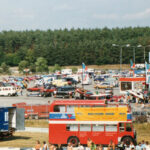
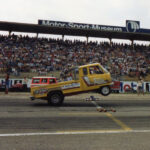
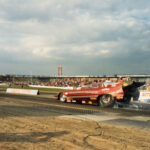
For genuine stock cars, there was the „Stock“ class; „Super Stock“ consisted of cars lightly tuned with stock parts; and the „true“ dragsters were grouped into „Competition Eliminator.“ Every race Sunday, heats were run until a class winner was determined, and then the races for the „Overall Eliminator of the Day“ took place, with cars from all classes competing in staggered heats. It could happen that a 200-horsepower diesel Mercedes with a 22-second time beat a 1,000-horsepower „hot rod“ with 12-second times and took home the hefty prize money of over 1,000$!
The starting field was colorful and diverse, from Beetles with Judson superchargers, to Opels with road racing or slalom backgrounds, to classic V8 US cars that could be bought for „pennies“ in the 70s when US soldiers were redeployed back home. But short dragster chassis with 4-cylinder engines from VW, Opel, Ford, Renault, or Volvo were also successful. Some of the pioneers of German drag racing remained active into the 2000s and won many national and European drag racing championships.
Of the first clubs, only the Hanau Auto Racing Association has survived. With its races in Erlensee and later Giebelstadt near Würzburg, the HARA e.V. celebrated its 50th anniversary in 2019 and still regularly produces German DMV and DMSB Champions as well as FIA European Champions.
HARA currently does not have its own race track. The active participants are competing in Germany at the NitrOlympX in Hockenheim and at smaller DMSB „Sportsman“ races on German airfields. Additionally, they will go „on tour“ to neighboring European countries for local quarter-mile events.
Get Curbs #52 conveniently delivered to your home with the Dragrace Report—right through our Online store