
The number of German motorsport teams that are in the Group C The number of teams that started is considerable. Names like Joest-Racing and Kremer are often mentioned first, as they were loyal to Group C prototypes from the beginning. In this context, the Gebhardt-Motorsport team from Kraichgau should not be forgotten. Because Gebhardt, in particular, stood out from this mass of teams, as they were not afraid to develop their own prototypes. In 2022, the family company Gebhardt Intralogistics Group celebrated its 70th anniversary. Looking back at the company's history, one thing stands out: technical progress is a top priority for the Gebhardt family. Developing their own sports prototypes was not a matter of course for Fritz and Günter Gebhardt, but rather a commitment.
Gebhardt-Motorsport: Fire and flame
The family business Gebhardt-Fördertechnik grew rapidly starting in 1952. With many patents, the company soon became the market leader. Richard and Elfriede Gebhardt were able to finance their son Günter's entry into motorsport. His brother Fritz organized the race operations from the very beginning. The in-house racing team's path followed the classic route through karting, Formula Vau, and Super V. Success came quickly: Günter won the German Formula Vau Championship in 1979 and became the runner-up in the Formula Super Vau European Championship. The years in Formula 3 and Formula 2 at the beginning of the 1980s were disappointing, but at the same time, Group C was launched, and the Gebhardt brothers were immediately „fired up.“ The newly invented Group C Junior (from 1985 Group C2) was intended to give small sports car and race car manufacturers, as well as private teams, the opportunity to develop and use their own prototypes at a low cost.
The Gebhardt JC02, nicknamed the UFO
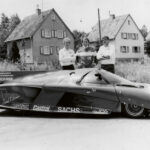
Gebhardt-Motorsport's first sports car was designated JC02. Its history began as early as 1980 at the Essen Motor Show. Swiss racing driver and constructor Chuck Graemiger planned to also develop a Group C Junior. In conversation, he agreed with engineer Michael Neumann to develop the design for a new sports prototype. Neumann had already developed Group 6 prototypes for Jörg Obermoser's TOJ team. The new vehicle received the designation Cheetah G602. However, it never made it to a race. During wind tunnel tests, however, a falling out occurred between the two, so Neumann continued his project on his own. For a short time, it looked as though his design would not progress beyond a 1/5 scale model.
At the same time, planning began by Fritz and Günter Gebhardt and their technician William Harris, who had already worked for TOJ. The good connections to Obermoser made it possible to use components from his successful sports car and also the design by Michael Neumann. Fritz and Günter Gebhardt were convinced by the concept of the lowest possible air resistance for high speed, the absence of large wings and the idea of generating downforce solely through a very large diffuser. A series of tests on August 2, 1983 in the BMW wind tunnel showed that the measured drag coefficient of 0.261 was a world-record low. The monocoque was developed by Günter Gebhardt and Bill Harris. It was kept very narrow, consisted of only 32 aluminum plates and was therefore very light. A little anecdote: during construction, Michael Neumann made a bet to estimate the weight of the monocoque. He had to pay the difference to the actual weight per kilogram with a crate of beer. He guessed 67 kilograms. In fact, it was 43 kilograms. He had to pay 24 crates.
The first functional test on the Hockenheimring caused no significant problems and proved that the aerodynamics and underbody worked excellently. Only the cooling and the doors had to be reworked. The JC02 had its first race appearance on July 3, 1983, at the 200-mile race at the Norisring. Kenneth Persson finished the race in a respectable ninth place. However, a disagreement with Michael Neumann followed because his bodywork design was very aerodynamic but not practical for racing.
Gebhardt Motorsport in the JC Series
Between the 1983 and 1984 seasons, the car was thoroughly revised in Bicester at Rolston Autotechnic and in Berwangen near Sinsheim and a second vehicle was built. The design of the bodywork was made even more efficient after the first races, which benefited the car's use in endurance races. Formula 1 designer Gustav Brunner, who was working for ATS at the time, also helped with this through the back door. Gebhardt built two versions during the winter.
The prototype designated JC 842 had a 2-liter BMW inline-four engine developed by Erich Baier. The engine had already been successfully used in Formula 2 at the time and produced approximately 315 hp. The abbreviation JC 843 also appeared in the results lists of these years. This was a structurally identical sports prototype. However, the second version had a 3-liter Ford-Cosworth DFV V8 engine with approximately 420 hp, with which Mario Andretti had won the F1 race at Watkins Glen. This was purchased directly from Bernie Ecclestone.
In their first outing of the 1984 season, Frank Jelinski and Cliff Hansen took 12th place overall and fourth in the C2 class at Monza. However, after an encouraging start, engine failures repeatedly dampened spirits. For a long time, the English engine tuners were unable to get the cylinder head problems under control. Only a switch to the Swiss engine builder Heini Mader resolved the engine issues. From then on, 3.3-liter Cossie engines were used, which also helped with fuel consumption in endurance races. Soon, the JC 842, JC 843, and the evolution models JC 853 and JC 873 ran like clockwork in all racing series.
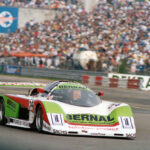
From 1984 to 1988, Gebhardt raced a combination of events from the World Sportscar Championship, Deutsche Rennsport-Meisterschaft, and Interserie annually with these two models, IMSA and later the Supercup. Another chassis was sold to the London-based ADA Engineering Team. The team entered a JC 843 in the World Sports Car Championship and in Le Mans on its own initiative. The flat flounder from Berwangen started a race a total of 96 times. When looking at the results lists, two names crop up again and again: Frank Jelinski and Stanley Dickens - both protégés of Fritz Gebhardt - raced more regularly and successfully.
The hour of truth struck for Gebhardt in Le Mans. Designer Michael Neumann wanted to achieve a top speed of 350 km/h with the flat design on the Hunaudières and Mulsanne straights. His plan worked, and the Gebhardt JC had a clear conceptual advantage over the rest of the C2 field here. The JC 843 from ADA-Engineering, driven by Steve Earle, John Sheldon, and Ian Harrower, finished in 16th place and took second place in the C2 class. The British narrowly missed out on a major success. A year later, ADA-Engineering, with a Gebhardt JC 843 powered by a Cosworth DFV engine, finally managed to win the C2 class. The eighth place in the overall standings tasted particularly sweet because the top 10 were almost entirely in Porsche's hands. The only exception was the Gebhardt JC 843 from ADA.
Different times dawned for Gebhardt-Motorsport
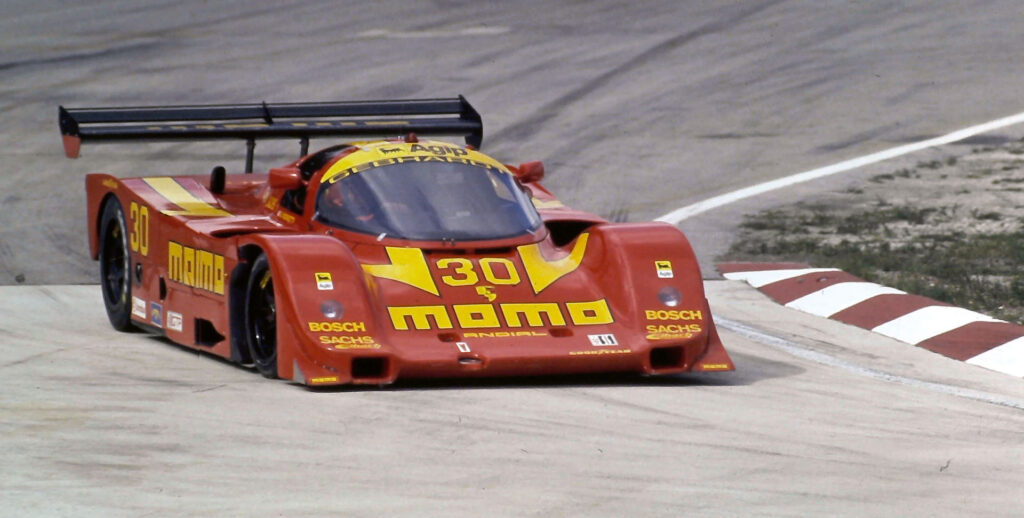
In the 1987 season, it became increasingly clear that Gebhardt's JC models were approaching the end of their time. Günter Gebhardt and Bill Harris decided to move away from the previous concept for the next C2 model. The vehicle was to have a shorter wheelbase and generate more downforce thanks to a large rear wing. Chassis 872/1 was used for this new design with the designation Gebhardt C88. At the rear was a real mini powerhouse - a five-cylinder turbo engine from the Audi quattro. Its distinctive hissing sound is well known to motorsport fans in Europe. Depending on the boost pressure, it could generate up to 500 hp from a displacement of 2.1 liters. Günter Gebhardt and Hellmut Mundas had used their contacts at Audi to get hold of these „orphaned“ engines. Between 1989 and 1991, Rudi Seher drove the C88 mainly in the ADAC Supercup, while Hellmut Mundas and Günter Gebhardt competed in the Interseries. In 1990, Gebhardt-Motorsport also entered the C88 in the 24 Hours of Daytona and caused a few surprised faces. While the cars in the World Sportscar Championship were divided into the C1 and C2 classes, the IMSA series was divided into GTP and GTP-Light. For the Americans, however, it was irrelevant that the Gebhardt C88 had been designed for class C2. In Daytona, it had to start in the GTP class between the Porsche 962, Nissan GTP-ZX-T and the Jaguar XJR-12. In practice, Günter Gebhardt, Costas Los and Hellmut Mundas drove between the big prototypes. The drivers of the GTP-Lights were significantly slower and were left behind by the small, inconspicuous prototype from Kraichgau. They would have started the race from 18th on the grid if technical problems had not prevented the start. Today, the Gebhardt C88 in that Momo design from Daytona 1990 is successfully driven by Marco Werner in historic motorsport.
Gianpiero Moretti at Gebhardt Motorsport!
For several years, Fritz Gebhardt ran a business dealing in sports car accessories. Among other things, he also imported Momo steering wheels. This small entrepreneurial decision paved the way for Fritz Gebhardt's most enjoyable time in motorsport in 1988.
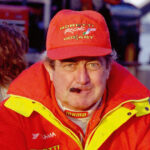
Gianpiero Moretti, a gentleman driver in the truest sense of the word, had been racing sports cars worldwide for years. In 1988, he was unhappy with his outings in the IMSA series in a March-Buick and wanted to switch to the successful Porsche 962. The contact to Moretti was made through ex-Joest manager Hans-Dieter Dechent, also because Fritz Gebhardt was the Momo importer. The chemistry between them and Gianpiero Moretti was immediate. Furthermore, the Italian insisted that the IMSA GTP outings not only be organized locally but also carried out by all Gebhardt mechanics.
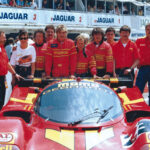
Having to operate in the USA was a pragmatic and cost-effective solution. Fritz Gebhardt said in the interview with a laugh: „We were kind of vagabonds. We didn't rent a hall in the USA, but did everything from the truck. We were always the first to arrive at the race track and the last to leave. We worked on the Porsche 962 in the paddock until Tuesday or Wednesday and then packed everything up again. We flew back and the truck driver drove to the next track. That's where we met up again. Every six to eight weeks, however, the Porsche came to Germany for a complete overhaul.“ Although Gianpiero Moretti only finished on the podium twice together with Stanley Dickens in the Momo Porsche 962, the outings in the IMSA series were consistently successful. However, the decisive factor here is not overall victories, but the constant top 10 finishes behind the works teams from Nissan, Jaguar and the experienced IM-SA teams. Gebhardt is also proud of the Kodak Trophy, which at the time was for the most kilometers driven without a retirement in a season. In addition, Gianpiero Moretti had continued to improve as a driver over the course of the races with Gebhardt Motorsport. Bill Harris, long-time technician at Gebhardt, remembers: „Our Porsche was always the first one at the exit of the pit lane before practice. Until it came to us, it didn't know what it was like to be there so early. Or even driving a stint, as Fritz said. He learned a lot with us.“
But it's not just the results in the IMSA that are fondly remembered in Berwangen near Sinsheim. Even more so, it was the relaxed atmosphere and the stories surrounding it: the traditional Thursday evening dinner with the entire team, Gianpiero Moretti cooking his ever-popular spaghetti for the paddock, well-deserved free beer at the Holiday Inn after a day's work, and of course, the enthusiastic fans at the natural race tracks.
Big steps
If you look at the starter lists, the chassis number 962C 001 GS appears from the 3-hour race in Miami onwards - GS = Gebhardt-Motorsport. For the 1989 season, the Porsche 962 was improved according to their own ideas by reinforcing the frame, the bracing to the engine and the gearbox. Derek Bell said at the time that it was the best Porsche 962 he had ever driven in terms of chassis.
By the late 1980s, despite its own further developments, the time of the 962 was over. Gianpiero Moretti was considering buying a Spice SE 90. Fritz Gebhardt advised him against it because the British racing car manufacturer was experiencing financial difficulties at the time, and there were fears that spare parts supply could collapse. For the amount he would have had to spend, he could have also bought a custom-designed Group C vehicle that was state-of-the-art. His brother Günter had good relations with Wolfgang Weigel and Johann Knapp from WRT-Renntechnik and knew that they had a fairly advanced concept for a modern Group C race car there. Together, they concluded that for the money Moretti intended to spend, they could also build a car themselves. After the presentation of the concept, they quickly reached an agreement, and in June 1990, the Gebhardt C901 project began.
The carbon fiber chassis was baked as a single unit with an integrated roll bar and weighed just 40 kg. The engine was to be a 2.2 liter in-line five-cylinder from Audi with a water-cooled KKK turbocharger with wastegate control and very high boost pressure. The engine block and the 4-valve cylinder head with two counter-rotating camshafts were made of aluminum. The injection nozzles and the engine were controlled by a Bosch 1.7 Motronic. The output of the small engine, which was used in the Audi IMSA GTO in 1989, was more than 800 hp at approx. 8000 rpm. It was able to generate a whopping 634 Nm of torque. Attached to the engine was the Hewland 5-speed gearbox, whose housing was made of magnesium. The small engine was held in place by a steel subframe and another A-shaped frame above the engine. Curious: the oil pan was also designed as a load-bearing component. A monoshock damper from Sachs with Eibach springs was used for the front wheels. At the rear, two damper units were installed in the direction of travel.
Headaches at Gebhardt Motorsport
The assembly took place in record time. Within eight months, the 15 technicians from WRT and Gebhardt built the C901 under the direction of Bill Harris. At the beginning, everything seemed to be going well, but a few weeks before the rollout, Dr. Werner Laurenz from Audi withdrew his verbal commitment to the powerful IMSA GTO engine. Gebhardt had to fall back on the old Audi engine that had been used in the C88. The C901 now had 200 hp less. After completion, the new C901 was sent to the USA, where it was presented to the public at Road Atlanta. The first test drives then revealed major construction sites: Thermal problems with the engine, defective turbochargers, major set-up problems with the front axle were just a few of the issues. Due to Johann Knapp's front axle design, the C901 had only 25 mm ground clearance and therefore almost no suspension travel. On the American race tracks with their undulating surfaces, the new prototype proved to be virtually undriveable. Johann Knapp refused to make any changes to the damper unit, which ultimately led to his break-up. Wind tunnel tests at Pininfarina revealed areas of air congestion, poor downforce and a heavy front end. Meanwhile, the beautiful C901 was completely out of control in terms of cost. In view of this fact, the major technical problems, the lack of test drives and the poor prospects, Gianpiero Moretti abruptly withdrew from the project, refused to make any further payments and left the racing car to the team.
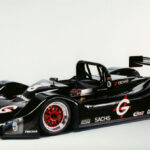
Bill Harris converted the front damper unit to a conventional layout. The weak Audi engine was replaced by a 3.5-liter V8 Ford Cosworth engine and the aerodynamics were heavily revised. In two outings in the World Sports Car Championship and in the Interseries, the sports car, now known as the C91, was able to show its potential. However, time had worked against Gebhardt. The Group C Sports Car World Championship was buried in 1992, which is why the main field of application and customer interest were missing. The high costs of the project and the financial hole that Gianpiero Moretti had left behind led to the premature end of the project. Although an attempt was made in 1999 to build on old successes in John Mangoletsi's ISRS racing series with a conversion as an open sports prototype, now under the name G4, there was no chance behind the disguised works teams from BMW, Ferrari and Lola. As so often, there was a lack of money. In 2013, Frank Lyons took over the G4 along with a large spare parts package and gradually rebuilt it back to a C901. His son Michael won the Le Mans Classic in 2018 against a whole armada of Group C prototypes and finally demonstrated what this vehicle is capable of.
Never miss an exciting article about historic motorsport again! Get your Curbs subscription. ALL images conveniently home – directly via our Online store