
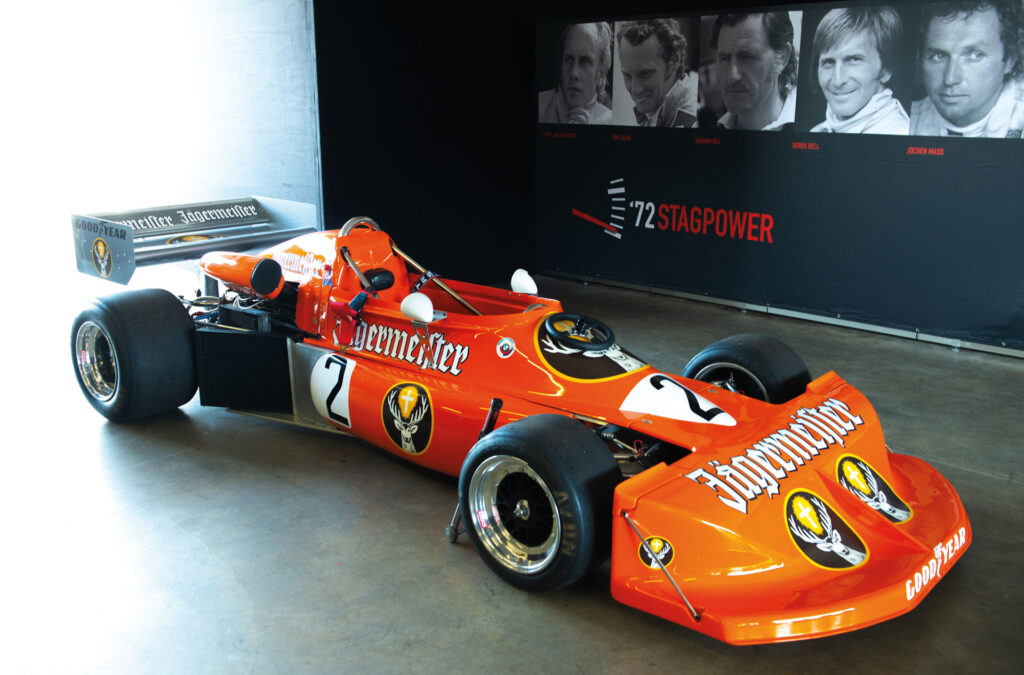
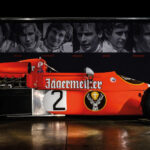
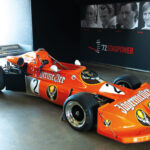
The 1977 March 772P-BMW Formula 2 car, as it was used for a long time by the March factory as a one-off.
In contrast to Formula 1, where March, despite its presence since 1970 for about two decades with interruptions and changing ownership of the brand name, only managed to win three Grand Prix races between 1970 and 1976, this manufacturer was the largely dominant brand in Formula 2 for a good dozen years. In 15 years of the Formula 2 European Championship between 1970, when March entered here alongside Formula 1, and 1984, the last year of Formula 2 in history, Formula 2 European champions drove a March no less than six times. No other Formula 2 brand was even remotely as successful during this period.
Especially from 1973 onwards, when March began its engine partnership with BMW, the March-BMW cars were the ones to beat for long stretches. After the Swede Ronnie Peterson had already clinched the title in a March 712 M-Cosworth FVA/Hart in 1971, the Frenchmen Jean-Pierre Jarier and Patrick Depailler achieved this in 1973/74, the Italian Bruno Giacomelli in 1978, the Swiss Marc Surer in 1979, and the Italian Corrado Fabi in 1982, each with BMW power at the rear of the March. There were also repeated phases where the two-liter BMW engines were clearly superior to competing units in terms of performance.
The intellectual architect of many March Formula 2 race cars and their lead engineer was the Briton Robin Herd, born in 1939. After studying at Oxford, he initially worked on the development of the Concorde. Between 1965 and 1968, he then built successful race cars for Bruce McLaren in various categories. In 1969, he designed the all-wheel-drive Cosworth Formula 1 car before becoming one of the four founding fathers of March in the same year. The „h“ in the company name stood for „Herd“. And of all the founding fathers, he remained by far the longest involved in or responsible for this racing car factory.
However, the cooperation between March and BMW, which was very successful right from the start, was apparently briefly „on the brink“ relatively soon – at the end of 1976, after already winning two Formula 2 titles in 1973/74. Somewhat prematurely, the German specialist magazine sport auto announced in its January 1977 issue: „The highly successful March/BMW Formula 2 marriage has been dissolved. The reason: the superiority of the French Renault 6-cylinders. Max Mosley will now equip his F2 racers with Hart engines. BMW will dedicate itself more to private drivers again with the construction of F2 engines.“
The relationship wasn't quite as bad as the sports car news made it out to be, but according to BMW, the alarm bells had rung. In the twelve races of the 1976 Formula 2 European Championship, drivers with Renault/Gordini V6 engines in the rear had won eight times, with only four race wins going to March-BMW drivers. Of those, two went to Hans-Joachim Stuck in the works March 762, both at Hockenheim. However, as a so-called A-driver and already an established Formula 1 driver, he could no longer score championship points in the Formula 2 European Championship anyway, and was also in a class of his own driving-wise, especially at Hockenheim, which is why he earned the nickname „King of Hockenheim“ during this period. The 1976 Formula 2 European Championship title, however, was won by Frenchman Jean-Pierre Jabouille in an Elf 2 J-Renault/Gordini V6. And so, behind the scenes, BMW put the pressure on March to come up with something.
In the following, March boss Max Mosley also made it clear that the cooperation between March and BMW would continue in 1977. „I don't believe the Renault Formula 2 engines are unbeatable,“ he added. Meanwhile, the Type 772 was already being delivered or was about to be delivered to March customers, which was essentially nothing more than a slightly improved version of the previous year's Type 762. Max Mosley then sat down at the drawing board again and additionally designed the Type 772p, with the „p“ standing for „prototype.“ He used a slimmer 1975 Formula Atlantic chassis and was therefore able to draw a considerably more aerodynamically favorable body for the Formula 2 car. BMW engine engineer Paul Rosche also took on the M 12/7 inline-four engine again and coaxed further extra horsepower out of the power unit, with power figures for the engine now exceeding 300 hp, and in some cases even up to 330 hp. Initially, only one example of this car was produced, which, with chassis number „U1,“ was used almost exclusively by the factory throughout the entire 1977 season until the last race at Donington Park. In the first F2 European Championship race of 1977 in Silverstone, Belgian Patrick Nève led for a long time before having to make an unscheduled pit stop because a wheel had come loose. However, he still finished third, and his performance in the 772p-BMW subsequently earned him a Formula 1 cockpit in the Frank Williams-March 771. In Thruxton, Brazilian Alex Ribeiro also took third place in the „prototype.“ Meanwhile, March Formula 1 driver and „March works driver on duty“ in Formula 2, Hans-Joachim Stuck, received a place in the Brabham-Alfa Romeo team for the rest of the season and left March after the Brazilian Carlos Pace died in a plane crash.
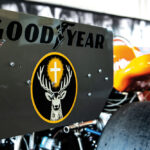
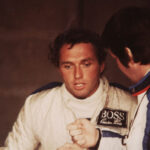
Thus, Jochen Mass received the 772p-BMW for the Formula 2 European Championship races „Jim Clark Memorial Race“ in Hockenheim and „Eifel Race“ at the Nürburgring, sponsored by „Yardley“ in Hockenheim and „Jägermeister“ at the Nürburgring. Mass, who was in peak driving form in 1977, was very grateful for this welcome opportunity between his Formula 1 engagements for McLaren and his services as a Porsche works driver in the sports car world championship – he won both races convincingly. Subsequently, the Italian Bruno Giacomelli took over the „U1“ until the second-to-last race in Estoril, Portugal, winning the European Championship races „Gran Premio di Roma“ in Vallelunga and „Gran Premio di Mugello“ before winning again in the last European Championship race at Donington Park in 1977 in the March 782-BMW for 1978, at the debut of this construction. The Brazilian Alex Ribeiro drove the chassis number 772p-BMW „U1“ here once more. And here a second example of this car with chassis number „U2“ appeared, with which the Swiss Marc Surer took fourth place in Donington. „U1“ and „U2“ remained the only chassis of this construction to be manufactured.
While the „U1“ ran after 1977 under Norman Dickson, among others, in the then so-called Aurora series for privately used older Formula 1 and Formula 2 racing cars, the „U2“ ran in Canada for a few years before being taken over by the Swiss Markus Hotz. He carefully restored the car once more and, after 2010, repeatedly entered it in historic hill climbs for several years.
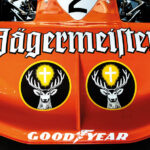
Eckhard and Oliver Schimpf from „72STAGPOWER“ managed to acquire this Hotz March 772p-BMW „U2“. They restored the car to its original „Jägermeister“ livery from that era, with which the car only started once in 1977 at the Eifelrennen Nürburgring under winner Jochen Mass.
Technical data of the F2-MARCH 772P-BMW from 1977
Engine:
- BMW M Inline-4 Cylinder
- Valves per cylinder: 4
- Bore/Stroke: 89.2 mm x 80.0 mm
- Engine displacement: 1,999 cc
- Mixture preparation
Bosch Kugelfischer gasoline injection - Dry sump lubrication
- Ignition: Bosch
- Power: more than 300 hp at 9,300 rpm
Power transmission
- Hewland FGA Five-Speed Transmission
- Rear-wheel drive
Chassis
- Body: GFRP
- Chassis: Aluminum monocoque with rear subframe
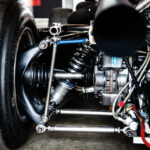
- Front suspension: two superimposed wishbones, Koni shock absorbers
- Rear suspension: Upper control arm,
two trailing arms below, two tie rods, Koni shock absorbers - Tire dimensions front/rear: 9.2/20.0×13 or 12.0/23.0×13
- Steering: Rack and pinion steering
- Brakes: AP disc brakes all around, front ventilated, rear internal and unventilated
Dimensions and Weights
- Unladen weight: approx. 500 kg