

„Jim Clark wants to see ‘P1plus 100’
For his 25 Grand Prix wins in World Championship races, which were a world record for some time, Jim Clark needed less than six years. Just for comparison, Jackie Stewart – with a total of 27 Grand Prix wins in the end – achieved the same number in about eight years, while Niki Lauda, also with 25 wins in total, needed about ten years.
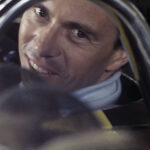

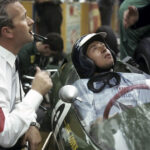
In contrast to these two, however, Jim Clark was far less publicity-oriented. He remained somewhat shy and reserved throughout his life, with his heart tied to his father's farm in Scotland. Even after increasingly rapid victories, he still spent every free hour on the farm, which he wanted to dedicate himself to again entirely after his racing career ended. „The most famous Scot since Robert Burns,“ as the US magazine „Time“ compared him in the mid-60s to the poet who died in 1796, he became the first and only Baron of his hometown Duns. He enjoyed hunting or was an avid amateur photographer. From his large record collection, he preferred to play jazz on long evenings, Ella Fitzgerald or Louis Armstrong. The non-smoker occasionally enjoyed a small glass of alcohol in moderation, „it doesn't hurt as long as you stay at home." He passed his private pilot's exam, bought a twin-engine Piper Comanche, and in 1967 moved his residence for tax reasons to a condominium in Pembroke, Bermuda. Of a quite attractive appearance, Jim Clark was also considered one of the most sought-after bachelors in the pit lanes at the time. Women played a role in his life repeatedly, but he never entered into a long-term relationship. For a time, he was involved with the prominent fashion model Sally Stokes; his last girlfriend was named Kate Accles.<
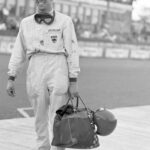

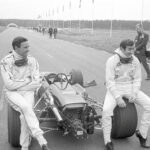
Jim Clark is the best driver in our county, his father the slowest.“
Jim Clark was born on March 4, 1936, in Duns, a dreamy town in the Scottish county of Berwickshire. His father, James Roger Clark, was a farmer and sheep breeder, and Jim was the longed-for son after three daughters. Although he couldn't reach over dashboards at the age of nine, he already drove the nanny's Austin Seven whenever the ignition key was in. At the same age, he moved to Loretto boarding school and was only allowed to go home on three Sundays a year from then on. He left school with a middling school certificate, learned to play cricket and hockey, and came to hate rugby. The now 16-year-old was encouraged by his father to do practical work on the estate before taking it over. In 1954, his parents transferred the estate in Edington Mains near Chirnside, consisting of a 400-year-old main building and 500 hectares of farmland, to their son.
- 1958 Winner of the "Scottish Speed Championship," driving a Jaguar D-Type, among other cars
- 1959 Winner of the "Scottish Speed Championship," driving a Lister-Jaguar, among other cars
- 1963 Formula 1 World Champion in a Lotus 25-Climax V8
- 1965 Formula 1 World Champion in a Lotus 33-Climax V8
- 1965 Tasman Series champion in a Lotus 32 B-Climax 2.5 L.
- 1967 Tasman Series winner in a Lotus 33-Climax 2.0 L.
- 1968 Tasman Series winner on Lotus 49 T-Ford Cosworth 2.5 L. V8
Two years earlier, the then 16-year-old Jim had secretly begun his motorsport career in rallies with a Sunbeam Talbot, using his sister's signature on the registration forms. When his father found out, he sent him out on foot with a shepherd's crook and dog to herd sheep. Motorsport was forbidden for the time being. Two years after taking over the farm, in 1956, Jim Clark, with the family's approval, donned the dark blue helmet, the color of his motorsport club „Border Reivers“ („Border Devils,“ mounted lancers as crest), and debuted on circuits in a DKW 3=6 in club events in the touring car class up to 1,000 cc.
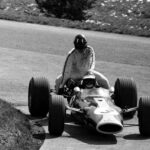
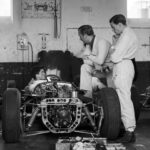

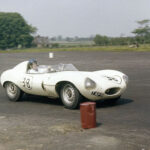
He later switched to a Porsche 356 1600, before „Border Reivers“ even provided him with a Jaguar D-Type, a relatively high-performance race car. Clark took immediately to this car as well. In total, by the end of 1958, he had secured 20 first-place finishes and eight second-place finishes in 33 races. He won the „Scottish Speed Championship“ (the Scottish national circuit championship), and among the farmers in his hometown, the saying went: „Jim Clark is the best driver in our county; his father is the slowest.“
Jim Clark's first Formula 1 victory after only ten months
During the 1959 season, the Scot racked up another 23 victories, alternating between a small 1.3-liter Granturismo Lotus Elite and a 250-horsepower Lister-Jaguar race car. In the Lotus, he also achieved a highly acclaimed tenth-place finish in the overall standings at the 24 Hours of Le Mans. His performances in the Lister prompted Lotus founder Colin Chapman to sign Clark for his Formula Junior works team in 1960. With his victory in the FJ-Lotus 18-Ford Cosworth at the Solitude Grand Prix near Stuttgart, the up-and-coming Scot also made a lasting impression on German spectators; a month later, he won his first Formula 2 race at the „Kentish ‚100‘“ at Brands Hatch in the Lotus 18-Climax. A long lead in the Formula Junior race in Monaco earlier that year had also earned him a promotion to the works Lotus Formula 1 team that same year; he made his debut there at the Dutch Grand Prix on June 6, 1960. After two fifth-place finishes in Belgium and France, as well as a third-place finish in the Portuguese Grand Prix in the Formula 1 version of the Lotus 18, he immediately shone by finishing eighth in the final standings of the 1960 World Drivers„ Championship. In the non-championship race at Snetterton, he even managed a second-place finish. Third place in the overall standings at the 24 Hours of Le Mans in a three-liter Aston Martin DBR I race car privately entered by “Border Reivers„ rounded out his reputation as a “rising star.” On April 3, 1961—at the start of only his second Formula 1 season—the 25-year-old celebrated his first Formula 1 victory at the non-championship Grand Prix de Pau in the southern French city near the Pyrenees in the Lotus 18-Climax, finishing a remarkable one and a half minutes ahead of Sweden’s Joakim Bonnier in an identical Scuderia Colonia car and two laps ahead of third-place finisher Lorenzo Bandini of Italy in a Cooper T51-Maserati from Scuderia Centro Sud. However, the level of competition in the non-championship races was not as high, and they took place largely without Ferrari participation that year. In the World Championship races of the 1.5-liter Formula 1 class, which took effect in 1961, however, Lotus and Jim Clark, like many other British teams that had nothing but the relatively weak 1.5-liter Climax four-cylinder engine at their disposal at the time, from a power deficit of 30 to 40 hp compared to the drivers of the V6-cylinder Ferrari Tipo 156. For them, too, things went virtually nowhere.
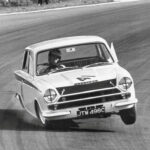
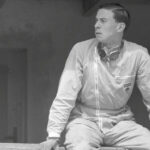
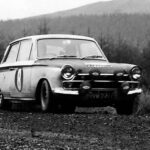
After all, Jim Clark improved to seventh place in the overall standings with the new Lotus 21-Climax, achieving third places in the Dutch and French Grands Prix, as well as a fourth place in the German World Championship race at the Nürburgring. However, he also had to overcome a very sad low point when he was involved in the collision on the second lap of the Italian Grand Prix in Monza, which claimed the lives of German title favorite and Ferrari driver Wolfgang Graf Berghe von Trips and 15 spectators.
Eternal four minutes and 54 seconds until the next
The Climax V8 engine, unveiled in 1961 and adopted by Lotus starting in 1962, turned the tables dramatically; Ferrari now found itself trailing behind. Jim Clark had a shot at the title all year long but, while leading in the final World Championship race in East London, South Africa, lost the World Championship to Graham Hill (BRM) due to a technical failure just a few laps before the finish. With the revolutionary Lotus 25-Climax V8—the first Formula car built with a monocoque chassis—as well as its direct predecessor, the Lotus 24, he celebrated eight Formula 1 victories in three Grands Prix (Belgium, Great Britain, USA) and five non-World Championship races (Snetterton, Oulton Park, Aintree, Mexico, and Kyalami). Less than four years after his Formula 1 debut, the Scot finally became the Drivers„ World Champion for the first time in 1963. He won no fewer than seven of ten World Championship races, plus five additional Formula 1 races at Pau, Imola, Silverstone, Oulton Park, and Karlskoga, Sweden. In addition, he secured three victories that season in the Lotus 23 B race car at Oulton Park, Crystal Palace, and Brands Hatch, and claimed a 16th victory after a touring car race in the Ford Galaxie at Brands Hatch. As long as his car ran flawlessly, he was essentially unbeatable, at times downright demoralizing the competition. Time and again in the Formula 1 World Championship races, the runner-up at the finish was over a minute behind; in the rain-soaked Belgian Grand Prix at Spa-Francorchamps, Clark even crossed the checkered flag a full four minutes and 54 seconds ahead of Bruce McLaren in the Cooper-Climax; at Zandvoort in the Netherlands, as the winner ahead of Dan Gurney (Brabham-Climax), he even lapped the entire field, including Gurney. The 1.5-liter Formula 1 class became known as “Formula Clark,„ and team boss Colin Chapman revealed his ambition in those days with the words: ‚Jim wants to see ‘P1 plus 100“ on our scoreboards.” In other words: the lead plus a 100-second advantage over the next car. The following year, however, things didn’t go quite so smoothly. In the 1964 Drivers’ World Championship, the Scot ultimately had to settle for third place in the standings behind John Surtees (Ferrari) and Graham Hill (BRM) in the less reliable Lotus 33-Climax V8. He won the Dutch, Belgian, and European Grands Prix at Brands Hatch, as well as the non-championship races in Goodwood and on the Solitude.
Stirling Moss: „Jim Clark has more natural talent than anyone else“
In 1965, however, he won again whenever, wherever, and however he wanted. With the Lotus 33-Climax V8, he achieved his second Formula 1 World Championship title, taking the checkered flag first in six Grand Prix races, five of them consecutively. In Spa-Francorchamps – on a track he actually hated – this happened for the fourth time in a row since 1962, and in Zandvoort for the third time since 1963. In the non-championship races in Syracuse and Goodwood, Clark secured two more Formula 1 victories. As the first European since 1916, he triumphed with the nearly 500 hp Lotus 38-Ford at the legendary 500 Miles of Indianapolis, simultaneously ensuring the first victory for a mid-engined racing car there. In Pau, Crystal Palace, Rouen, Brands Hatch, and Albi, he crossed the finish line first five times with the Formula 2 Lotus 35-Cosworth. On the fifth continent, in Australia and New Zealand, he won the so-called Tasman Series with Lotus racing cars similar to Formula 1 cars. With the racing touring car Ford Cortina Mk I Lotus, he dominated the 3h Sebring and also secured the only victory for a Lotus 30 sports racing car in Silverstone. During this time, Stirling Moss, the benchmark driver immediately before the Clark era, grudgingly attested: „He has more natural talent than anyone else.“
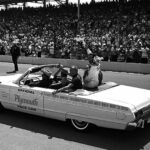
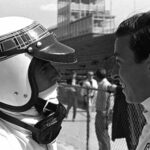
For the three-liter Formula 1, which became effective in 1966, long-time engine supplier Climax could no longer provide a suitable power unit for Lotus. Colin Chapman temporarily resorted to bored-out 1,500 cc engines increased to two liters and simultaneously experimented with BRM's complicated three-liter H16 cylinder. When the latter ran satisfactorily for once at the end of the year, Jim Clark achieved his only Grand Prix victory of the season at Watkins Glen (USA). Sixth place in the drivers' world championship reflected the circumstances. Second place in the 500 Miles of Indianapolis at least financially compensated for the comparatively meager sporting results of the year.
With the compact, powerful three-liter Ford Cosworth V8 at his back, the „Flying Scot“ returned to the ranks of title contenders in Formula 1 in 1967. However, the Lotus 49 proved to be a bit too prone to breakdowns, so ultimately, after no less than four season victories in the Netherlands, Great Britain, USA, and Mexico, no more than third place in the Drivers' World Championship was possible. In four other Grands Prix, the Scot retired while leading, sometimes with a clear advantage. For the second time after 1965, he became Tasman Champion with five victories and also won three times in Formula 2 with the Lotus 48 Cosworth FVA in Barcelona, Jarama, and Keimola, Finland.
In January 1968, he set a new world record at Kyalami in South Africa with his 25th Formula 1 Grand Prix victory, ahead of Juan Manuel Fangio with 24 Grand Prix victories. Christchurch, Surfers Paradise, and Sandown Park once again were milestones on his path to a third Tasman title. Everything pointed to another triumphant racing year for him… Yet the great Jim Clark, who had won five Formula car championship titles in five years between 1963 and 1968, died at an event where, relatively speaking, there was nothing at stake for him. He was unable to score points toward the Formula 2 European Championship as a so-called „A-driver,“ nor did his Formula 2 Lotus 48 really have a chance of winning at that point when the Scot took to the rain-soaked track at Hockenheim on April 7, 1968, for his final race. After the field had settled, Clark was alone in eighth place, with no direct contact to the leading group or the pursuers. On the fifth lap, British driver Chris Irwin, who was driving about 200 meters behind him, observed that Clark suddenly began to spin out for no apparent reason on the way to the “Ostkurve” behind the long right-hand bend. About 500 meters away stood a track marshal who was able to corroborate Irwin’s eyewitness account: The car had moved from one side of the road to the other as if in a slalom; Clark had tried to correct the course with steering movements before the Lotus spun completely sideways and crashed broadside into a tree.The front and rear sections of the car were torn off and scattered over 100 meters. Jim Clark, who suffered a skull base fracture and a broken neck, was killed instantly. The cause of the accident was debated for a long time and ultimately never fully clarified. The most likely explanations cited were a rear suspension failure, a tire blowout, engine seizure, or an evasive maneuver due to spectators who had suddenly run across the track. The investigation into the accident, commissioned by Lotus boss Colin Chapman and conducted by Peter Jowitt—an engineer specializing in accident investigations of military aircraft prototypes—concluded that a tire blowout was the cause of the crash.
Clark's driving error at this point was very soon ruled out with a very high degree of probability, just as aquaplaning was not a consideration. According to other pilots, the maximum speed achieved there of about 265 km/h did not even pose increased demands on driving skill in pouring rain. And it had stopped raining at the time of the accident.
Never miss an exciting article about historic motorsport again! Get your Curbs subscription. ALL images conveniently home – directly via our Online store