
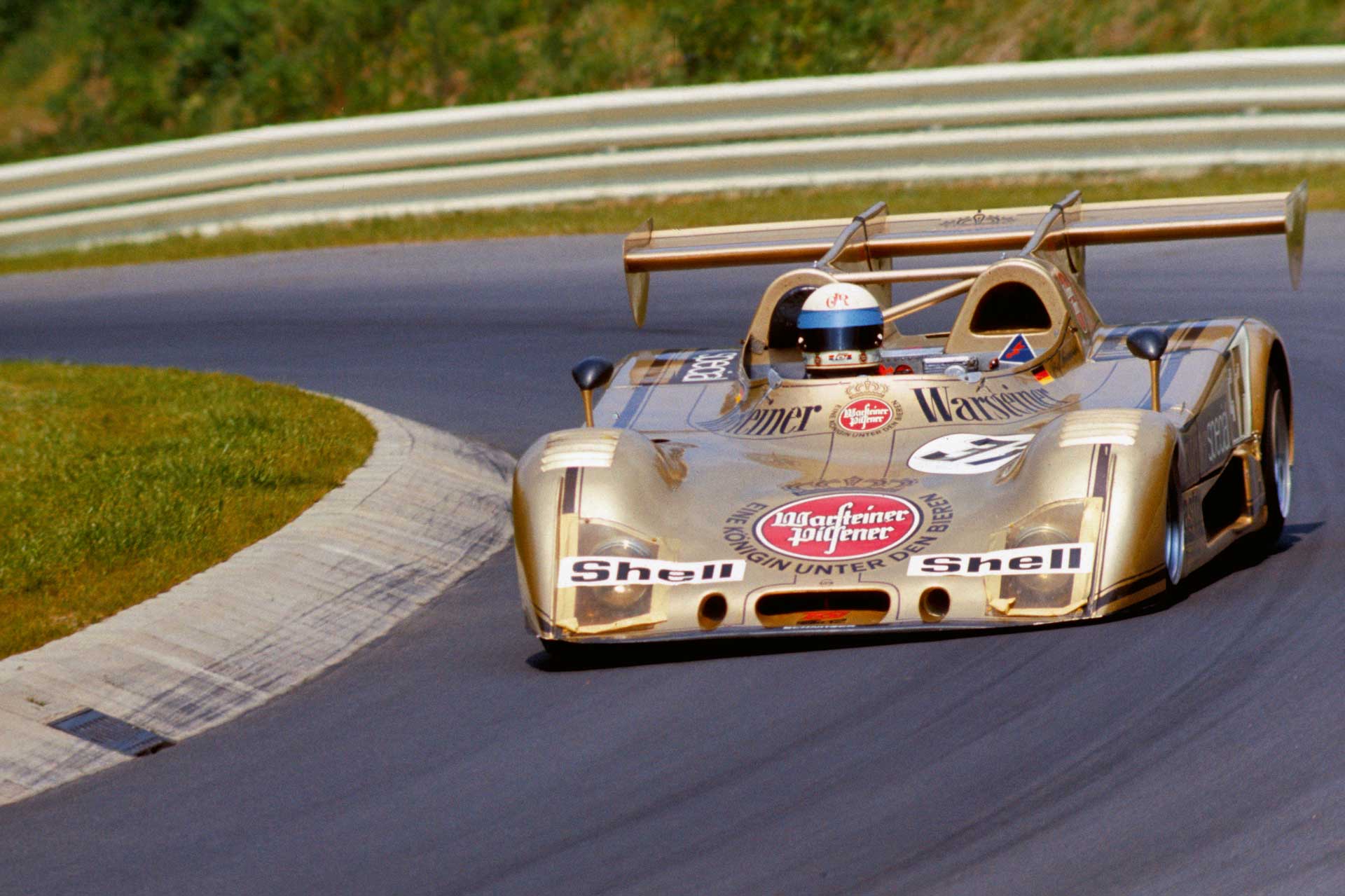
The golden racing cars with Warsteiner advertising were hard to miss in the 1970s. The harmonious design is still remembered today. The brewery from the Sauerland region has supported many drivers and teams in the past. A look back at around 50 years of Warsteiner sponsorship.
Do you know Wormatia Worms? Don’t you? The soccer club from the city of Worms, which lies on the left bank of the Rhine and on the border between Rheinhessen and the Palatinate, has existed since 1908 and briefly made it into the two-e Bundesliga in the 1970s. Since then, Wormatia Worms has played in various amateur leagues, currently in the Oberliga Rheinland-Pfalz/Saar. With a brief momentum, the soccer club occupies a special place in German sports history.
On August 20, 1967, the team wore a kit with the lettering “CAT”, the abbreviation of the construction machinery manufacturer Caterpillar, in the season opener against SV Alsenborn. This caused a scandal and the shirt advertising was hotly debated in the press. At an emergency meeting, the DFB banned shirt advertising for companies by amending its statutes. The DFB’s efforts to put a stop to this failed six years later. The financial opportunities opened up by advertising for clubs and athletes were too great. The small soccer club was thus one of the pioneers of the commercialization of German sport.
Commercialization of motorsport also benefited Warsteiner
The same phenomenon is also reflected in motorsport history. From 1970 onwards, advertising on racing cars became established in European motorsport. Companies that decided to do so early on still had to make small compromises with other sponsors and were able to determine the overall design of the racing car without having to pay dearly for it. The Martini, Gulf, John Player, Jägermeister and Marlboro brands created legendary vehicle designs. These vehicles undoubtedly include the golden racing cars with Warsteiner lettering, which are still popular in historic motorsport today.
The Warsteiner brewery has been run by the Cramer family since it was founded in 1753, currently in its ninth generation by Catharina Cramer. From the mid-1970s onwards, Warsteiner used the motorsport stage to grow its fine bitter beer into a premium brand. The story of the golden racing cars began – as is so often the case – small and informal.
The Warsteiner Eurorace foundation team
Claus Cramer, head of finance and marketing at the brewery at the time, competed in various hill climb races in a BMW 1600 at the end of the 1960s. His home race was the Sauerland Hillclimb between Nuttlar and Kallenhardt. His brother Peter was also infected by the racing bug, bought a Ford Escort and also competed regularly on the mountain. In search of support, he met Jörg Obermoser. The two founded a racing team for the 1972 season. A thorn in the side of the Cramer brothers, however, was Obermoser’s sponsor: Riegler Bier.
The small brewery from Kaiserstuhl near Freiburg im Breisgau was not a competitor that could have posed a threat to the Warsteiner brewery’s business. Nevertheless, it was an untenable situation for the Cramers. Claus Cramer decided to support Jörg Obermoser financially on a large scale and enable him to set up his racing car company TOJ (Team Obermoser Jörg) in Bruchsal.
From 1974, golden racing cars with large Warsteiner lettering rolled onto the starting grid in many racing series; all under the wing of Jörg Obermoser and the “Team Warsteiner Eurorace”. In the second year, the activities were expanded. Peter Scharmann and Günter Gebhardt started with a TOJ MSV in the Formula Super Vau. Willy Deutsch moved up to the Formula 2 European Championship in a March 752 and Gunnar Nordström competed in the Formula 3 Championship in a Modus M1. Jörg Obermoser himself contested the German Racing Championship in a GS BMW 2002 ti and the European 2-liter one-make championship in a self-built TOJ SC02 BMW. A mammoth program that would not have been possible without financial support from Claus Cramer! Until 1978, the team’s drivers regularly finished on the podium in their golden racing cars.
Albrecht Krebs was then generously supported with funds by Claus Cramer. A BMW 320i Gr. 5 was used in the German Racing Championship. After it was irreparably damaged at the Nürburgring, Albrecht Krebs was offered an M1 Procar as a BMW dealer. Krebs used the M1 in the Procar series and in the German Racing Championship. Jochen Mass and Prince Leopold of Bavaria also took the wheel on occasion. The last car that Albrecht Krebs drove in Warsteiner colors was an Osella-BMW Turbo in hill climb races until 1982.
Cash injection for Harald Ertl
After surprisingly good results in the Formula 2 European Championship at the Nürburgring, Jochen von Osterroth suggested to his protégé Harald Ertl that he enter the 1975 German Grand Prix without further ado. Although it was less complicated in Formula 1 in the 1970s to enter the premier class of motorsport on a private basis within a short space of time, this brought with it many challenges. Von Osterroth contacted Heseketh manager Anthony “Bubbles” Horsley. For a loan fee of 8,000 pounds sterling, Harald Ertl was to be provided with a ready-to-use Hesketh 308 for test drives and races, including a replacement engine and support.
But then came one piece of bad news after another: Due to a shortage of engines at Hesketh, the car could not be made available. Georg Loos, the impulsive team boss and self-proclaimed Kremer Racing enemy, offered two Cosworth DFV engines on loan. But even this did not seem to be of much use. During the phone call, Horsley explained that team owner Lord Hesketh now wanted a loan fee of 15,000 pounds instead of the agreed 8,000 because the value of the Hesketh had increased after James Hunt had won the race in Zandvoort and finished second in France. For Harald Ertl and Jochen von Osterroth, the price was out of the question. Further inquiries to Surtees and Williams were unsuccessful.
Then came the next piece of bad news: at the British Grand Prix, many drivers destroyed their cars after rain flooded the Silverstone circuit. Within seconds, there was a shortage of driveable Formula 1 cars for customers. But Jochen put his network to good use and found a way out. The Hesketh 308-1, James Hunt’s winning car in the 1974 Daily Express Trophy, was for sale from Brabham owner Bernie Eccelstone. However, the costs had now risen several times over. All calculations were invalid. A new sponsor had to be found. Claus Cramer saw his chance to enter Formula 1 with Warsteiner and took on a large part of the costs. Two days later, a transporter rolled from London to Warstein, where the Hesketh was painted gold and adorned with Warsteiner emblems. Harald Ertl was able to finish the German Grand Prix on the Nürburgring-Nordschleife, albeit in eighth place and therefore last in the race. “I hadn’t expected more anyway,” he said after the race. Thanks to further financial injections from Claus Cramer, the original one race turned into three races in the Formula 1 World Championship after all.
Warsteiner went out into the wide world with Arrows
Initially, Harald Ertl and Rolf Stommelen were only supported sporadically. Stommelen was looking for a driver’s seat before the 1978 Formula 1 season, with Warsteiner as a sponsor in his “rucksack”. At the same time, the newly founded Arrows Racing International team under the management of Jackie Oliver was looking for a sponsor to join the team. Bernie Eccelstone acted as an intermediary and drew Oliver’s attention to Rolf Stommelen, saying that he had a good sponsor. The deal was struck in the winter. Claus Cramer and Warsteiner became the stirrup holders for Arrows’ entry into Formula 1. In addition to the experienced driver from Cologne, Arrows also hired Riccardo Patrese, 24 Years young and full of bite. The golden Arrows FA1s did extremely well in the field of established teams.
The Formula 1 entry of Arrows and Warsteiner was then immediately overshadowed by a scandal. When the first FA1 model was presented for the season, a scandal broke out: the car looked confusingly similar to the Shadow DN8. Designer Tony Southgate had taken his plans with him after leaving Team Shadow and developed the Ar-rows A1 from them. He regarded the plans as his intellectual property. Two almost identical vehicles were created from his plans. British courts ruled in favor of Shadow team boss Don Nichols and Arrows had to build a new chassis, the A1, within 52 days. The legal dispute was hotly debated in the media. A Warsteiner racing car was always pictured in the articles.
Usually, the amount of sponsorship money is kept under wraps. In this case, it was even made public in 1978. During the court hearing in London, Jackie Oliver had to disclose the financing of the Arrows team. In Rallye Racing issue 9, an amount of DM 840,000 was mentioned in an additional article.
Warsteiner’s years in the Formula 1 World Championship were both sociable and sobering. For three years, the brewery’s hospitality was a popular meeting place in the paddock. However, the sporting successes fell short of expectations. The futuristic Arrows A2 caused a stir, but was not successful. With the exception of the US Grand Prix in Long Beach, the 1980 season also brought no notable successes with the conventional Arrows A3. Apparently under pressure from co-owner and nephew Albert Cramer, the big appearance in Formula 1 came to an end after the season. Claus Cramer told a journalist at the time: “We don’t sell any more bottles of beer than we used to.”
Only figures from the Warsteiner brewery can prove whether this is true. There is no doubt, however, that Warsteiner’s name recognition abroad has increased.
A royal friendship
In 1976 and 1977, the ADAC circuit race Sylt “Friendship Prize of the Warsteiner Brewery” was held. This is also where the paths of Leopold Prince of Bavaria, known to all as “Poldi”, and Claus Cramer crossed. He demonstrated his skills in a Formula Vau and a BMW 320. Cramer was impressed by the young racing driver from the old Wittelsbach dynasty and knew what (advertising) value a fast young royal highness would have as a racing driver for the Warsteiner brand. They quickly came to an agreement and the partnership lasted well into the 1980s.
It was even better on a human level. A close friendship developed over the years. “I owe an incredible amount to Warsteiner and Claus Cramer because he promised me what I needed for racing for a long time. He always kept his promises. I have fond memories of evenings together when he invited me and my family to Warstein or to the Palace Hotel in St. Moritz. Everyone knows how much that costs. One night, when Claus was already fast asleep, we wrapped his house in 40 rolls of toilet paper and poured a lot of baking powder into the well. Unfortunately, it rained during the night and all the soup ran over his property. Claus always knew how to have fun. In my memory, he remains a good and generous friend.” So “Poldi”!
From 1977, the Bavarian prince was increasingly supported by Cramer. Initially only sporadically, such as in 1977 with a TOJ SC303 in the Eurorace Team Warsteiner, then from 1980 onwards in a BMW M1 Procar. He was promoted to Group C in 1983. In the German Racing Championship, he competed with the Porsche 936 from Joest-Racing.
One year later, Poldi brought Claus Cramer and Walter Brun together in St. Moritz. The money from Warstein enabled Poldi and Walter Brun to enjoy a full season: the German Production Car Championship with a BMW 635 CSi, races in the German Racing Championship, in the Sports Car World Championship and also the 24-hour race at Le Mans; all in a Porsche 956. It was almost enough for a big success in the endurance classic at the Sarthe. He, Walter Brun and Bob Akin were in second place overall for almost 22 hours. After 22 hours, they were well behind the Joest Porsche with Klaus Ludwig and Hen-ri Pescarolo. Only a technical defect could have put them in 1st place. In the final hour, the technical problems got worse and worse and the Porsche dropped back to third place. The team decided that Poldi should drive the last stint. The aim was to maintain the podium position. However, the Porsche became increasingly unstable over the last five laps, forcing him to slow down. The Skoal Bandit Porsche 956 was already approaching in the rear-view mirror. All maneuvers did not help. “After such an exhausting race, it was still a good result. But fourth place is actually – in Bavaria we say – the Oaschkortn ziagn”.
The Warsteiner beer war with touring cars
The Year 1985 marks a turning point in Warsteiner’s motorsport sponsorship. Claus Cramer was caught in the rotor blades of a helicopter while heli-skiing in the Alps. He only just survived the accident, but later died as a result. Three months later, his nephew Albert Cramer became the sole owner of the company. Until then, the house law was that the two first-borns of the two Cramer family branches each held 50 percent of the shares. Albert Cramer bought the company shares from his cousin Claus. The figures vary from 200 to 300 million DM.
The contracts with teams and drivers that had been in force up to that point were suddenly null and void. Albert Cramer, who was described as down-to-earth, had his public image in the sporting world realigned. Ballooning, horse riding, skiing and soccer were now added. However, statements in today’s media that Warsteiner withdrew completely from motor sport under Albert Cramer are not true. New contracts were signed with works teams in particular.
In the German Touring Car Championship, the Warsteiner logo adorned the works BMW M3 from Zakspeed and Schnitzer from 1987 to 1992. Eric van de Pole and Roberto Ravaglia won the title in 1987 and 1989. A veritable beer sponsorship war developed in the DTM and later also in the STW. Many breweries saw the touring car racing series in Germany as the perfect basis. In addition to Warsteiner, the breweries König-Pilsener, Diebels, Preußen-Pils, Hasseröder, Lederer, Bellheimer and Bitburger also sponsored the teams, racing drivers and racing series.
During the short phase of the FIA GT1 World Championship, Warsteiner was the series sponsor and the Mercedes and Porsche works teams even raced against each other with the Warsteiner logo on the doors. The company even ventured back into the Formula 1 World Championship with McLaren. After a break of several years, they then returned to Formula E with the Abt. However, the legendary golden racing cars of the 1970s have not yet returned.
Why not? A recommendation in the direction of Warstein!
Never miss an exciting article about historic motorsport again! Get the Curbs Abo ALL pictures comfortably at home – directly via our online store