
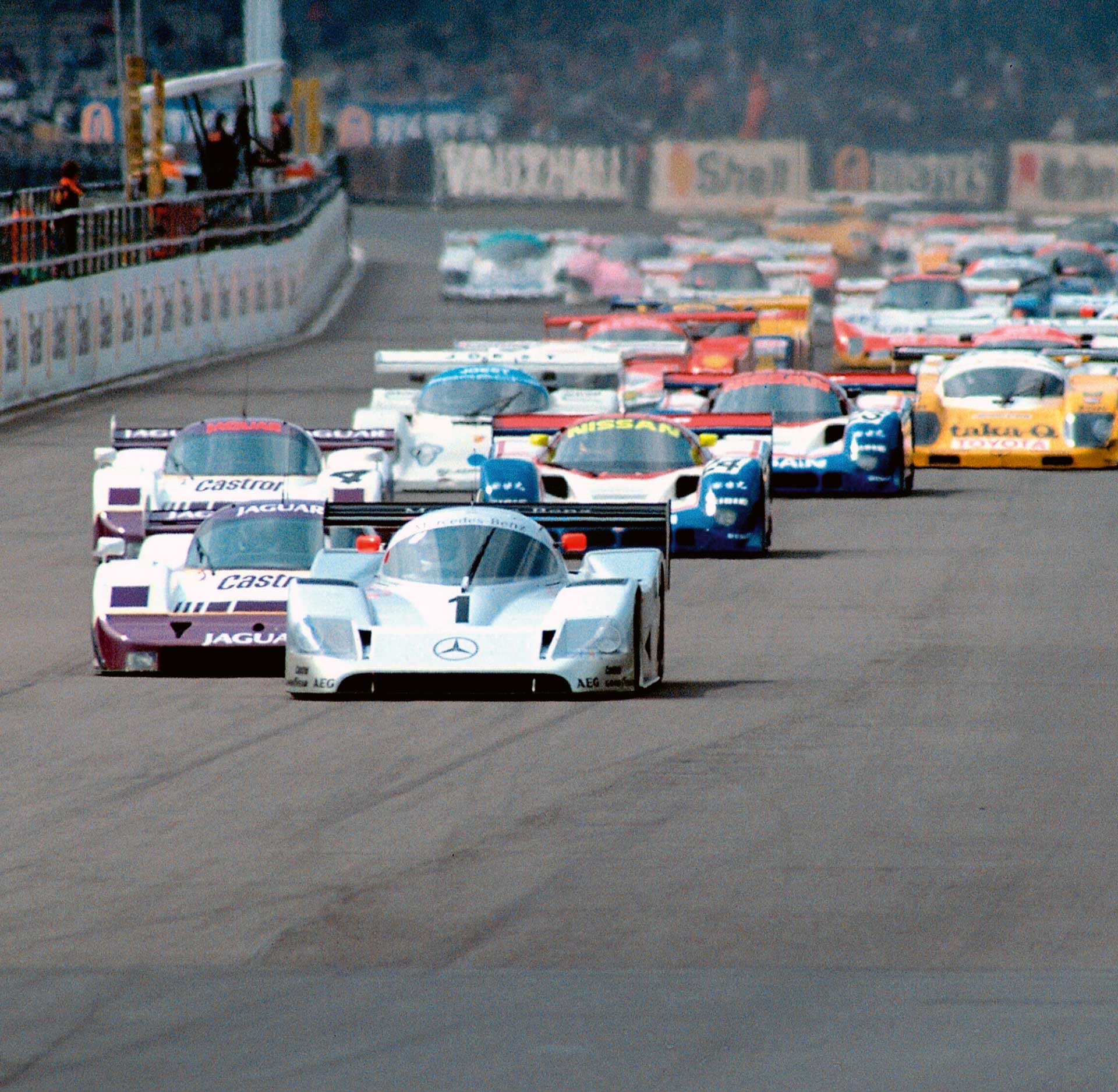
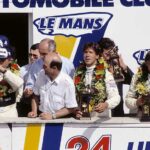
On June 11, 1989, three Sauber-Mercedes C9s rolled across the finish line at Le Mans in formation. Jochen Mass, Manuel Reuter and Stanley Dickens won the 24 Hours of Le Mans in their Silver Arrows. It was the return of the Silver Arrows to the motorsport stage – and at the same time the rehabilitation of a great automotive name that had become somewhat staid and stuffy in racing in the preceding years. Today, Mercedes and its subsidiary AMG stand for performance and innovation. Behind this is a person who had helped Mercedes to this victory and two titles in the sports car world championships: Peter Sauber.
Sauber-Mercedes – The return of the Silver Arrows!
On June 11, 1989, three Sauber-Mercedes C9s rolled across the finish line at Le Mans in formation. Jochen Mass, Manuel Reuter and Stanley Dickens won the 24 Hours of Le Mans in their Silver Arrows. It was the return of the Silver Arrows to the motorsport stage – and at the same time the rehabilitation of a great automotive name that had become somewhat staid and stuffy in racing in the previous years. Today, Mercedes and its subsidiary AMG stand for performance and innovation. Behind this is a person who had helped Mercedes to this victory and two titles in the sports car world championships: Peter Sauber.

From Switzerland to the international stage
As is so often the case with major motorsport teams and their founders, Peter Sauber also started out in racing in small steps. For him, it all began in Hinwil. After dropping out of his studies in electrical engineering, Peter Sauber decided to build his own racing cars, even though cars had a reputation in the Sauber family up to that time as being more of a commodity. Nevertheless, his family was always there for Peter Sauber: traditionally, Sauber Motorsport racing cars begin with the letter “C”, which comes from Christine, his wife’s first name. Every racing car from Hinwil was a step forward that ultimately led to victory at Le Mans, the sports car world championship title, entry into the Formula 1 world championship and the first Grand Prix victory as a BMW works team.
His first racing cars raced in smaller, national races in which Peter Sauber gained a lot of experience. He then took his first step onto the international motorsport stage with the Sauber C5. This prototype was built according to Group 6 regulations. Herbert Müller won the 1976 Interseries with it in the Francy Racing Team. The Sauber C5 was also the first time that a racing car from Hinwil was on the starting grid at Le Mans. Although the first race was unsuccessful and no Sauber racing cars competed at Le Mans for a few years afterwards, Peter Sauber remained loyal to the sports cars and the goal was and remained Le Mans. Apart from Le Mans, a Group 5 wide-body BMW M1 developed by Peter Sauber on the basis of a tubular frame attracted a great deal of attention. This design made it a remarkable 155 kg lighter than the Procar version. Nelson Piquet and Hans-Joachim Stuck won the 1000 km race at the Nürburgring in 1981, although it has to be said that they benefited from an early race stoppage. In the middle of the race, Herbert Müller had collided with a parked Porsche 935 in the Kesselchen area, the tank of which was still full. Herbert Müller had had no chance of escaping the flames.
Commissioned by Sauber-Mercedes
The company Seger & Hoffmann from Steckborn on Lake Constance had already produced individual plastic parts for the BMW M1. Peter Sauber was commissioned to design a sports car for the company in order to establish itself as a manufacturer of racing cars for the newly created Group C World Championship. The result was the SHS C6. One model was sold to GS-Tuning, another to Walter Brun, which was then also used by Peter Sau-ber. In sporting terms, the SHS C6 was a flop. The Cosworth DFL V8 engine produced strong vibrations and shook attachments and itself off the chassis. As a result, an engine mount broke during the 24 Hours of Le Mans in 1982. The real success of this season was more on a personal level.
At Seger & Hoffmann, contact was made with the Mercedes engineers Leo Ress, Rüdiger Faul and Hans-Helmut Jülicher. Rüdiger Faul gave him the opportunity to visit the large Mercedes-Benz wind tunnel in the evenings. The successor model, the C7, was largely developed by Leo Ress, even though he had switched from Mercedes to BMW at the same time. A short time later, he was the chief engineer at Peter Sauber.
Mercedes engines in the Sauber-Mercedes
With the C7 model, only Toni Garcia, Diego Montoya and Pablo Montoya broke through the Porsche phalanx at the 1983 24 Hours of Le Mans and prevented only Porsche 956s from finishing in the first ten places. In order to have any chance of overall victory, a new engine had to be found. The 3.5-liter naturally aspirated engine from the BMW M1 simply had too little power. As Leo Ress, Rüdiger Faul and Hans-Helmut Jülicher were also involved in the record-breaking races in Nardo, the idea was born to use a twin-turbocharged V8 engine from the same Nardo record-breaking car. Initially, the idea met with little approval from Mercedes. However, Mercedes engines were tolerated in private teams. After discussions with a delegation of Mercedes engineers in Hinwil, support from Mercedes was also forthcoming.
In parallel to the C7, Leo Ress developed the C8 for the 1986 season. Many improvements to the aluminum monocoque, the chassis, the aerodynamics and the Mercedes engine, which was based on the M119 block, turned the Group C prototype into a favorite with the potential for some serious upsets. For the 1986 season, Yves Saint Laurent and its own brand Kouros were secured as sponsors. The Sauber-Mercedes C8s, painted in dark blue, now regularly finished in the top 10. And then came the bombshell that many in the sports car world championship had expected in the medium term, because the Kouros-Mercedes were simply fast: Mike Thackwell and Henri Pescarolo won the rainy 1000-km race at the Nürburgring after all the Rothmans-Porsche and Silk Cut Jaguar XJR-6s had retired. It was the first victory for a Mercedes-engined race car in 30 years, and the Mercedes board of directors attended the race. All the decision-makers were made aware of the significance that Peter Sauber’s commitment could have for the image of the still seemingly staid Mercedes brand.
Jean-Louis Schlesser finally proved that the new C9 also had sprinting qualities in the final round of the 1987 ADAC Supercup at the Nürburgring. The competition was strong. Experienced Group C drivers from recognized teams and Hans-Joachim Stuck in a Porsche 962 PDK faced the two Sauber-Mercedes C8s. But Schlesser was not to be deterred and crossed the finish line in first place. The Frenchman proved once again that the Swiss team would play a bigger role in the sports car world championship in the future.
1988 – Official support for Sauber-Mercedes
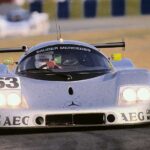
The twin-turbocharged V8 engine now ran with the new Bosch Motronic 2.7, was more powerful and also more efficient. A new tire manufacturer had been found in Michelin, which supplied tires of the very highest quality. As early as the end of 1987, the Deputy Chairman of the Board of Management announced his intention to return Mercedes-Benz to motorsport. In the Group A touring cars, the AMG team was supported for the German Touring Car Championship and in the Sports Car World Championship, Peter Sauber could finally officially rely on financial and technical support from Mercedes-Benz. In 1988, the Sauber-Mercedes now came in all black, with a stripe design reminiscent of a circuit board. AEG Olympia, a subsidiary of Mercedes-Benz, was emblazoned above it as a sponsor. The C9 thus had one of the most beautiful designs in the Group era.
The Porsche 962s were no longer the dominators in Group C. In 1988, the aim was to beat the TWR Jaguars. With the support of the factory, the Sauber-Mercedes now became the main opponent for Jaguar. The season began immediately with a sensational act that was not unexpected. Jean-Louis Schlesser and Jochen Mass won the opening race of the 1988 season in Jerez, Spain. The Sauber-Mercedes had already shown signs of strength in practice. Schlesser/Mass were two seconds faster than Martin Brundle in the Jaguar XJR-9, but despite the strong start, the Jaguar XJRs were unbeatable until the middle of the 1988 season. However, this changed from July 1988, when Schlesser/Mass again won the opening race on the new circuit in Brno, Czech Republic. They repeated this overall victory at the Nürburgring and at Sandown Park in Australia. The second driver pairing of Mauro Baldi and Stefan Johannson won the 1000km race at Spa-Franchorchamps. Although the team and their drivers had driven a strong season, they were beaten in the final standings by the Silk Cut Jaguar of Tom Walkinshaw-Racing. Martin Brundle secured the drivers’ championship.
Trauma Le Mans
In 1955, one of the worst accidents in motorsport history occurred at Le Mans. Since then, this race has meant one thing above all for Mercedes: a trauma.
When Mercedes entered three silver-colored 300 SLRs for the 24-hour race in 1955, the Germans were immediately considered the favorites. The racing cars, dubbed the “Silver Arrows”, already enjoyed cult status at the time. Juan-Manuel Fangio and Stirling Moss shared the number 19 car, Karl Kling and André Simon the number 21, while the third 300 SLR was driven by Pierre Levegh and John Fitch. The race went well. At 6.30 a.m., Mike Hawthorn in the Jaguar headed for the pits. He had just passed Lance Macklin in the Austin Healey. Macklin drove down the start and finish straight at around 200 km/h. When Hawthorn hit the brakes and his brake lights came on, Macklin tried to take evasive action and collided with Levegh, who was attempting to overtake him on the left at around 240 km/h at the same time. The Mercedes-Benz overturned, was torn into several pieces, the tank exploded and the wreckage flew over the heads of the spectators like a scythe. The terrible result was 83 fatalities and 100 spectators, some of them seriously injured. Mercedes withdrew from racing after the 1955 season. This decision had already been taken months before the race in Le Mans, but the terrible accident in Le Mans was one of the final reasons why the Board of Management at the time decided to no longer compete in motorsport with Silver Arrows from the factory. Private initiatives in touring car racing were grudgingly tolerated. Meanwhile, motorsport fans in Germany kept wondering when Mercedes would send its Silver Arrows back into battle. But being associated with another devastating accident at Le Mans would have been the “worst-case scenario” that Mercedes wanted to avoid at all costs.
Meanwhile, the 24-hour race at Le Mans had become a sensitive issue for Peter Sauber, because his prototypes, it seemed, did not like this race. In 1985, John Nielsen overturned in the C8 at the end of the Mulsanne straight and fortunately landed on all four wheels again. It was later discovered that the underbody had come loose and the car had become airborne. The team was no longer able to repair the C8. Two years later, Klaus Niedzwiedz blew a tire at over 350 km/h on the Mulsanne straight. As this was the fourth tire blowout of the season, Peter Sauber withdrew both of his C9s. Fortunately, no spectators were injured in either accident. However, the memory of the 1955 accident kept resurfacing. For the Mercedes board of management, it was imperative that such an accident should never happen again. And so over 30 years of Le Mans passed – without Mercedes being involved.
Sauber-Mercedes: Silver Arrows
At the 1989 season opener in Suzuka, the motorsport world was astonished. Firstly, for the first time since 1955, a Mercedes works team was on the grid and secondly – and this was the surprise par excellence – the two Sauber-Mercedes C9s were painted silver. Almost without a sponsor, they were reminiscent of glorious victories from the 1930s and 1950s. The Mercedes-Benz Board of Management thus made a commitment to itself. After all, a Silver Arrow was there to win.
However, the decision to resurrect the Silver Arrows was not a unanimous one. Mercedes CEO Professor Dr. Niefer had had Peter Sauber bring a silver-painted model to a meeting in Stuttgart in order to convince the extended Board of Management of the new traditional design. This was rejected by most members because they did not want to expose themselves to political pressure. A little later, in talks with Peter Sauber, Dr. Niefer simply pushed through his wish to paint the cars in silver over the heads of the board. Peter Sauber had clear instructions.
Dream Le Mans
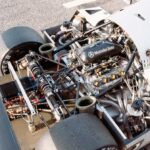
In 1989, the C9 was even more sophisticated thanks to factory support. The five-liter V8 Mercedes engine had electrically controlled exhaust valves, which significantly improved its fuel consumption. The torque was enormous, 810 Nm at 3500 rpm, and the power could reach up to 930 hp in qualifying with the appropriate boost pressure and 7000 rpm. One of the biggest changes for the 1989 season was the switch to a 16-valve cylinder head.
The driver pairings in 1989 were once again Jean-Louis Schlesser and Jochen Mass as well as Kenny Acheson and Mauro Baldi. The Sauber drivers won almost every race in the 1989 World Sportscar Championship: Suzuka, Jarama, Brands Hatch, Nürburgring, Donington, Spa-Franchorchamps and Mexico, with a Sauber-Merce-des C9 always crossing the finish line first. As a result, they easily won the World Sports Car Championship and Jean-Louis Schlesser the drivers’ title. Jochen Mass, Mau-ro Baldi and Kenny Acheson finished the season in second to fourth place. Porsche driver Frank Jelinski followed in fifth place overall. The 1989 season was a disaster for Jaguar.
Le Mans was not part of the World Sportscar Championship in the 1989 season. But that did not diminish its significance. In 1989, everything was looking towards Le Mans. The return of the Silver Arrows generated a huge media response. In order to avoid another tire blowout like in 1988, extensive testing was carried out in advance. The Michelin tires were retained. However, they had learned where the limits of this type of tire lay. The Michelin engineers recommended driving with even less downforce than planned in the race. As a result, Jean-Louis Schlesser drove along the long Hunaudières straight, which was not yet divided by chicanes, at almost 400 km/h in qualifying and achieved the second highest speed ever recorded at Le Mans. The driver pairing of Jean-Louis Schlesser/Alain Cudini/Jean-Pierre Ja-bouille was no less than four seconds faster than the best Jaguar XJR-9 in practice. The other two C9s were driven by Jochen Mass/Manuel Reu-ter/Stanley Dickens and Mauro Baldi/Kenny Acheson/Gianfranco Brancatelli.
Immediately after the start, two of three Sauber-Mercedes took the lead. The Jaguar XJR-9s attacked on the first lap. Between them was the Joest-Racing Porsche 962, driven by Hans-Joachim Stuck and Bob Wollek. An exciting duel developed between these protagonists, in which no one escaped unscathed. Manuel Reuter drove over a lost exhaust pipe at the start of the race and damaged the underbody, which could be repaired during a longer pit stop. Alain Cudini spun during the race and damaged the rear wing. Jean-Louis Schlesser had to pit with a flat tire and lost a lot of time in the process. The Sauber-Mercedes dropped back during the night. The Jaguar XJRs also retired one after the other. The Joest-Porsche 962 of Stuck and Wollek led during the night. However, a leak in the water hose then forced the Porsche into the pits. Now the Jaguar XJR-9 of Gilbert-Scott/Jan Lammers/Patrick Tambay took the lead until the early hours of the morning, when it dropped back due to a gearbox failure. The Sauber-Mercedes were lurking in the wings and now took the lead, finishing the race with a comfortable lead of several laps. Jochen Mass, Manuel Reu-ter and Stanley Dickens gave Mercedes-Benz a brilliant return of the Silver Arrows to the top of motorsport. This put an end to the staid image of Mercedes and fulfilled a long-cherished dream for Peter Sauber: To be able to leave Le Mans with the winning car.
The winning streak continues for Sauber-Mercedes
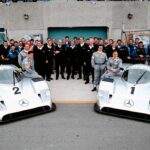
As early as the 1989 season, Sauber and Mercedes set about developing a successor to the C9. Japanese manufacturers in particular were now forcing their way into the sports car world championship with vehicles of the latest design. The new Sauber-Mercedes was given the designation C11 and was again developed by Leo Ress. The chassis was made of carbon fiber and was manufactured in Great Britain by David Price Composites. The engine was only slightly revised. The new Bosch Motronic 1.8 optimized the control of ignition and injection, which again improved performance and fuel consumption. The vulnerable Hewland gearbox was now replaced by an in-house development from Mercedes. Another change that paid off was the switch from Michelin to Goodyear, as the Goodyear tires were better suited to the characteristics of the C11 and they also benefited from years of experience in Formula 1.
The winning streak from the previous year was repeated in 1990. The only race that was not won by a Sauber-Mercedes was the race at Silverstone. However, this only came about because the C11 of Mass/Schumacher was disqualified for allegedly using outside help and the second C11 of Jean-Louis Schlesser retired due to damage to the camshaft. Jean-Louis Schles-ser and Mauro Baldi won the drivers’ championship this Year with equal points.
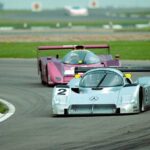
Juniors at Sauber-Mercedes
There were also major personnel changes in the Sauber-Mercedes team. Jochen Neerpasch had set up a junior team, as he had once done at BMW. The aim was to prepare the three best German Formula 3 drivers for Formula 1 by entering them in Group C races. Karl Wendliger, Heinz-Harald Frentzen and Michael Schumacher were appointed to the team. During test drives in Paul Ricard, the three 20-year-old racing drivers were gradually introduced to the powerful C9 and later the C11. The juniors’ tasks also included finding their feet in a professional team. Jochen Mass, with his many years of experience as a sports car driver, acted as mentor to the three. In the races of the 1990 season, Mass drove alternately with Karl Wendlinger, Heinz-Harald Frentzen and Michael Schumacher. All three juniors had their strengths and weaknesses. Karl Wendlinger won the race at Spa-Franchorchamps with Jochen Mass, Michael Schumacher the season finale in Mexico. It is well known that the Mercedes junior program paved the way to Formula 1 for all of them. The outstanding importance of this program is not least due to the fact that it paved the way for Michael Schumacher to his seven Formula 1 world championship titles.
Problem child for Sauber-Mercedes: The C291
The new FIA regulations stipulated 3.5-liter naturally aspirated engines from 1991. The old Group C cars were still allowed to participate for this season, partly in order to fill the starting fields. The fuel consumption limit was also dropped from the regulations. The prescribed engines were similar in their requirements to those of Formula 1. For the Mercedes board, remaining in Group C was attractive because they could now demonstrate how they were able to develop a pure-race engine. The choice fell on a 12-cylinder flat engine, which enabled particularly high engine speeds. At the end of the season, around 640 hp was available.
Many problems were revealed during test bench runs with the new engine, as well as during the tests at Paul Ricard and on other racetracks. One key problem was the supply of sufficient lubricant to the engine. Due to the long list of problems, Peter Sauber decided to take a C11 to the season opener in Suzuka. This was actually faster than the new C291 in which Michael Schumacher and Karl Wendlinger started the race. The Sauber-Mercedes C291 only got into its stride towards the middle of the race after the oil circuit had been completely overhauled. At Silverstone, Michael Schumacher and Karl Wendlinger finished second behind the Jaguar XJR-14 of Teo Fabi and Derek Warwick. It was a first ray of hope. Although the C291 had been developed with the aim of being able to win at Le Mans, the team preferred to rely on the proven C11 from the previous year. Mercedes sent three cars into the race. Jean-Louis Schlesser, Jochen Mass and Alain Ferté started the race in the C11 with starting number 1. Juniors Fritz Kreuzpointner/Karl Wendlinger/Michael Schumacher started the race in the number 31 car. The third C11 with starting number 32 was driven by Kurt Thiim/Jonathan Palmer/Stanley Di-ckens. At times, all three Sauber-Mercedes C11s were in the lead, but retired or fell back due to technical defects. The C11 with the juniors was the only Mercedes to finish the race in fifth place.
The rest of the 1991 season was harrowing. No C291 finished at the Nürburgring, Magny-Cours or Mexico City. The causes were technical faults of various kinds and these repeatedly revealed how immature the technology still was. Further development continued at full speed during the 1991 season. The season finally came to a conciliatory end in Autopolis, Japan. Michael Schumacher and Karl Wendlinger won the season finale ahead of the two favored Jaguar XJR-14s, not by luck, as they were later said to have done, but because the C21 finally got into its stride after endless improvements. It now showed the direction in which things could have gone. In Hinwil, intensive work was already underway on the Sauber-Mercedes C292, with which the 1992 season would have been contested.
However, the Mercedes board decided not to continue competing in the World Sportscar Championship and to devote itself to Formula 1 and Indycar in the future. In 1998, Mika Häkkinen won the Formula 1 World Championship in a silver McLaren-Mercedes. Peter Sauber also decided to enter Formula 1 in 1993 and was supplied with engines by Mercedes in 1993 and 1994.
Michael Schumacher impressed the motorsport world on his debut at Spa-Francorchamps and had a multi-year contract with Be-netton in his pocket by the end of the season. Karl Wendlinger also contested his first two Formula 1 races at Leyton-House March in 1991. Heinz-Harald Frentzen followed his former colleagues in the junior team into Formula 1 and started again for Peter Sauber in 1994.